Lesson 03 — Bodies Grow at Different Rates
Learners discover that bodies grow and change at different rates, and that every pace is normal. Using a simple growth-line picture, they see that two children of the same age can be different heights — and that growth comes in spurts, not a steady straight line. They draw their own growth line and mark where they are now.
Objectives
Objectives
- D03.S1.05.02 Describe how bodies grow and change at different rates and that every pace is normal.
Essential question
Why do bodies of the same age grow at different times and speeds?
Key vocabulary
Materials
Standard materials
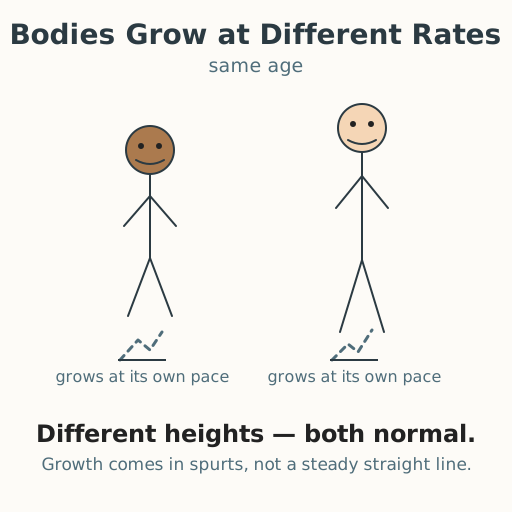
- Growth rates poster · 1 A poster showing two children of the same age at different heights, both smiling, with a growth line beneath each labeled 'same age, different heights — both normal'
- Blank growth line page · 1 per learner A page with a simple rising growth line and space to mark 'me now' and 'me soon'
- Pencils and crayons · per learner
Low-tech / no-cost
- Standing height line on a wall or in the sand Mark each learner's height on a wall, string, or stick and compare — different heights, same age, all normal; no page needed
- Seedling and sprout comparison Compare two seeds or plants of the same kind that have sprouted to different heights, as a living picture of different growth rates
Enriched / lab & device
- A class growth chart · 1 A shared, unlabeled-by-name wall chart where learners mark heights over the year and watch different lines rise at different slopes
- A short video of a growing plant or child over time · 1 A time-lapse to show that growth happens in spurts, not a steady straight line
Works in different contexts
- large-group Mark a class height line together and talk about the spread of heights, then have small groups draw their own growth line
- multi-age Younger learners line up by height to see the range; older learners explain why two same-age children can be different heights and both be normal
- self-directed A learner draws a growth line, marks 'me now,' and writes one reason heights can differ, then reads it back to check
- level-grouped Learners ready to extend compare a growth spurt (fast rise) with a steady rise and name what a spurt might feel like
- outdoor-only Compare plants, seedlings, or even trees of different sizes in the same area and notice that the same kind can grow at different rates
Lesson 3 — Bodies Grow at Different Rates
Summary
Learners discover that bodies grow and change at different rates, and that every pace is normal. They meet a simple growth-line picture showing two children of the same age at different heights, learn that growth comes in spurts rather than a steady straight line, and draw their own growth line, marking where they are now. The wide range of human bodies is honored with dignity, never shame.
Objectives
- Describe how bodies grow and change at different rates and that every pace is normal. (D03.S1.05.02)
Connection
Plant two seeds of the same kind at the same time. One sprouts tall and fast; the other comes up later, smaller, and then catches up — or stays smaller, and that is fine too. Human bodies are like that. Two children the same age can be very different heights, and both are normal. Whether the difference comes from family, food, place, or just the timing that each body has, no pace is better than another — every pace is a real pace.
Materials
- Growth rates poster
- Blank growth line page
- Pencils and crayons
Preparation
- Print or draw the growth rates poster (two same-age children at different heights, both smiling, each with a rising growth line labeled “same age, different heights — both normal”).
- Copy a blank growth line page for each learner.
- If using a height line, prepare a wall, string, or stick for marking heights.
Facilitator note
This lesson is written to the learner (“you”). The idea to land is that growth varies and
every pace is normal — never that a smaller or larger body is “wrong,” “slow,” or “behind.”
Height and build are shaped by genes, nutrition, and environment, and growth comes in
spurts, so comparing bodies as a race is both scientifically false and unkind. Guard
against teasing about height or size; frame all bodies with dignity. Some learners may feel
self-conscious about their own size — keep the tone warm and factual, and never single
anyone out to be measured publicly. See docs/facilitation.md on assessing without ranking.
Procedure
- Gather (5 min). You have learned how your mind and body are connected. Now another part of knowing your body: growth. And the first truth about growth is that it does not happen at the same rate for everyone.
- Meet the growth line (10 min). Look at the poster. Two children, the same age — one shorter, one taller. Both are smiling; both are normal. Beneath each, a growth line rises, but not the same way: growth comes in spurts — fast for a while, then slower — like a staircase more than a smooth slide. No one grows “on time”; each body has its own clock.
- Notice a range (10 min). In a group or by looking around, notice the wide range of heights, hands, and shoe sizes among people your age. Is there one “right” size? No — a wide range is exactly what healthy looks like. Share one thing you notice with a partner.
- Draw your own line (15 min). On your page, draw a rising growth line. Mark “me now” somewhere on it, and “me soon” a little further up. Under it, write one reason heights can differ — family, food, place, or timing. There is no right place on the line; your spot is a real spot.
- Close (5 min). Your body is growing on its own schedule, and so is everyone else’s. Different rates, every pace normal — that is how humans actually grow.
Differentiation
- Support: Provide a pre-drawn growth line to mark “me now” and “me soon” and a word bank of reasons heights differ; scribe the learner’s sentence.
- Extension: Describe what a growth spurt might feel like (clothes fitting differently, shoes too small, feeling tired) and why that is normal, not a problem.
Assessment
- Formative (observation): Can the learner state that bodies grow at different rates and that every pace is normal, and give one reason heights can differ?
- Self-check: The learner reads their growth line and sentence back and checks that they framed their own pace as normal, never “behind.”
Home connection
Ask someone at home about when they had a growth spurt — and share that every body grows on its own schedule.
Resources
- Human growth is measured against standard growth references that show a range of normal, not a single number. The World Health Organization publishes child growth standards that treat a wide range of heights and weights as normal: https://www.who.int/toolkits/child-growth-standards. Growth is shaped by genes, nutrition, and environment — evidence, not a value judgment about any body.