Lesson 06 — Helpful Feedback to a Peer
Learners learn to give feedback that helps a peer improve a skill — specific, kind, and about the action, never the person. They meet a contrast of helpful and hurtful feedback, practice a three-part starter ('I noticed ___. What helped me was ___. Try ___.'), and give one real, kind tip as their partner practices the skill from Lesson 5, then try again.
Objectives
Objectives
- D03.S2.05.01 Refine a specific motor skill, such as throwing accurately or balancing, through repeated practice and give a peer helpful feedback.
Essential question
How do I give feedback that helps a peer improve — without hurting them?
Key vocabulary
Materials
Standard materials
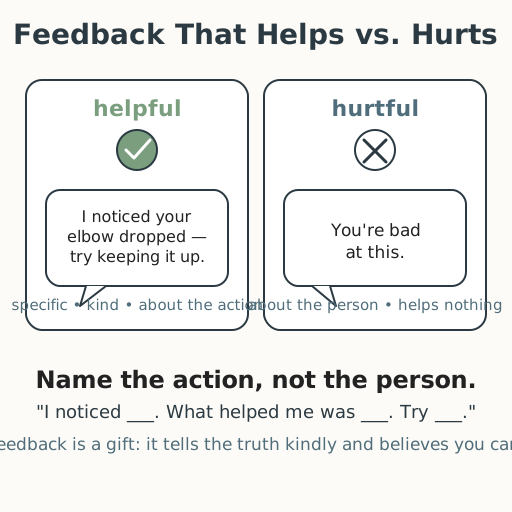
- Helpful feedback poster · 1 A poster contrasting a kind, specific tip ('I noticed your elbow dropped — try keeping it up') with an unhelpful one ('you're bad at this') crossed out
- Feedback sentence-starter card · 1 per pair A card with the starter 'I noticed ___. What helped me was ___. Try ___.'
- Target or balance line and a soft ball · 1 per pair Reuse the throwing target or balance line from Lesson 5 for observed practice
Low-tech / no-cost
- Voice and a partner Practice giving feedback on any small skill — a jump, a balance step, a draw — using the three-part starter aloud; no page needed
- A 'helpful vs. hurtful' sorting game Say a comment aloud and have partners sort it into 'helps' or 'hurts' with a thumbs up or down; no cards needed
Enriched / lab & device
- A class 'feedback wall' · 1 A shared wall where learners post specific, kind tips they gave and received, building a bank of helpful feedback
- A recording of a feedback exchange · 1 per group To replay a practice round and hear whether the feedback was specific, kind, and useful
Works in different contexts
- large-group Model one helpful and one hurtful comment on the board, then have pairs practice the three-part starter on a real skill
- multi-age Older learners give the full three-part feedback while younger learners practice saying one specific, kind thing they noticed
- self-directed A learner watches their own practice (or a recorded try) and writes one specific, kind tip for themselves using the starter
- level-grouped Learners ready to extend distinguish feedback about the *action* from feedback about the *person* and explain why one helps and the other hurts
- outdoor-only In pairs, one tries a skill while the other gives one specific, kind tip aloud, then they swap; no paper needed
Lesson 6 — Helpful Feedback to a Peer
Summary
Learners learn to give feedback that helps a peer improve a motor skill — feedback that is specific, kind, and about the action, never the person. They meet a contrast of helpful and hurtful feedback, practice a three-part starter (“I noticed ___. What helped me was ___. Try ___.’”), and give one real, kind tip as their partner practices the skill from Lesson 5 — then try again.
Objectives
- Refine a specific motor skill, such as throwing accurately or balancing, through repeated practice and give a peer helpful feedback. (D03.S2.05.01)
Connection
If a friend misses a throw, which helps more — “you’re bad at this” or “I noticed your elbow dropped — try keeping it up”? The first hurts and teaches nothing; the second is a gift. Good feedback is like a teammate’s hand on your back: it names what is real, in a way you can use, and it believes you can improve. Whether in a game, a kitchen, or a workshop, the people who help us grow are the ones who tell us the truth kindly.
Materials
- Helpful feedback poster
- Feedback sentence-starter card
- Target or balance line and a soft ball
Preparation
- Print or draw the helpful feedback poster (helpful vs. hurtful comment, the hurtful one crossed out).
- Copy a feedback sentence-starter card for each pair.
- Reuse the throwing target or balance line from Lesson 5.
Facilitator note
This lesson is written to the learner (“you”). The idea to land is feedback about the
action, not the person — specific, kind, and usable. Model the difference vividly and stop
any feedback that is about the person (“you’re slow,” “you’re bad”) the moment it appears,
redirecting to the action. Feedback is the strongest lever in learning (Hattie, Visible
Learning), but only when it is clear and kind. Honor every body’s pace: feedback is about a
next step, never about ranking. See docs/contexts.md and docs/facilitation.md.
Procedure
- Gather (5 min). Last time you learned that practice builds skill. Today you learn the partner skill: giving feedback that helps a peer improve.
- Meet helpful feedback (10 min). Look at the poster. Two comments about the same missed throw. Hurtful: “You’re bad at this.” Crossed out — it names the person, not the action, and helps nothing. Helpful: “I noticed your elbow dropped — try keeping it up.” It is specific (names one thing), kind (believes you can grow), and about the action. That is feedback that helps.
- Learn the starter (5 min). Read the three-part starter: “I noticed ___ . What helped me was ___ . Try ___ .” Practice it once with a partner about a simple skill, using kind words.
- Give real feedback (15 min). Partner up at the target or balance line. One partner practices the skill from Lesson 5; the other observes quietly, then gives one specific, kind tip using the starter. The first partner tries again with the tip in mind. Then swap. Each of you gives and gets one tip.
- Close (5 min). A kind, specific word can help someone improve faster than hours of silent practice. You can be that help for someone — and ask for it for yourself.
Differentiation
- Support: Provide the starter printed large with blanks, and model one full example before partners begin; allow a tip about one single, visible thing.
- Extension: Distinguish feedback about the action from feedback about the person, and rewrite two hurtful comments into helpful ones.
Assessment
- Formative (peer/performance): Does the learner give feedback that is specific, kind, and about the action, and can their partner act on it and try again?
- Self-check: The learner asks, “Was my tip about the action, not the person, and was it kind enough that I would welcome hearing it myself?”
Home connection
Give one specific, kind piece of feedback to someone at home today — and notice whether it helps them more than a general “good job.”
Resources
- Feedback is among the strongest influences on learning (Hattie, Visible Learning); it works best when it is specific, timely, and about the work, not the person. For classroom SEL framing of giving and receiving feedback, see CASEL’s relationship-skills competency: https://casel.org/fundamentals-of-sel/