Lesson 07 — Movement Helps My Heart
Learners discover that the heart is a muscle and that movement makes it work — and regular movement makes it stronger. They feel and count their own pulse at rest and after a short burst of movement, then connect the faster beat to the heart being exercised, the way practice builds a skill. This is the first of two lessons on how movement benefits the body.
Objectives
Objectives
- D03.S2.05.02 Explain how regular movement benefits the heart, muscles, and mood.
Essential question
How does regular movement make my heart stronger?
Key vocabulary
Materials
Standard materials
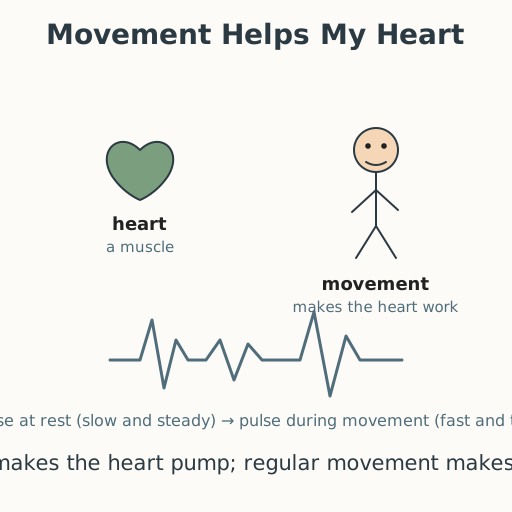
- Heart and movement poster · 1 A poster showing a heart and a person moving, with a pulse line that quickens during movement and a label 'movement makes the heart pump; regular movement makes it stronger'
- Pulse count page · 1 per learner A page with a space to count resting pulse and active pulse and compare them
- A clock or timer · 1 For counting beats for 15 seconds
Low-tech / no-cost
- Your own pulse and a song or clap rhythm Feel the pulse at the wrist or neck before and after moving; count beats to a clapped rhythm; no clock needed if you count a steady clap
- A short burst of movement Run, hop, or dance in place, then feel the heart beat faster; the body shows the change, no page needed
Enriched / lab & device
- A classroom timer or stopwatch app · 1 per group To count pulse accurately before and after two minutes of movement
- A simple heart-rate chart · 1 A shared chart where learners plot resting and active pulse, seeing the heart's response to movement
Works in different contexts
- large-group Count pulses together before and after a whole-group two-minute movement, then plot the class range on a chart
- multi-age Younger learners feel and describe their heartbeat before and after; older learners count beats and compare the two numbers
- self-directed A learner counts their own resting pulse, moves for two minutes, counts again, and writes why the heart beats faster and stronger with regular movement
- level-grouped Learners ready to extend explain why the heart, being a muscle, strengthens with repeated work — the same way practice builds a skill
- outdoor-only Feel the pulse, then run or climb a little, then feel it again, comparing before and after aloud
Lesson 7 — Movement Helps My Heart
Summary
Learners discover that the heart is a muscle and that movement makes it work — and regular movement makes it stronger. They feel and count their own pulse at rest and after a short burst of movement, then connect the faster beat to the heart being exercised, the way practice builds a skill. This is the first of two lessons on how movement benefits the body.
Objectives
- Explain how regular movement benefits the heart, muscles, and mood. (D03.S2.05.02)
Connection
Put your hand on your chest and you will feel your heart beating — it has been beating since before you were born, and it is a muscle. Like any muscle, it gets stronger when it works. When you run, dance, or climb, your heart pumps faster to carry blood — with the oxygen from the air you breathe — to your body; do that regularly, and the heart grows strong and steady, so it does not have to work so hard when you rest. Whether you walk to a well, play a game, or dance at a festival, your heart is getting its exercise.
Materials
- Heart and movement poster
- Pulse count page
- A clock or timer
Preparation
- Print or draw the heart and movement poster (a heart and a moving figure with a pulse line that quickens, labeled “movement makes the heart pump; regular movement makes it stronger”).
- Copy a pulse count page for each learner.
- Prepare a way to time 15 seconds and 2 minutes, and a safe space to move.
Facilitator note
This lesson is written to the learner (“you”). The idea to land is that the heart is a
muscle strengthened by regular movement. Keep the movement short, joyful, and inclusive:
hopping in place, dancing, brisk walking, or arm circles — every body can move in its own way,
and seated or adapted movement exercises the heart too. Some learners may have a heart
condition or feel anxious about their heartbeat; reassure them that a faster beat after
movement is normal and healthy. Do not push any learner beyond comfort. See
docs/facilitation.md and docs/contexts.md.
Procedure
- Gather (5 min). You have practiced a skill and given feedback. Now a bigger question: what does movement do for your body? Today, your heart.
- Meet the heart (10 min). Look at the poster. Your heart is a muscle about the size of your fist. It pumps blood — carrying oxygen and fuel — to your whole body, all day, every day. The wavy line is a pulse — the rhythm of the heart’s beats. When you move, the line gets taller and faster: the heart works harder. Do that regularly, and the heart grows stronger and steadier — exactly like practice builds a skill (remember Lesson 5).
- Feel your pulse (10 min). Find your pulse: press two fingers gently on the inside of your wrist, or on the side of your neck. Count the beats for 15 seconds with the timer. Write the number on your page. That is your resting pulse.
- Move and feel again (15 min). Move for two minutes — hop, dance, walk fast, or pump your arms. Then find your pulse again and count for 15 seconds. Write the number. Compare: why is the second number bigger? Because your heart was working — and work is how a muscle grows strong.
- Close (5 min). Your heart works for you every second. When you move, you give it its exercise — and a stronger heart is a gift you carry for life.
Differentiation
- Support: Guide learners to find the pulse by demonstrating on your own wrist, and count beats aloud together; offer seated movement options.
- Extension: Explain why the heart, being a muscle, strengthens with repeated work — and connect this to the resting heart working less hard in fit bodies.
Assessment
- Formative (observation): Can the learner feel and count a pulse, and explain in their own words why movement makes the heart work and regular movement makes it stronger?
- Self-check: The learner compares their two pulse counts and says one sentence about what the bigger number means.
Home connection
With someone at home, find your pulses, move together for two minutes, and feel them again — then share what changed and why.
Resources
- The heart is a muscle that strengthens with regular aerobic activity, and physical activity supports heart health. The World Health Organization recommends that children and young people aged 5–17 do at least 60 minutes of moderate-to-vigorous physical activity daily: https://www.who.int/news-room/fact-sheets/detail/physical-activity