Lesson 10 — My Body at Work
In this capstone lesson, learners bring the whole unit together in a 'my body at work' note: one mind–body example, one growth-at-my-pace idea, one practiced skill with feedback, and one movement benefit. They assemble the four-part note, share it with a peer, and close the unit with agency, dignity, and joy.
Objectives
Objectives
- D03.S1.05.01 Explain the mind-body connection with a simple example, such as how worry can make a stomach feel tight.
- D03.S1.05.02 Describe how bodies grow and change at different rates and that every pace is normal.
- D03.S2.05.01 Refine a specific motor skill, such as throwing accurately or balancing, through repeated practice and give a peer helpful feedback.
- D03.S2.05.02 Explain how regular movement benefits the heart, muscles, and mood.
Essential question
How do my mind, my growth, and my movement all work together in one body?
Key vocabulary
Materials
Standard materials
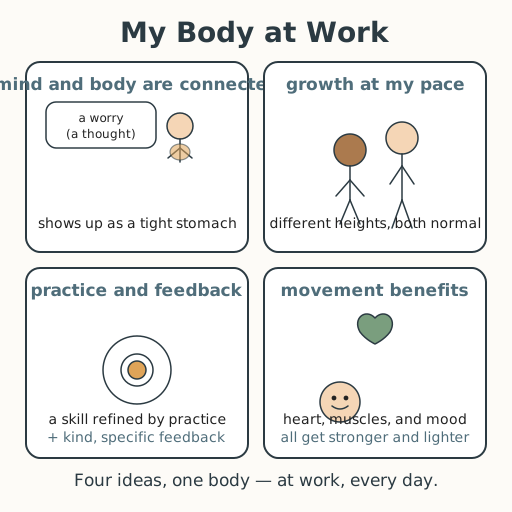
- My body at work poster · 1 A poster with four sections — mind–body connection, growth at my pace, practice and feedback, movement benefits — showing what the unit covered
- My body at work note page · 1 per learner A four-part frame for the learner to record one example from each section of the unit
- Pencils and crayons · per learner
Low-tech / no-cost
- A spoken 'my body at work' sharing circle Each learner shares one example from each of the four sections aloud; no page needed
- A four-section frame drawn on the ground Draw four boxes in the sand or dirt — mind–body, growth, practice, benefits — and mark an example in each
Enriched / lab & device
- A class 'our bodies at work' gallery · 1 A shared display of every learner's four-part note, showing the whole class's learning and the range of bodies honored
- A tablet or camera · 1 per group To record a short 'my body at work' explanation as a spoken portfolio artifact
Works in different contexts
- large-group Review the four sections together, have learners complete their notes, then share in small groups and post to a class gallery
- multi-age Younger learners draw one example per section while older learners write a full sentence and explain one connection across sections
- self-directed A learner completes all four sections of the note for their own body and reads it back to check each example is real and complete
- level-grouped Learners ready to extend add one sentence connecting two sections — for example, how practice and movement benefits work together
- outdoor-only Draw a four-section frame on the ground and mark or tell one example in each, then share in a circle
Lesson 10 — My Body at Work
Summary
In this capstone lesson, learners bring the whole unit together in a “my body at work” note: one mind–body example, one growth-at-my-pace idea, one practiced skill with feedback, and one movement benefit. They assemble the four-part note, share it with a peer, and close the unit with agency, dignity, and joy. The note becomes a portfolio artifact.
Objectives
- Explain the mind–body connection with a simple example, such as how worry can make a stomach feel tight. (D03.S1.05.01)
- Describe how bodies grow and change at different rates and that every pace is normal. (D03.S1.05.02)
- Refine a specific motor skill, such as throwing accurately or balancing, through repeated practice and give a peer helpful feedback. (D03.S2.05.01)
- Explain how regular movement benefits the heart, muscles, and mood. (D03.S2.05.02)
Connection
Throughout this unit you have been getting to know your body — how it talks with your mind, how it grows at its own pace, how it learns through practice, and how movement keeps it strong and joyful. Now you put it together, because these are not four separate facts; they are one body, at work, every day. Knowing all four is how you care for yourself — and how you honor everyone else’s body too.
Materials
- My body at work poster
- My body at work note page
- Pencils and crayons
Preparation
- Print or draw the “my body at work” poster (four sections: mind–body connection, growth at my pace, practice and feedback, movement benefits).
- Copy a “my body at work” note page for each learner.
- Arrange a circle and a space for paired sharing.
Facilitator note
This lesson is written to the learner (“you”). This capstone is a celebration of mastery, not
a ranking — each learner assembles what they learned about their own body, and every note
is complete and valuable as it is. Review the four sections with the poster, then let learners
work independently and share in pairs. Honor the wide range of bodies: some learners will write
a seated or adapted movement, a different growth pace, or a signal their own body sends — all
are correct. Keep the tone warm and proud. See docs/facilitation.md on assessing without
ranking.
Procedure
- Gather (5 min). This is your capstone — the lesson that ties the whole unit together. You have learned four big things about your body. Today you show them all, in one “my body at work” note.
- Review the four sections (10 min). Look at the poster. Section one: mind and body are connected — a worry can make a stomach tight (Lesson 1). Section two: growth at my pace — bodies grow at different rates, and every pace is normal (Lessons 3–4). Section three: practice and feedback — repeated practice builds skill, and kind, specific feedback helps (Lessons 5–6). Section four: movement benefits — movement strengthens the heart and muscles and lifts mood (Lessons 7–8). Four ideas, one body.
- Build your note (15 min). On your page, write or draw one example for each section from your own body and week. One mind–body signal you noticed. One way you are growing at your own pace. One skill you practiced and one piece of feedback you gave or received. One way movement helped your heart, muscles, or mood.
- Share and listen (10 min). With a partner, share your note. Listen to theirs with respect. Notice: your bodies are different, and your notes are different — and both are complete.
- Close (5 min). You know your body now with new precision — its signals, its pace, its skills, its strength. Carry that knowledge like a good friend, for yourself and for every body you meet.
Differentiation
- Support: Provide a four-section frame with sentence starters (“I noticed my body sends the signal ___ when I feel ___”) and a word bank; scribe as needed.
- Extension: Add one sentence connecting two sections — for example, how practice (section three) and movement benefits (section four) work together in your week.
Assessment
- Summative (portfolio): Does the learner’s note include one accurate example in each of the four sections, grounded in their own body and week, without shaming language about any body?
- Self-check: The learner reads their note and checks each section is real and complete, then shares it with a peer who confirms they understood it.
Home connection
Share your “my body at work” note with someone at home, and tell them one thing you learned about your own body that you will keep practicing.
Resources
- This capstone synthesizes the unit’s four standards, which trace to the Body & Wellness domain (D03) and its evidence base: mind–body connection (embodied emotion; CASEL self-awareness), growth variation (WHO child growth standards), motor-skill practice and feedback (motor learning; Hattie), and the health benefits of movement (WHO physical activity guidelines). See: https://casel.org/fundamentals-of-sel/, https://www.who.int/toolkits/child-growth-standards, and https://www.who.int/news-room/fact-sheets/detail/physical-activity