Lesson 09 — My Practice Plan
Learners turn everything they have learned this unit into action: they build a simple three-day practice plan that interleaves the motor skill they refined (throwing or balancing) with a heart-pumping movement, each day framed by a warm-up and cool-down. They set one small goal and connect the plan to the heart, muscle, and mood benefits of movement.
Objectives
Objectives
- D03.S2.05.01 Refine a specific motor skill, such as throwing accurately or balancing, through repeated practice and give a peer helpful feedback.
- D03.S2.05.02 Explain how regular movement benefits the heart, muscles, and mood.
Essential question
How do I make a simple plan to keep practicing my skill and keep moving?
Key vocabulary
Materials
Standard materials
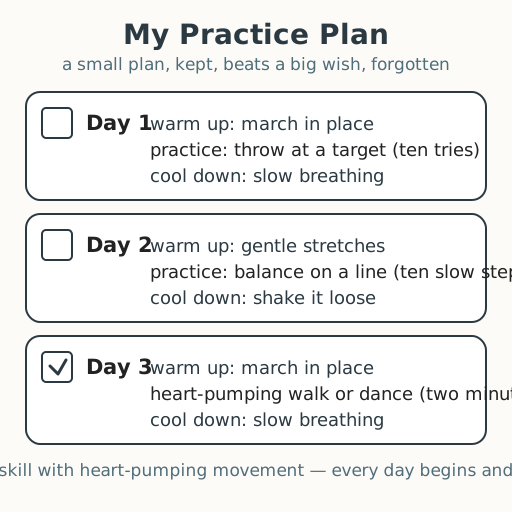
- Practice plan poster · 1 A poster showing a three-day plan card — Day 1 throwing, Day 2 balancing, Day 3 a heart-pumping walk — each with a warm-up and cool-down
- Blank practice plan page · 1 per learner A three-day plan frame with a goal line, a warm-up, and a cool-down for the learner to fill in
- Pencils · per learner
Low-tech / no-cost
- A plan told aloud or drawn in the sand Say or draw three days of practice — the skill, the warm-up, and the cool-down — no page needed
- A stick-figure plan on the ground Draw three day boxes in the dirt and mark a skill or movement in each with a simple figure
Enriched / lab & device
- A class 'practice-plan wall' · 1 A shared wall where learners post their three-day plans and, later, mark what they completed
- A simple movement-tracking sheet or app · 1 per group An optional tool to track practice days — used as a help, with the reminder that the body's signals, not a number, come first
Works in different contexts
- large-group Build a class example plan together on the board, then have each learner fill their own three-day frame and share one day with a partner
- multi-age Younger learners fill one day's skill and a fun movement; older learners plan all three days with warm-up, skill, and cool-down
- self-directed A learner writes a three-day plan — a skill to practice, a heart-pumping movement, and a warm-up and cool-down — and sets one small goal
- level-grouped Learners ready to extend interleave two skills across the days and explain why mixing skills helps learning stick
- outdoor-only Plan three days aloud or in the sand, naming a skill, a heart-pumping movement, and a warm-up and cool-down for each
Lesson 9 — My Practice Plan
Summary
Learners turn the unit’s learning into action: they build a simple three-day practice plan that interleaves the motor skill they refined (throwing or balancing) with a heart-pumping movement, each day framed by a warm-up and cool-down. They set one small goal and connect the plan to the heart, muscle, and mood benefits of movement. This is a portfolio artifact.
Objectives
- Refine a specific motor skill, such as throwing accurately or balancing, through repeated practice and give a peer helpful feedback. (D03.S2.05.01)
- Explain how regular movement benefits the heart, muscles, and mood. (D03.S2.05.02)
Connection
Wanting to get better is one thing; a plan is how “someday” becomes “today.” A farmer plans which days to plant; a musician plans which days to practice. Your plan does not need to be big — just three days, a skill to practice, a movement that makes your heart work, and a gentle warm-up and cool-down to care for your body. A small plan, kept, beats a big wish, forgotten.
Materials
- Practice plan poster
- Blank practice plan page
- Pencils
Preparation
- Print or draw the practice plan poster (a three-day card: Day 1 throwing, Day 2 balancing, Day 3 a heart-pumping walk, each with a warm-up and cool-down).
- Copy a blank practice plan page for each learner.
- Arrange a circle and a quiet space for writing.
Facilitator note
This lesson is written to the learner (“you”). The idea to land is that a simple plan turns
learning into action, and that the plan should be small, flexible, and kind to every body.
Interleaving — mixing the skill with heart-pumping movement — helps learning stick (spacing and
interleaving). Keep goals small and personal, never competitive. If learners mention
step-counters or fitness apps, frame them as optional tools — useful, but the body’s own
signals always come first, and no one needs a device to move well. Honor every body’s pace and
ability; a seated movement is a full movement. See docs/contexts.md.
Procedure
- Gather (5 min). You have learned so much: the mind–body connection, how bodies grow, how practice builds skill, how movement helps your heart, muscles, and mood. Today you make a plan to keep all of it alive.
- Meet the plan (10 min). Look at the poster — a worked example. A three-day plan. Day 1: warm up (march in place), practice throwing at a target, cool down (slow breathing). Day 2: warm up, practice balancing on a line, cool down. Day 3: warm up, a heart-pumping walk or dance, cool down. Notice it mixes the skill you practiced (throwing or balancing) with heart-pumping movement — mixing helps learning stick and gives the heart, muscles, and mood their gifts.
- Set a small goal (10 min). Choose one small, doable goal for your plan — “hit the target five times,” “balance for ten slow steps.” Write it on your page. A small goal you can keep is better than a big one you drop.
- Build your three days (15 min). Fill your plan frame: for each day, a warm-up, a skill or movement, and a cool-down. Include at least one day for your motor skill and one for a heart-pumping movement. Share one day with a partner and listen to theirs.
- Close (5 min). A plan is a promise you make to yourself — small, kind, and doable. Keep it for three days and watch what your body and mood tell you.
Differentiation
- Support: Provide a partially filled plan with pictures and a word bank of warm-ups, skills, and cool-downs; scribe the goal.
- Extension: Interleave two skills across the days and write one sentence about why mixing skills — rather than cramming one — helps learning stick.
Assessment
- Formative (portfolio): Does the plan include a warm-up, a skill or movement, and a cool-down for each of three days, with a small, doable goal and a heart-pumping day?
- Self-check: The learner asks, “Is my goal small enough to keep, and does my plan care for my body with a warm-up and cool-down?”
Home connection
Share your three-day plan with someone at home and invite them to try one day of it with you.
Resources
- Spacing and interleaving — mixing and revisiting skills across days rather than cramming — support long-term learning (see the learning-science literature; Kirschner, Sweller & Clark, 2006). Optional tracking tools can help, but movement requires no device; the body’s own signals are the primary guide. For activity guidance, see WHO: https://www.who.int/news-room/fact-sheets/detail/physical-activity