Lesson 08 — Meeting Shared Needs: Food, Safety, and Learning
Learners investigate how a community meets three shared needs — food, safety, and learning. They meet a needs frame, brainstorm who feeds, protects, and teaches their own community, and then investigate their home or neighborhood to answer how each need is met, producing a record of the community's shared work.
Objectives
Objectives
- D02.S3.05.02 Investigate how people in a community meet shared needs such as food, safety, and learning.
Essential question
How do people in a community work together to meet shared needs — food, safety, and learning?
Key vocabulary
Materials
Standard materials
- Community-needs poster · 1 A poster with three columns — food, safety, learning — each listing the people and practices a community uses to meet that need (markets and farms; neighbors and helpers and rules; schools, elders, and libraries)
- Investigate-a-need page · 1 per learner A three-question page — "How does my community get food? How does it keep people safe? How do people learn?" — with room to write or draw
- Pencils · per learner
Low-tech / no-cost
- A walking investigation Walk through the neighborhood or home area and notice who feeds, protects, and teaches the community, naming each aloud; no page needed
- A three-corners discussion Mark three corners — food, safety, learning — and stand in each while naming one real way the community meets that need
Enriched / lab & device
- A community map · 1 A local map on which learners place food, safety, and learning places — markets, clinics or helpers, schools and libraries — building a needs map
- A visitor or recorded interview · 1 A community helper (a farmer, a shopkeeper, a teacher, a health worker) shares how their work meets a shared need
Works in different contexts
- large-group Chart the three needs on the board with learner examples, then have each learner complete the investigate page for one need and share out
- multi-age Younger learners point to or draw one food, safety, and learning place while older learners write how each meets the need and lead the share-out
- self-directed A learner investigates their own home or neighborhood, answering the three questions in writing or drawing, and notes one need met especially well
- level-grouped Learners ready to extend compare two communities — their own and one from a day card in Lesson 5 — and note how each meets the same three needs differently
- outdoor-only Walk the area and identify where food is grown or sold, what keeps people safe, and where learning happens; record by drawing in a shared sand or chalk map
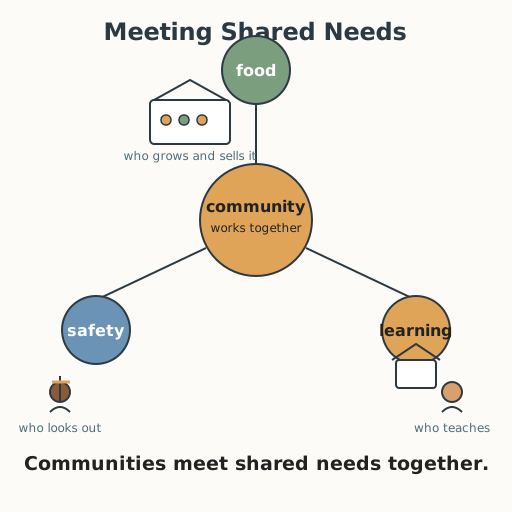
Lesson 8 — Meeting Shared Needs: Food, Safety, and Learning
Summary
Learners investigate how a community meets three shared needs — food, safety, and learning. They meet a needs frame, brainstorm who feeds, protects, and teaches their own community, and then investigate their home or neighborhood to answer how each need is met, producing a record of the community’s shared work.
Objectives
- Investigate how people in a community meet shared needs such as food, safety, and learning. (D02.S3.05.02)
Connection
Think about one ordinary day. Someone grew or made the food you ate, someone kept the street or home safe, and someone taught you a thing you now know. A community is, in part, a system for meeting shared needs: food, safety, and learning are not solved by one person alone — they are solved by many hands, from the farmer and the shopkeeper to the neighbor who looks out and the elder or teacher who passes on what they know.
Materials
- Community-needs poster
- Investigate-a-need page
- Pencils
Preparation
- Print or draw the community-needs poster (three columns: food, safety, learning).
- Copy an investigate-a-need page for each learner.
- Identify a few local examples of food, safety, and learning places to prime the discussion.
Facilitator note
This lesson is written to the learner (“you”). The idea to land is that communities are
systems of shared care: food, safety, and learning are met collectively, not alone. Keep
it concrete and local first — the learner’s own neighborhood — before broadening. Frame
the investigation as wonder, not a checklist to be graded. Be sensitive: some learners
experience hunger or unsafe conditions; keep the discussion about how communities meet
needs (the system), never about a family’s lack, and always connect to agency and hope —
something learners can contribute. See docs/facilitation.md on holding difficulty with
hope.
Procedure
- Gather (5 min). Last time you saw how shared work, symbols, and stories build a community. Today you look closer: how does a community meet its shared needs?
- Meet the three needs (10 min). Look at the poster. Every community must meet three needs. Food: who grows, catches, makes, or sells it? Safety: who looks out, what rules and helpers keep people safe? Learning: who teaches, and where do people learn — schools, elders, workshops, libraries?
- Brainstorm together (10 min). For your own community, name one real answer for each need. Food: a market, a garden, a shop. Safety: a neighbor who looks out, a crossing guard, rules everyone follows. Learning: a school, an elder, a library, a place where a skill is taught.
- Investigate one need (15 min). Choose one need and go deeper. On your page, answer: How does my community meet this need? Who does it, and where? Write or draw what you find. If you can, notice it with your own eyes — a walk to a shop, a look at a garden, a question to an adult.
- Close (5 min). A community meets its needs through many hands working together. Today you saw the system behind your own ordinary day — and you saw that you are part of it, too.
Differentiation
- Support: Provide an illustrated “who does this?” sorting activity and scribe the one-need answer.
- Extension: Compare how two communities — your own and one from a Lesson 5 day card — meet the same three needs differently, and note why the difference makes sense.
Assessment
- Formative (observation/portfolio): Can the learner name how their community meets each shared need — food, safety, learning — and describe who does it?
- Self-check: The learner asks, “Did I find a real answer for how my community meets the need, and can I name who makes it happen?”
Home connection
At home, trace one shared need back to the people who meet it — ask who grew or made the food, who keeps the home safe, and who taught a family skill.
Resources
- Meeting shared needs is framed by the UN Convention on the Rights of the Child, which names rights to food and health (Art. 24, 27), safety (Art. 19), and education (Arts. 28–29) — held as a shared agreement to work toward, not a claim that every child already has them honored. On food systems, see the FAO’s food-and-agriculture work (https://www.fao.org/); on water as a shared need, see WHO’s drinking-water guidance.