Lesson 01 — Paraphrase a Speaker's Points
Learners learn to paraphrase: to restate a speaker's points in their own words while keeping the meaning the same. They meet a worked example, practice a "listen → hold the idea → say it back" routine with sentence starters, and check their paraphrase against the original with a partner. This is the first of two skills for understanding a speaker; asking clarifying questions follows in the next lesson.
Objectives
Objectives
- D04.S1.05.01 Paraphrase a speaker's points accurately and ask clarifying questions when unsure.
Essential question
How do I put a speaker's points into my own words without changing the meaning?
Key vocabulary
Materials
Standard materials
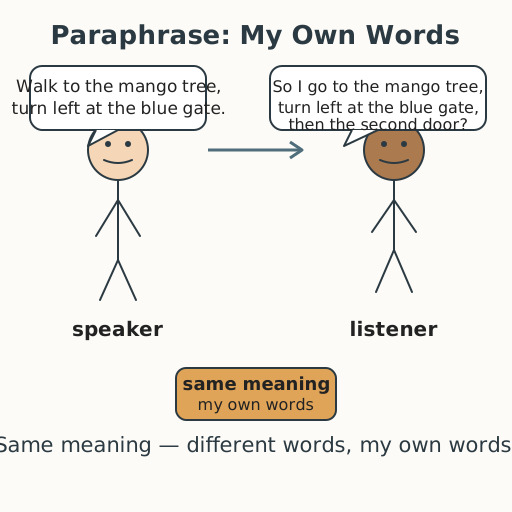
- Paraphrase poster · 1 A poster showing one speaker's original words beside a listener's paraphrase, joined by an arrow labeled "same meaning"
- Paraphrase sentence starters · 1 per pair A card with starters such as "So what you're saying is ___.", "In other words, ___.", and "If I understand right, ___."
- A short spoken message to practice on · 1 per pair Any 2–3 sentence message — a direction, a bit of news, a classroom announcement — read or said aloud by one partner
Low-tech / no-cost
- Voice, a partner, and a real message One partner says a short message aloud; the other says it back in their own words; no poster or card needed
- A 'keep or change the meaning' game Partners say a line aloud, then the listener says it back; they check together whether the meaning stayed the same
Enriched / lab & device
- A recording of a short talk or announcement · 1 per group To replay a spoken passage and practice paraphrasing it more than once
- A class paraphrase wall · 1 A shared wall where learners post a speaker's line and their own paraphrase side by side across the unit
Works in different contexts
- large-group Model one full paraphrase on the board together, then have pairs practice on a short message with the starter cards
- multi-age Younger learners say back one key idea while older learners give the full paraphrase and check it against the original
- self-directed A learner listens to or reads a short message and writes two paraphrases, checking each keeps the meaning
- level-grouped Learners ready to extend paraphrase a longer or more technical message and explain which words they changed and why
- outdoor-only Partners stand a few steps apart and practice "say it back" across a distance, as if relaying a message in a field or market
Lesson 1 — Paraphrase a Speaker’s Points
Summary
Learners learn to paraphrase: to restate a speaker’s points in their own words while keeping the meaning the same. They meet a worked example, practice a “listen → hold the idea → say it back” routine with sentence starters, and check their paraphrase against the original with a partner. This is the first of two skills for understanding a speaker; asking clarifying questions follows in the next lesson.
Objectives
- Paraphrase a speaker’s points accurately. (D04.S1.05.01)
Connection
A neighbor gives you directions: “Walk to the mango tree, turn left at the blue gate, and it’s the second door.” If you only nod, you might get lost. But if you say it back — “So I go to the mango tree, turn left at the blue gate, then take the second door?” — the neighbor can catch a mistake before you walk. Paraphrasing is that “say it back”: putting someone’s words into your own words while keeping the meaning the same, whether the directions lead through a busy city street or across a mountain field.
Materials
- Paraphrase poster
- Paraphrase sentence starters
- A short spoken message to practice on
Preparation
- Print or draw the paraphrase poster (original words → paraphrase, arrow labeled “same meaning”).
- Copy a paraphrase sentence-starter card for each pair.
- Have ready a few short messages (2–3 sentences) learners can use: directions, a piece of news, a classroom reminder.
Facilitator note
This lesson is written to the learner (“you”). The idea to land is that a paraphrase keeps the meaning and changes only the words — it is not a shorter version (that is summarizing) and not a repeat (that is quoting). Model the worked example aloud and slow it down: listen, hold the idea, then say it back. Because paraphrasing is a skill, use explicit instruction and guided practice before independent work (Kirschner, Sweller & Clark, 2006). Honor every home language: learners may paraphrase into their strongest language, which is itself a valuable act of understanding. Stop any correction that shames a learner’s word choice; the test is meaning, not grammar.
Procedure
- Gather (5 min). Think of a time you repeated someone’s words and they smiled and said “yes, exactly” — or a time you got it wrong and had to be corrected. Today you learn to paraphrase: to say a speaker’s points back in your own words without changing the meaning.
- Meet paraphrasing (10 min). Look at the poster. A speaker says, “Walk to the mango tree, turn left at the blue gate, and it’s the second door.” A listener paraphrases: “So I go to the mango tree, turn left at the blue gate, then take the second door.” The words changed; the meaning stayed the same. That is a paraphrase. A paraphrase is not a shorter version, and not word-for-word — it is the same idea in your own words.
- Learn the starters (5 min). Read the starter card: “So what you’re saying is ___.” “In other words, ___.” “If I understand right, ___.” These are doors into your own words. Practice saying one starter once, aloud.
- Listen and say it back (15 min). With a partner, one of you says a short message aloud — directions, news, or a reminder. The other paraphrases using a starter, in your own words. Then check together: did the meaning stay the same? If not, try again. Swap roles so each of you paraphrases twice.
- Close (5 min). A good listener is not just quiet — they say back what they heard so both people know it landed. Paraphrasing is how you make sure you understood, not just heard.
Differentiation
- Support: Provide the message in short, simple sentences and a printed word bank of synonyms; allow a one-sentence paraphrase first.
- Extension: Paraphrase a longer or more technical message and circle the exact words you changed, explaining why you kept the meaning.
Assessment
- Formative (peer/observation): Can the learner restate a short spoken message in their own words so the meaning stays the same, and catch a changed meaning with a partner?
- Self-check: The learner asks, “If the speaker heard my version, would they say ‘yes, that’s what I meant’?”
Home connection
Listen to a family member’s news or directions today, say it back in your own words, and ask them if you got it right.
Resources
- Paraphrasing and asking for clarification are core active-listening skills; for a classroom-friendly framing, see the International Listening Association’s “Listening Skills” primer and CASEL’s relationship-skills competency: https://casel.org/fundamentals-of-sel/. On explicit instruction for novice skills, see Kirschner, Sweller & Clark (2006), “Why Minimal Guidance During Instruction Does Not Work.”