Lesson 02 — Asking Clarifying Questions
Learners learn to ask clarifying questions when a speaker's meaning is unclear. They meet a worked example, learn a set of question starters ("Did you mean ___?", "What do you mean by ___?"), and practice on deliberately unclear messages until the meaning becomes clear. This completes the pair of listening skills begun in the paraphrase lesson.
Objectives
Objectives
- D04.S1.05.01 Paraphrase a speaker's points accurately and ask clarifying questions when unsure.
Essential question
What do I do when I do not fully understand what a speaker said?
Key vocabulary
Materials
Standard materials
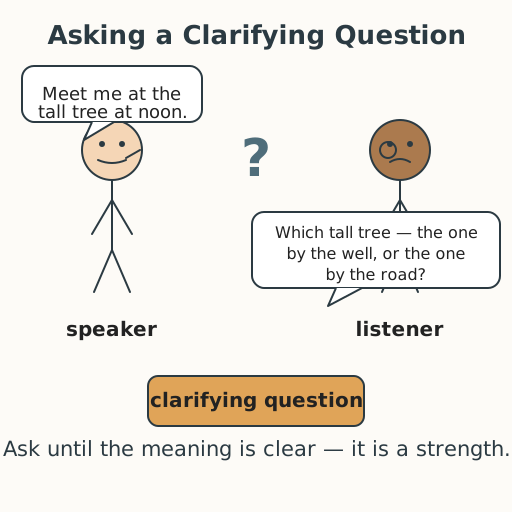
- Clarifying-question poster · 1 A poster showing a puzzled listener asking a clarifying question beside a speaker, with starters such as "Did you mean ___?", "Could you say more about ___?", "What do you mean by ___?"
- Clarifying-question starter card · 1 per pair A card listing question starters to use when unsure
- An unclear message to practice on · 1 per pair A deliberately vague or confusing message — a direction with a missing detail, an instruction with an unknown word — said or read aloud
Low-tech / no-cost
- Voice and a partner One partner says a deliberately unclear message; the other asks a clarifying question aloud until the meaning is clear
- A 'wonder box' of unclear messages Learners write an unclear message on a slip and draw one to practice asking about; no cards needed
Enriched / lab & device
- A recorded unclear announcement · 1 per group To replay and practice asking which detail was missing
- A class question bank · 1 A growing wall of strong clarifying questions learners can borrow across the unit
Works in different contexts
- large-group Read one unclear announcement to everyone and collect clarifying questions aloud before pairs practice on their own messages
- multi-age Younger learners ask one "what do you mean by ___?" while older learners distinguish a clarifying question from a new-topic question
- self-directed A learner reads an unclear message and writes three clarifying questions, then checks whether each gets the missing information
- level-grouped Learners ready to extend sort questions into "clarifies the message" versus "changes the subject" and explain why
- outdoor-only In pairs, one gives a real outdoor direction missing a detail (a tree, a path), and the other asks clarifying questions to find it
Lesson 2 — Asking Clarifying Questions
Summary
Learners learn to ask clarifying questions when a speaker’s meaning is unclear. They meet a worked example, learn a set of question starters (“Did you mean ___?”, “What do you mean by ___?”), and practice on deliberately unclear messages until the meaning becomes clear. This completes the pair of listening skills begun in the paraphrase lesson.
Objectives
- Ask clarifying questions when unsure of a speaker’s meaning. (D04.S1.05.01)
Connection
Someone says, “Bring the thing we use for the water.” Which thing? A bucket, a gourd, a cup, a pump? Guessing could waste a trip; asking — “Do you mean the bucket, or the gourd?” — saves it. A clarifying question is the question you ask when you are not sure what a speaker means. It is not rude and it is not a sign of being slow; it is how careful people make sure they understand before they act, in a kitchen, a workshop, or a classroom.
Materials
- Clarifying-question poster
- Clarifying-question starter card
- An unclear message to practice on
Preparation
- Print or draw the clarifying-question poster (a puzzled listener asking a clarifying question beside a speaker, with starters listed).
- Copy a starter card for each pair.
- Prepare a few deliberately unclear messages (a direction missing a detail, an instruction with an unknown word).
Facilitator note
This lesson is written to the learner (“you”). The idea to land is that asking for clarity
is a strength, not a weakness — it prevents errors and shows respect for the speaker’s
meaning. Some classrooms or homes teach children to stay silent rather than question; gently
reframe asking as wondering together, and offer the “wonder box” for anonymous questions
where speaking up feels unsafe (see docs/contexts.md). Distinguish a clarifying question
(it stays on the speaker’s meaning) from a new-topic question (it moves elsewhere). Model
the starters and do guided practice before independent work.
Procedure
- Gather (5 min). Last time you learned to paraphrase — to say a speaker’s points back in your own words. But sometimes you can’t paraphrase, because you are not sure what the speaker meant. Today you learn the second listener’s tool: the clarifying question.
- Meet the clarifying question (10 min). Look at the poster. A speaker says, “Meet me at the tall tree at noon.” A listener is puzzled: which tall tree? The listener asks, “Which tall tree — the one by the well, or the one by the road?” That is a clarifying question: it asks about the speaker’s meaning, not a new topic. The speaker answers, and now the message is clear.
- Learn the starters (5 min). Read the starter card: “Did you mean ___?”, “Could you say more about ___?”, “What do you mean by ___?”, “Which ___ do you mean?” Practice saying one aloud.
- Ask until it’s clear (15 min). With a partner, one of you says a deliberately unclear message. The other asks a clarifying question using a starter. Keep asking — one, two, or three questions — until the meaning is truly clear. Then check: did your questions stay on the speaker’s meaning? Swap roles.
- Close (5 min). Asking “what do you mean by ___?” is not admitting failure — it is building a bridge to understanding. The best listeners ask, and the best speakers are glad they did.
Differentiation
- Support: Provide a two-choice clarifying question (“Do you mean A or B?”) as a scaffold, and praise any question that stays on the meaning.
- Extension: Sort a mixed list of questions into “clarifies the message” and “changes the subject,” and rewrite the off-topic ones as clarifying questions.
Assessment
- Formative (peer/observation): Does the learner ask a question that stays on the speaker’s meaning and results in clearer understanding?
- Self-check: The learner asks, “Did my question help me understand this speaker’s meaning — not just make conversation?”
Home connection
The next time an instruction at home is unclear, ask one clarifying question instead of guessing — and notice how much smoother the task goes.
Resources
- Clarifying questions are a core component of active listening; for an accessible classroom framing, see CASEL’s relationship-skills competency: https://casel.org/fundamentals-of-sel/. On explicit instruction for novice skills, see Kirschner, Sweller & Clark (2006).