Lesson 06 — Author's Structure: Problem and Solution
Learners learn to recognize how authors use a problem-and-solution structure to organize ideas. They meet signal words ("the problem is," "one solution is," "to solve this"), label the problem and solution in a short passage, and explain how the author organized the text. This completes the pair of lessons on an author's text structure.
Objectives
Objectives
- D04.S2.05.01 Explain how an author uses structure, such as cause and effect or problem and solution, to organize ideas.
Essential question
How do authors use a problem-and-solution structure to organize ideas?
Key vocabulary
Materials
Standard materials
- Problem-and-solution poster · 1 A poster showing a problem box on the left, an arrow, and a solution box on the right, with signal words "the problem is," "one solution is," "to solve this"
- Problem-and-solution short passage · 1 per pair A short informational passage organized by problem and solution (for example, a village's water shortage and a shared well, or an invasive pest and a natural control)
- Problem/solution signal-word card · 1 per pair A card listing signal words that mark problem and solution in a text
Low-tech / no-cost
- A real problem nearby Name a small real problem — a leaking roof, a path washed out — and say one possible solution aloud; no poster needed
- A 'problem or solution' sorting game Say a sentence aloud and have partners signal with a thumb down (problem) or thumb up (solution)
Enriched / lab & device
- A problem-and-solution text set · 1 per group A few short passages on the same topic, some organized by problem and solution and some not, to compare structures
- A class 'problem solved' wall · 1 A shared wall of real problems and the solutions learners found in texts and in life
Works in different contexts
- large-group Map one shared passage into a problem box and a solution box on the board, then have pairs map their own passage
- multi-age Younger learners match a problem to its solution from pictures while older learners explain how the author signaled each part
- self-directed A learner reads a short passage, labels the problem and solution, and explains in a sentence how the author organized it
- level-grouped Learners ready to extend find a passage with more than one proposed solution and compare which the author favors
- outdoor-only Find a real problem outside — erosion on a path, a blocked waterway — and propose one solution, saying the signal words aloud
Lesson 6 — Author’s Structure: Problem and Solution
Summary
Learners learn to recognize how authors use a problem-and-solution structure to organize ideas. They meet signal words (“the problem is,” “one solution is,” “to solve this”), label the problem and solution in a short passage, and explain how the author organized the text. This completes the pair of lessons on an author’s text structure.
Objectives
- Explain how an author uses a problem-and-solution structure to organize ideas. (D04.S2.05.01)
Connection
A roof leaks, so someone patches it. A path washes out, so the village digs a channel. Life is full of problems and the solutions people build for them. Authors who write about real challenges — a dry well, an invasive insect, a flooded market — often organize their writing exactly that way: first the problem, then the solution, linked with words like so and to solve this. Spot the pattern and you can see not just what happened, but how people answered it.
Materials
- Problem-and-solution poster
- Problem-and-solution short passage
- Problem/solution signal-word card
Preparation
- Print or draw the problem-and-solution poster (problem box → arrow → solution box, with signal words).
- Copy a short passage organized by problem and solution for each pair.
- Copy the signal-word card.
Facilitator note
This lesson is written to the learner (“you”). The idea to land is that a
problem-and-solution structure is a second tool authors use, and that spotting it turns a
reader from a receiver of facts into a follower of an argument. Teach the signal words
explicitly, then let learners hunt. Choose problems from many places — water, soil, pests,
transport, food storage — and never frame any community as helpless; the point is human
agency and shared solutions. Connect the structure to hope: a problem named is a problem that
can be met. See docs/facilitation.md on holding real-world difficulty with agency attached.
Procedure
- Gather (5 min). Last lesson you learned how authors chain cause and effect. Today you meet a second structure: problem and solution — how authors set up a challenge and then show the answer.
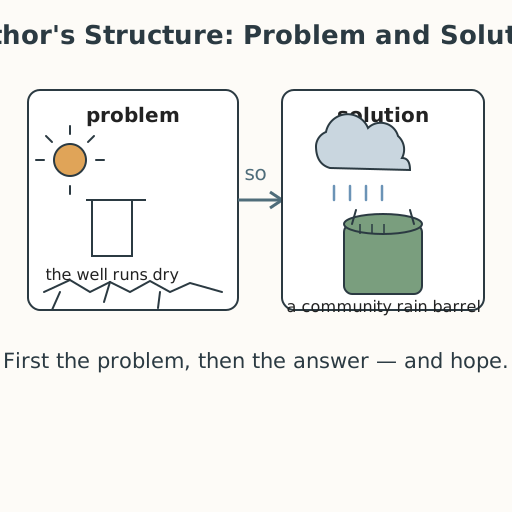
- Meet the structure (10 min). Look at the poster. On the left, a problem: “the well runs dry.” On the right, a solution: “the community builds a shared rain barrel.” An arrow marked so connects them. Authors signal this with words like the problem is, one solution is, and to solve this.
- Read and label (15 min). With a partner, read the short passage. Mark the problem and the solution. Circle the signal words. Then draw the two boxes and the arrow the author used.
- Explain the author’s choice (10 min). Answer together: why did this author choose problem and solution? How is it different from the cause-and-effect chain you read last time?
- Close (5 min). Readers who can name a text’s structure can hold its whole shape in their hands — and writers (like you) can use the same shape to make their own ideas clear.
Differentiation
- Support: Provide the passage with the problem pre-marked, and have the learner find the solution and the signal words.
- Extension: Find a text that offers two solutions, compare them, and say which the author seems to favor and why.
Assessment
- Formative (observation/peer): Can the learner identify a passage’s problem and solution and explain how the author organized the text?
- Self-check: The learner asks, “Can I say the problem in one sentence, the solution in one sentence, and the signal word that joins them?”
Home connection
Name one real problem at home and one solution your family uses for it — and say it with a signal word like “to solve this.”
Resources
- Text-structure instruction supports comprehension (see the IES “Improving Adolescent Literacy” practice guide; Duke & Pearson’s synthesis of comprehension research). On explicit instruction for novice skills, see Kirschner, Sweller & Clark (2006).