Lesson 07 — Fact or Opinion?
Learners learn to distinguish facts (claims that can be checked) from opinions (what someone thinks or feels). They meet the two test questions — "Can I check it?" versus "Does someone believe it?" — sort sentences into the two columns, and write a fact and an opinion of their own, stating how the fact could be checked.
Objectives
Objectives
- D04.S2.05.02 Distinguish fact from opinion and identify the author's purpose and point of view.
Essential question
How do I tell a fact (something I can check) from an opinion (what someone thinks)?
Key vocabulary
Materials
Standard materials
- Fact vs. opinion poster · 1 A poster with two columns — "fact (can be checked)" and "opinion (what someone thinks)" — with example sentences and the questions "Can I check it?" versus "Does someone believe it?"
- Fact-or-opinion sentence strips · 1 set per pair A set of sentences to sort into fact and opinion, drawn from many contexts (food, sport, weather, music, nature)
- Two-column sorting page · 1 per learner A page with a "fact" column and an "opinion" column to sort the strips onto
Low-tech / no-cost
- Voice and a 'fact or opinion' game Say a sentence aloud and have partners signal with a flat palm down (fact, can be checked) or a raised palm (opinion, someone's belief)
- Found facts and opinions Take turns saying one fact about something you can see and one opinion about it; the partner checks each
Enriched / lab & device
- A fact-or-opinion passage · 1 per pair A short text mixing facts and opinions to underline in two different ways and discuss
- A 'how would we check it?' chart · 1 A shared chart where learners post a fact and the way it could be checked, building a bank of checking strategies
Works in different contexts
- large-group Sort several sentences aloud as a whole group first, then have pairs sort their own strips and justify each choice
- multi-age Younger learners sort simple, obvious sentences while older learners tackle closer calls and explain how they would check
- self-directed A learner sorts the strips alone, then writes one fact and one opinion of their own and states how the fact could be checked
- level-grouped Learners ready to extend revise an opinion into a checkable fact and vice versa, and discuss sentences that mix both
- outdoor-only Point to something outside and say one checkable fact and one opinion about it; a partner decides which is which
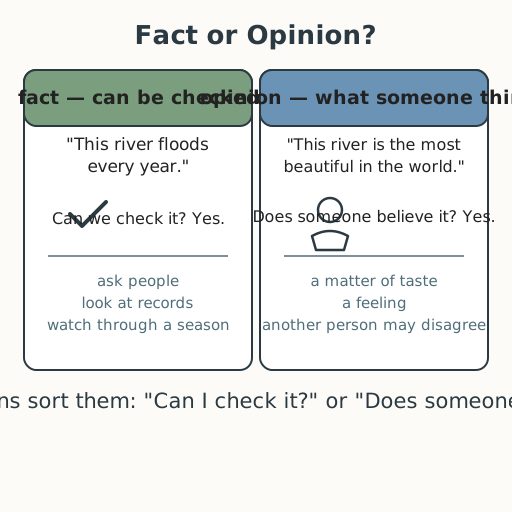
Lesson 7 — Fact or Opinion?
Summary
Learners learn to distinguish facts (claims that can be checked) from opinions (what someone thinks or feels). They meet two test questions — “Can I check it?” versus “Does someone believe it?” — sort sentences into the two columns, and write a fact and an opinion of their own, stating how the fact could be checked.
Objectives
- Distinguish fact from opinion. (D04.S2.05.02)
Connection
“This river floods every year” and “this river is the most beautiful in the world” are two very different sentences. The first you can check — ask people, look at records, watch through a season. The second is a matter of taste — someone’s feeling, and another person may feel differently. Both have their place, but they are not the same thing. Learning to tell them apart is how you keep from being fooled — in a market, in the news, in a family argument.
Materials
- Fact vs. opinion poster
- Fact-or-opinion sentence strips
- Two-column sorting page
Preparation
- Print or draw the fact vs. opinion poster (two columns with the two test questions).
- Copy a set of fact-or-opinion sentence strips for each pair.
- Copy the two-column sorting page.
Facilitator note
This lesson is written to the learner (“you”). The idea to land is that the difference between
fact and opinion is how the claim behaves — a fact can be checked, an opinion is held. Avoid
framing opinions as “bad”; they are how we feel and choose, and they matter. The skill is
telling which is which and knowing what each is for. Be careful with close calls (a taste
judgment dressed up as fact, or a value stated as a fact) — those are the interesting ones to
discuss, not to rush past. This is a critical-thinking habit, not a one-day module
(docs/philosophy.md §7). Keep sorting non-competitive and let learners justify their choices.
Procedure
- Gather (5 min). Think of two things someone said today — one you could check, and one that was just how they felt. Today you learn to name that difference: fact and opinion.
- Meet the two questions (10 min). Look at the poster. A fact is a claim you can check — “this river floods every year” can be checked by asking and observing. An opinion is what someone thinks or feels — “this river is the most beautiful in the world” is a feeling, not a check. Two questions sort them: Can I check it? (fact) and Does someone believe or feel it? (opinion).
- Sort the strips (15 min). With a partner, read each sentence strip and place it in the “fact” or “opinion” column. For each one, say why: what could you check, or whose feeling is it? Take your time with the close ones.
- Write your own (10 min). Write one fact and one opinion about the same thing — a food, a place, a game. Under the fact, write how you could check it.
- Close (5 min). Facts tell us what is; opinions tell us what matters to someone. A thoughtful person keeps both — and never confuses the two.
Differentiation
- Support: Start with obvious pairs (“It rained yesterday” vs. “Rain is wonderful”) and provide a checking-words bank (ask, look, measure, count, record).
- Extension: Take a sentence that mixes both (“This cheap, delicious fruit grows here”) and separate its fact parts from its opinion parts.
Assessment
- Formative (peer/self): Can the learner sort sentences into fact and opinion and say how a fact could be checked?
- Self-check: The learner asks, “For each one, could I say exactly how to check it — or whose belief it is?”
Home connection
Listen for one fact and one opinion at home or in the street today, and tell someone which is which and why.
Resources
- Fact/opinion distinction is a foundational critical-literacy skill; for classroom framing
see Duke & Pearson’s synthesis of comprehension strategy research and the IES practice guides.
On critical thinking as a habit across subjects, see the framing in
docs/philosophy.md.