Lesson 01 — Reading and Writing Decimals to Thousandths
Learners read and write decimals to the thousandths by building them on a place-value chart, naming each place (tenths, hundredths, thousandths), and writing the same number in standard, word, and expanded form. They connect decimals to the fractions 1/10, 1/100, and 1/1000 and notice that a decimal point simply marks where whole ones end.
Objectives
Objectives
- D05.S1.05.01 Read, write, compare, and round decimals to the thousandths and connect them to fractions with denominators of 10 and 100.
Essential question
How do I read and write decimals to the thousandths, and what does each place mean?
Key vocabulary
Materials
Standard materials
- Place-value chart to thousandths · 1 A chart with columns ones, decimal point, tenths, hundredths, thousandths, plus expanded-form rows
- Digit cards (0-9) and a decimal-point card · 1 set per pair Cards to build decimal numbers and read them aloud
- Decimal recording page · 1 per learner A page with blank place-value charts and numbers to read, write, and expand
Low-tech / no-cost
- A hand-drawn place-value chart Draw the columns in the dirt or on paper; use stones, seeds, or shells as digit markers, with a small stick as the decimal point
- Voice and body Read decimals aloud and clap once for each place; no chart or cards needed
Enriched / lab & device
- A digital place-value slider · 1 per group An interactive place-value chart where digits slide into columns and the number updates, for devices that have it
- A decimal 'match the form' game · 1 per group Cards matching standard form, word form, and expanded form of the same decimal for repeated play
Works in different contexts
- large-group Build one large place-value chart at the front and build numbers together, reading each aloud in chorus before pairs build their own
- multi-age Younger learners place whole-number digits while older learners place and name the tenths, hundredths, and thousandths
- self-directed A learner works through the recording page alone, building numbers with cards, reading them aloud, and checking against the worked examples
- level-grouped Learners ready to extend build numbers with a missing place (e.g., 3.05) and explain the zero as a placeholder, then write decimals beyond thousandths
- outdoor-only Draw a place-value chart in the dirt or sand and use stones, leaves, or seeds as digits; a twig marks the decimal point
Lesson 1 — Reading and Writing Decimals to Thousandths
Summary
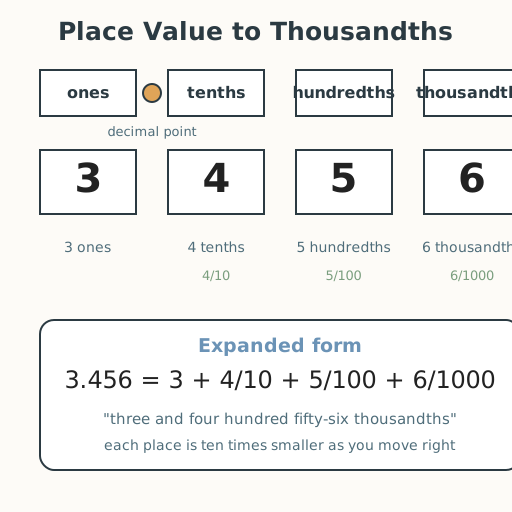
Learners read and write decimals to the thousandths. They build numbers on a place-value chart, name each place (tenths, hundredths, thousandths), and write the same number three ways — standard form (3.456), word form (“three and four hundred fifty-six thousandths”), and expanded form (3 + 4/10 + 5/100 + 6/1000). They see that the decimal point is just a marker between whole ones and the parts smaller than one.
Objectives
- Read, write, and expand decimals to the thousandths and name the value of each place. (D05.S1.05.01)
Connection
You already know whole numbers — ones, tens, hundreds. Now think about one single chapatis or flatbread torn into ten equal strips. Each strip is one tenth of the bread. Tear one strip into ten again and you get one hundredth; tear again and you get one thousandth. Decimals are how we write those small parts next to whole ones — and people use them every day for money, medicine, measurements, and weather. In many parts of the world the decimal point is written as a comma instead (3,456), but the idea is the same: a marker between whole ones and parts of one.
Materials
- Place-value chart to thousandths
- Digit cards (0–9) and a decimal-point card
- Decimal recording page
Preparation
- Print or draw the place-value chart (ones · tenths · hundredths · thousandths).
- Copy digit-card sets for pairs and a recording page for each learner.
- Have two or three example numbers ready to build (3.456, 0.205, 12.7).
Facilitator note
This lesson is written to the learner (“you”). The idea to land is that a decimal point
separates whole ones from parts smaller than one, and that each place to the right is ten
times smaller — tenths, then hundredths, then thousandths. Because this is a foundational
skill, use explicit instruction and worked examples before independent practice
(Kirschner, Sweller & Clark, 2006): model building 3.456 step by step, name each place, then
guide a second number together before learners work alone. Watch for two common slips: reading
“3.456” as “three point four five six” only (also teach the place-value reading “three and
four hundred fifty-six thousandths”), and skipping the value of a zero (in 3.05, the zero
holds the tenths place — there are 0 tenths). Note the global point: many countries use a
comma as the decimal separator and a space or period for thousands — this is a difference of
convention, not of correctness. The number facts here are evidence; the claim that no system
is “better” is a value we hold (docs/philosophy.md §4–5).
Procedure
- Gather (5 min). Think of the smallest amount of money you know. A whole coin or bill is “one.” What about a part of it? Today you learn how to read and write parts of one using decimals.
- Meet the chart (10 min). Look at the place-value chart. To the left of the decimal point are whole ones; to the right are parts: tenths (1/10), hundredths (1/100), thousandths (1/1000). Each place to the right is ten times smaller than the one before it.
- Worked example (10 min). Build 3.456 together. Put a 3 in the ones column, a 4 in the tenths, a 5 in the hundredths, and a 6 in the thousandths. Read it two ways: “three point four five six,” and “three and four hundred fifty-six thousandths.” Write it in expanded form: 3 + 4/10 + 5/100 + 6/1000. Notice the 4 means 4 tenths, the 5 means 5 hundredths, the 6 means 6 thousandths.
- Build your own (15 min). With a partner, build 0.205 and 12.7. For each, say each digit’s place and value aloud, then write it in standard, word, and expanded form. Check: in 0.205, what is the 0 in the hundredths place doing? (Holding the place — there are 0 hundredths.)
- Close (5 min). Remember: the decimal point is just a marker. Every digit in a decimal has a name and a value, and now you can read and write them all the way to the thousandths.
Differentiation
- Support: Start with tenths and hundredths only; use a place-value chart with the value of each column printed in it. Describe each place aloud and trace the digits with a finger so learners with low vision can follow by listening and touch.
- Extension: Write decimals with a zero in a middle place (3.05, 0.040) and explain the zero’s role; extend the chart one more place to ten-thousandths and name it.
Assessment
- Formative (observation/self): Can the learner place digits of a decimal to the thousandths and name each place’s value?
- Self-check: The learner asks, “Can I read 3.456 two ways, and can I write any decimal to thousandths in expanded form?”
Home connection
Ask someone at home where they see decimals — on a receipt, a scale, a medicine label, a weather report — and read one decimal aloud together.
Resources
- Place value with decimals is standard in elementary mathematics; see John A. Van de Walle,
Elementary and Middle School Mathematics (10th ed., 2019) for place-value teaching models.
The note that a comma serves as the decimal separator in many countries is a documented
convention (ISO 80000-1, which stipulates the decimal sign is “either a comma or a point on
the line,” and national standards); treating all conventions as valid is a value commitment
(
docs/philosophy.md§4).