Lesson 02 — Comparing, Rounding, and Connecting Decimals to Fractions
Learners compare and round decimals to the hundredths and thousandths and connect them to equivalent fractions with denominators of 10 and 100. They use a number line to see that 0.5 = 5/10 = 50/100, compare decimals by place value, and round to the nearest tenth and hundredth using the "look at the next place" rule.
Objectives
Objectives
- D05.S1.05.01 Read, write, compare, and round decimals to the thousandths and connect them to fractions with denominators of 10 and 100.
Essential question
How do I compare and round decimals, and how do they connect to fractions with denominators of 10 and 100?
Key vocabulary
Materials
Standard materials
- Decimal number line (0 to 1) · 1 A large number line marked in tenths and hundredths, with fraction equivalents labeled
- Decimal comparison cards · 1 set per pair Pairs of decimals to compare with <, >, or = and to round to the nearest tenth or hundredth
- Comparison and rounding page · 1 per learner A page with decimals to compare, order, and round, plus blank number lines
Low-tech / no-cost
- A string or rope number line Stretch a string and mark tenths and hundredths with knots or clips; place pebbles or paper slips at decimal values
- Voice and fingers Compare decimals by saying each place aloud and holding up the sign (<, >, =) with arms; round by chanting the rule
Enriched / lab & device
- A digital number-line app · 1 per group A number line where learners drag decimals to their place and watch the fraction equivalent update, where devices allow
- A decimal rounding game · 1 per group A game of rounding decimal cards to the nearest tenth or hundredth with a partner checking the answer
Works in different contexts
- large-group Compare decimals on the big number line together, then have pairs order their cards and round to a target place before sharing one reasoning
- multi-age Younger learners compare tenths only while older learners compare and round hundredths and thousandths
- self-directed A learner works the comparison and rounding page alone, placing each decimal on a number line and checking against the worked examples
- level-grouped Learners ready to extend compare decimals to thousandths and round to any given place, and explain a case where rounding changes a comparison
- outdoor-only Draw a long number line in the dirt, mark tenths and hundredths with sticks, and stand or place stones at decimals to compare and round them
Lesson 2 — Comparing, Rounding, and Connecting Decimals to Fractions
Summary
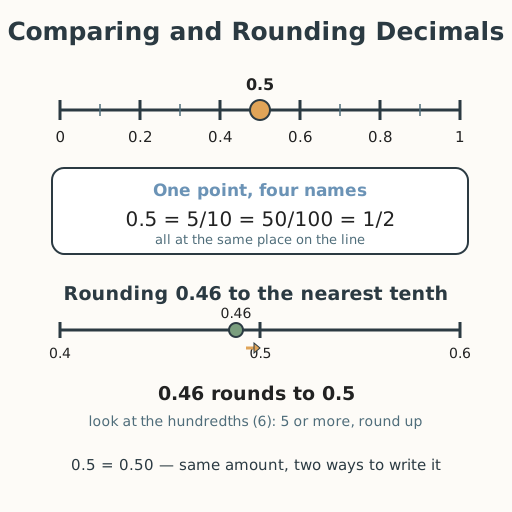
Learners compare and round decimals and connect them to equivalent fractions with denominators of 10 and 100. On a number line they see that 0.5 = 5/10 = 50/100 = 1/2. They compare decimals by lining up place values, and round to the nearest tenth or hundredth using the “look at the next place” rule.
Objectives
- Compare decimals to the hundredths and thousandths and connect them to equivalent fractions with denominators of 10 and 100. (D05.S1.05.01)
- Round decimals to the nearest tenth and hundredth. (D05.S1.05.01)
Connection
Two market stalls sell the same cloth. One writes the price as 0.5, the other as 0.50. Which is cheaper? Trick question — they are the same: 0.5 and 0.50 are equal, just written two ways, like saying “half” or “fifty hundredths.” In a shop, at a farm weighing grain, or measuring rain, we compare decimals to decide what is more or less, and we round long decimals to something easier to think about — a price of 4.376 becomes about 4.38, or 4.4.
Materials
- Decimal number line (0 to 1)
- Decimal comparison cards
- Comparison and rounding page
Preparation
- Print or draw the number line (tenths and hundredths, with fraction labels).
- Copy comparison cards for pairs and the page for each learner.
- Have examples ready: compare 0.45 vs 0.4; round 0.46 to the nearest tenth; round 0.457 to the nearest hundredth.
Facilitator note
This lesson is written to the learner (“you”). The ideas to land: (1) equivalent forms —
0.5, 0.50, 5/10, and 1/2 all name the same amount; (2) comparing by aligning place values
(0.45 has 45 hundredths, 0.4 has 40, so 0.45 > 0.4); and (3) rounding by looking at the
digit in the next place to the right — 5 or more rounds up. Model each as a worked example
on the number line first (Kirschner, Sweller & Clark, 2006), then guide a second before
independent practice. Two common slips to watch for: thinking more digits means a larger
number (0.4 is not less than 0.45 just because it is shorter), and rounding without
looking at the correct place. Reinforce with retrieval: ask “what did we build last lesson?”
and have a learner name the places. The equivalence facts here are evidence; the habit of
checking our own rounding is a value (docs/philosophy.md §7).
Procedure
- Gather (5 min). Last time you read and wrote decimals to the thousandths. Quick recall: in 3.456, what does the 5 mean? Today you compare and round those decimals, and see them as fractions.
- Meet equivalent forms (10 min). Look at the number line. Find 0.5. Notice it is also 5/10, 50/100, and 1/2 — all the same point. Decimals and fractions with denominators of 10 and 100 are two languages for the same amount.
- Worked example — compare (10 min). Which is more, 0.45 or 0.4? Line them up by place value: 0.45 has 4 tenths and 5 hundredths; 0.4 has 4 tenths and 0 hundredths. 45 hundredths is more than 40 hundredths, so 0.45 > 0.4. Plot both on the number line to check.
- Worked example — round (10 min). Round 0.46 to the nearest tenth. Look at the next place (hundredths): the digit is 6, which is 5 or more, so round up: 0.46 → 0.5. Round 0.457 to the nearest hundredth: look at the thousandths (7), round up: 0.457 → 0.46.
- Practice with a partner (10 min). Sort your comparison cards using <, >, or =, and round each decimal to the nearest tenth and hundredth. Check each other: did you look at the right place?
- Close (5 min). Comparing and rounding are skills you use every day — with money, time, and measures. The trick is the same each time: line up the places, and look at the next place to round.
Differentiation
- Support: Use only tenths and hundredths; round to the nearest tenth only, and keep the number line under each problem. Describe each step aloud and use tactile markers so learners with low vision can follow by touch.
- Extension: Compare and round decimals to the thousandths, and explain a case where two different decimals round to the same number (e.g., 0.43 and 0.44 both round to 0.4).
Assessment
- Formative (observation/self): Can the learner compare two decimals correctly and round a decimal to a given place, explaining why?
- Self-check: The learner asks, “Can I show 0.5 and 0.50 are equal, and can I round 0.457 to the nearest hundredth and explain the rule?”
Home connection
Find two prices at a market or shop, compare them as decimals, and round one to the nearest tenth with someone at home.
Resources
- Decimal equivalence and rounding are standard in elementary mathematics; see John A. Van de
Walle, Elementary and Middle School Mathematics (10th ed., 2019). The claim that checking
our own reasoning matters is a value (
docs/philosophy.md§7).