Lesson 04 — Adding and Subtracting Fractions in Sharing and Cooking
Learners add and subtract fractions in sharing and cooking contexts. They add and subtract fractions with like denominators directly, and rename with equivalent fractions to combine unlike denominators such as 1/2 and 1/4. Bar models and paper folding make the renaming visible.
Objectives
Objectives
- D05.S1.05.02 Add, subtract, multiply, and divide fractions and decimals in real contexts such as sharing, cooking, and money.
Essential question
How do I add and subtract fractions, and where do I use it in sharing and cooking?
Key vocabulary
Materials
Standard materials
- Fraction bar strips · 1 set per pair Strips cut into halves, thirds, fourths, and eighths to model adding and subtracting fractions
- Recipe fraction cards · 1 set per group Cards with recipe and sharing problems (e.g., 1/2 cup + 1/4 cup; 3/4 loaf shared)
- Fraction recording page · 1 per learner A page for recording fraction sums and differences with drawn models
Low-tech / no-cost
- Paper folding Fold paper strips into equal parts to model fractions; shade and combine parts to add or subtract
- Real food to share Share a real flatbread, fruit, or cup of water into equal parts, then combine or take away parts and name the fraction
Enriched / lab & device
- A digital fraction bar app · 1 per group Virtual fraction bars to combine and compare, where devices allow
- A class cooking project · 1 A real recipe scaled to the class, where learners add and subtract fraction amounts of ingredients
Works in different contexts
- large-group Model one fraction addition with bars at the front, then have pairs build sums and differences and share one drawing
- multi-age Younger learners combine same-denominator halves and fourths while older learners rename to add unlike denominators
- self-directed A learner works the recording page alone, drawing bar models and checking sums against the worked examples
- level-grouped Learners ready to extend add and subtract mixed numbers and explain when denominators must be made alike
- outdoor-only Fold and shade paper or leaves into equal parts, or share real portions of food, to act out each fraction problem
Lesson 4 — Adding and Subtracting Fractions in Sharing and Cooking
Summary
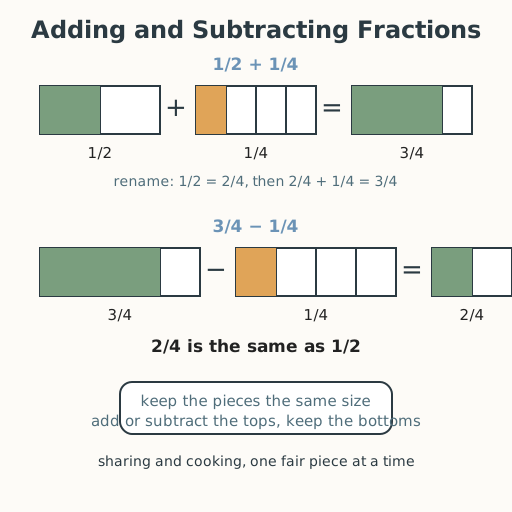
Learners add and subtract fractions in real sharing and cooking contexts. With like denominators they combine or take away parts directly (1/4 + 2/4 = 3/4). With unlike denominators they first rename using equivalent fractions (1/2 = 2/4, so 1/2 + 1/4 = 3/4). Bar models and paper folding make the renaming visible.
Objectives
- Add and subtract fractions in real sharing and cooking contexts, using like denominators and simple equivalent-fraction renaming. (D05.S1.05.02)
Connection
You are cooking with a grown-up. The recipe calls for 1/2 cup of rice and 1/4 cup of lentils. How much grain is that altogether? Or you share a flatbread: you eat 3/4 of it and give 1/4 to a friend — how much did you keep? Adding and subtracting fractions is the math of sharing and cooking, done the same way in a home in Cairo, a farm kitchen in the Andes, or a soup kitchen serving a neighborhood.
Materials
- Fraction bar strips
- Recipe fraction cards
- Fraction recording page
Preparation
- Copy fraction bar strips for pairs and recipe cards for groups.
- Copy the recording page.
- Have worked examples ready: 1/2 + 1/4 = 3/4; 3/4 − 1/4 = 1/2.
Facilitator note
This lesson is written to the learner (“you”). The ideas to land: (1) with like
denominators, add or subtract the numerators and keep the denominator (the size of the
pieces does not change); (2) with unlike denominators, rename to a common denominator using
equivalent fractions before combining. Model each as a worked example with bar models
first, then guide a second together (Kirschner, Sweller & Clark, 2006). The most common slip
is adding denominators too (1/2 + 1/4 = 2/6); the bar model shows why that is wrong — the
pieces are not the same size. Retrieval: ask learners to recall decimal–fraction equivalence
(0.5 = 1/2) and reuse it to check that 1/2 + 1/4 = 3/4 = 0.75. Sharing food fairly is a
fairness value woven through the unit (docs/philosophy.md §4); the arithmetic itself is
evidence.
Procedure
- Gather (5 min). Recall: what fraction is the same as 0.5? Today you add and subtract fractions — the math of sharing and cooking.
- The rule (5 min). To add or subtract fractions, the pieces must be the same size — same denominator. Then add or subtract the numerators and keep the denominator.
- Worked example — like denominators (10 min). You eat 3/4 of a flatbread and give 1/4 to a friend. How much did you keep? Same denominator (fourths): 3/4 − 1/4 = 2/4, which is the same as 1/2. Model it with bars: shade 3 fourths, erase 1, see 2 fourths.
- Worked example — unlike denominators (10 min). A recipe needs 1/2 cup rice plus 1/4 cup lentils. The pieces differ, so rename: 1/2 = 2/4. Now 2/4 + 1/4 = 3/4. Build it with bars: a half bar equals two quarter bars.
- Practice with a partner (15 min). Take your recipe cards. For each, draw or build the bar model, rename if needed, and find the sum or difference. Check each other: are the pieces the same size before you combine?
- Close (5 min). Fractions are about equal parts. Add or subtract them only when the parts are the same size — rename first if they are not. That one idea unlocks all of sharing and cooking math.
Differentiation
- Support: Use only halves and fourths; provide pre-cut bars and keep denominators the same. Describe each step aloud and use raised/tactile bars so learners with low vision can follow by touch.
- Extension: Add and subtract mixed numbers (1 1/2 + 3/4) and explain each renaming step.
Assessment
- Formative (observation/self): Can the learner add and subtract fractions with like denominators, and rename to add unlike denominators like 1/2 and 1/4, using a model?
- Self-check: The learner asks, “Did I keep the pieces the same size? Can I show 1/2 + 1/4 = 3/4 with bars?”
Home connection
While helping cook or share food, find a fraction (half a cup, a quarter of a loaf) and add or subtract it with another to name the total.
Resources
- Fraction addition/subtraction with equivalent-fraction renaming is standard in elementary
mathematics; see John A. Van de Walle, Elementary and Middle School Mathematics (10th ed.,
2019). The fairness value of sharing equally is a commitment (
docs/philosophy.md§4).