Lesson 03 — Adding and Subtracting Decimals with Money
Learners add and subtract decimals in a market context by lining up the decimal points, adding or subtracting place by place, and regrouping when a column makes ten or needs to borrow. They use the skill to total purchases and give change with money.
Objectives
Objectives
- D05.S1.05.02 Add, subtract, multiply, and divide fractions and decimals in real contexts such as sharing, cooking, and money.
Essential question
How do I add and subtract decimals, and where do I use it with money?
Key vocabulary
Materials
Standard materials
- Market price tag cards · 1 set per pair Cards with prices (e.g., 2.50, 1.75, 0.80) to add and subtract in a pretend market
- Decimal money recording page · 1 per learner A page with money problems to solve by lining up decimal points, plus blank bar models
- Play money or paper coins · 1 set per group To act out making totals and giving change
Low-tech / no-cost
- Real or found objects as goods Use stones, seeds, fruit, or drawings as items for sale with hand-written prices; add and subtract aloud or on paper
- A chalk or dirt money board Draw two columns (paid, spent) in the dirt and move pebbles to find the total and the change
Enriched / lab & device
- A simple calculator or spreadsheet · 1 per group To check sums and differences after computing by hand, where devices allow
- A class market simulation · 1 A fuller market with several stalls so groups total purchases and give change across the room
Works in different contexts
- large-group Model one purchase on the board, then have pairs total two or three items and find change before sharing one method
- multi-age Younger learners total whole-unit prices while older learners handle decimals with regrouping and giving change
- self-directed A learner works the recording page alone, lining up decimal points and checking sums against a worked example
- level-grouped Learners ready to extend solve multi-item totals with regrouping across several places and estimate change mentally
- outdoor-only Set up a pretend market outdoors with found items and hand-written prices; buyers total purchases and sellers make change
Lesson 3 — Adding and Subtracting Decimals with Money
Summary
Learners add and subtract decimals by lining up the decimal points and working place by place, regrouping when needed. They practice in a market context — totaling purchases and giving change with money — and check that every answer makes sense with the amounts they started with.
Objectives
- Add and subtract decimals in a real money context, lining up place values and regrouping as needed. (D05.S1.05.02)
Connection
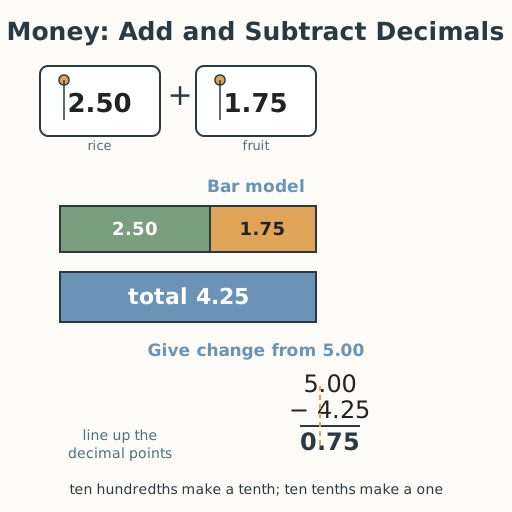
You are at a market with 5.00. You buy rice for 2.50 and fruit for 1.75. How much do you pay, and how much change do you get back? Adding and subtracting decimals is exactly the math of buying and selling — the same skill a seller uses to give the right change in a market in Lagos, a shop in Lima, or a floating market in Bangkok. Money works in many currencies, but the place-value idea — line up the points, work place by place — is the same everywhere.
Materials
- Market price tag cards
- Decimal money recording page
- Play money or paper coins
Preparation
- Copy price tag cards for pairs and the recording page for each learner.
- Set up play money or paper coins for groups.
- Have a worked example ready: 2.50 + 1.75 = 4.25; change from 5.00.
Facilitator note
This lesson is written to the learner (“you”). The skill to carry is aligning the decimal
points so tenths add to tenths and hundredths to hundredths, then regrouping exactly as
with whole numbers (ten hundredths make a tenth; ten tenths make a one). Because this is a
foundational skill, model a worked example step by step, then guide a second together
before independent practice (Kirschner, Sweller & Clark, 2006). Common slips to watch for:
lining up numbers on the right edge instead of at the decimal point, and forgetting to write
the decimal point in the answer. Retrieval: ask learners to recall last lesson’s rounding rule
and reuse it to estimate (“about 2.50 + 1.75 ≈ 4.25, so the answer should be near 4”). Using
real local currency is fine; keep the math generic so it works with any currency, and avoid
assuming one currency is the “default.” The arithmetic is evidence; the habit of giving exact
change so no one is cheated is a fairness value (docs/philosophy.md §4).
Procedure
- Gather (5 min). Recall: how do you round 4.36 to the nearest tenth? Today you use decimals to add and subtract — the math of money.
- The rule (5 min). When you add or subtract decimals, line up the decimal points, then work place by place, just like whole numbers. The decimal point in the answer sits right under the others.
- Worked example — add (10 min). A customer buys rice (2.50) and fruit (1.75). Write 2.50 and 1.75 with the points lined up. Add hundredths: 0 + 5 = 5. Add tenths: 5 + 7 = 12 tenths → write 2, carry 1 one. Add ones: 2 + 1 + 1 = 4. The total is 4.25.
- Worked example — subtract (10 min). The customer pays 5.00. Subtract 4.25 to find the change. Line up the points: 5.00 − 4.25. Hundredths: borrow from the tenths — 10 − 5 = 5. Tenths: 9 − 2 = 7. Ones: 4 − 4 = 0. The change is 0.75.
- Practice at the market (15 min). With a partner, pick two or three price tags, total them, and find the change from an amount you choose. Use play money to act it out, then check each other’s work — did you line up the points? Is the change right?
- Close (5 min). Adding and subtracting decimals is a daily-life skill. When the points line up, the math is as easy as whole numbers — and you can always estimate first to check your answer is sensible.
Differentiation
- Support: Use amounts with only tenths (2.5, 1.7) and no regrouping at first; keep the place-value chart visible and describe each step aloud. Provide tactile markers so learners with low vision can follow.
- Extension: Solve multi-item totals with several regroupings, estimate the change mentally first, and compare your estimate to the exact answer.
Assessment
- Formative (observation/self): Can the learner line up decimal points, add and subtract with regrouping, and give correct change in a market task?
- Self-check: The learner asks, “Did I line up the decimal points, and does my answer make sense for the amounts I started with?”
Home connection
Next time something is bought, help figure out the total or the change, and line up the decimal points to do it.
Resources
- Decimal addition/subtraction by place-value alignment is standard in elementary mathematics;
see John A. Van de Walle, Elementary and Middle School Mathematics (10th ed., 2019). The
claim that giving exact change so no one is cheated is a fairness value (
docs/philosophy.md§4).