Lesson 06 — Dividing Fractions and Decimals in Real Life
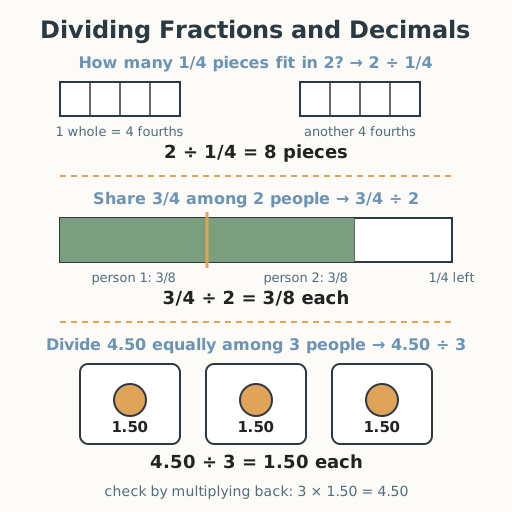
Learners divide fractions and decimals in real contexts. They find how many 1/4 pieces fit in 2 (2 ÷ 1/4 = 8), share 3/4 among 2 people (3/4 ÷ 2 = 3/8), and divide money equally (4.50 ÷ 3 = 1.50). Bar models make the meaning of each division visible.
Objectives
Objectives
- D05.S1.05.02 Add, subtract, multiply, and divide fractions and decimals in real contexts such as sharing, cooking, and money.
Essential question
How do I divide fractions and decimals, and where do I use it in real life?
Key vocabulary
Materials
Standard materials
- Fraction bar strips · 1 set per pair Strips to model dividing a fraction among people or finding how many pieces fit
- Division story cards · 1 set per group Cards with problems: 3/4 ÷ 2, 2 ÷ 1/4, 4.50 ÷ 3
- Division recording page · 1 per learner A page for recording division problems with drawn models
Low-tech / no-cost
- Paper folding and tearing Fold and tear a strip into equal parts to divide a fraction among people, or share real food
- Real objects to share Divide a real portion (half a fruit, three-quarters of a loaf) among people and name each share
Enriched / lab & device
- A digital fraction division app · 1 per group A tool that animates dividing a fraction into equal shares, where devices allow
- A class 'fair share' money task · 1 Divide a real or pretend amount of money equally among a team and record each share as a decimal
Works in different contexts
- large-group Model one fraction division with bars at the front, then have pairs build their own and share one drawing
- multi-age Younger learners divide a whole number of objects equally while older learners divide fractions and decimals
- self-directed A learner works the recording page alone, drawing bar models and checking quotients against the worked examples
- level-grouped Learners ready to extend divide mixed numbers and decimals to hundredths, and check by multiplying back
- outdoor-only Tear a leaf or paper strip into equal shares, or divide a real portion of food among a group, and name each share
Lesson 6 — Dividing Fractions and Decimals in Real Life
Summary
Learners divide fractions and decimals in real contexts. They find how many 1/4 pieces fit in 2 (2 ÷ 1/4 = 8), share 3/4 among 2 people (3/4 ÷ 2 = 3/8), and divide money equally (4.50 ÷ 3 = 1.50). Bar models make the meaning of each division visible, and they check division by multiplying back.
Objectives
- Divide fractions and decimals in real contexts such as sharing and money, using models and reasoning. (D05.S1.05.02)
Connection
Three children share a 3/4 flatbread equally — each gets 3/8. A cook cuts a 2-metre rope into 1/4-metre pieces — that is 8 pieces. A team of 3 earns 4.50 and splits it fairly — 1.50 each. Dividing fractions and decimals is the math of fair shares and fitting pieces, done in homes, workshops, and markets everywhere.
Materials
- Fraction bar strips
- Division story cards
- Division recording page
Preparation
- Copy fraction bar strips for pairs and division story cards for groups.
- Copy the recording page.
- Have worked examples ready: 2 ÷ 1/4 = 8; 3/4 ÷ 2 = 3/8; 4.50 ÷ 3 = 1.50.
Facilitator note
This lesson is written to the learner (“you”). The ideas to land: (1) whole ÷ fraction asks
“how many of these pieces fit?” (2 ÷ 1/4 = 8, because there are 8 fourths in 2); (2)
fraction ÷ whole number asks “what is each equal share?” (3/4 ÷ 2 = 3/8, because each half
of 3/4 is 3/8); and (3) decimal ÷ whole number works like whole-number division, then
place the decimal point (4.50 ÷ 3 = 1.50). Model each as a worked example with bars, then
guide a second together (Kirschner, Sweller & Clark, 2006). The key habit is checking by
multiplying back (8 × 1/4 = 2; 2 × 3/8 = 3/4; 3 × 1.50 = 4.50). Retrieval: ask learners to
recall last lesson’s multiplication models and reuse them to check today’s division. Division
here is evidence; dividing fairly, so each share is equal, is a fairness value
(docs/philosophy.md §4).
Procedure
- Gather (5 min). Recall: what is 1/2 × 1/3? Today you divide fractions and decimals — the math of fair shares and fitting pieces.
- How many pieces fit? (10 min). How many 1/4 pieces are in 2 whole bars? Draw 2 bars, cut each into fourths: 4 + 4 = 8 pieces. So 2 ÷ 1/4 = 8. Check: 8 × 1/4 = 2.
- Equal shares of a fraction (10 min). Share 3/4 of a flatbread among 2 people. Draw 3/4 shaded. Split each fourth in half — you get 6 eighths. Each person takes half of the shaded part: 3/8 each. So 3/4 ÷ 2 = 3/8. Check: 2 × 3/8 = 6/8 = 3/4.
- Divide money equally (10 min). A team of 3 earns 4.50. Divide: 4.50 ÷ 3 = 1.50. Think: 3 ones each, then 15 tenths ÷ 3 = 5 tenths. Each person gets 1.50. Check: 3 × 1.50 = 4.50.
- Practice with a partner (10 min). Take your division story cards. For each, draw the bar or group model, divide, and check by multiplying back. Check each other: is every share equal?
- Close (5 min). Division always answers one of two questions: “how many pieces fit?” or “what is each equal share?” Draw the model, and always check by multiplying back.
Differentiation
- Support: Use only whole-number ÷ fraction (2 ÷ 1/2) and decimal ÷ whole with no regrouping; keep bars pre-cut. Describe each step aloud and use tactile strips so learners with low vision can follow by touch.
- Extension: Divide mixed numbers (2 1/2 ÷ 2) and decimals to hundredths, and explain the check-by-multiplying for each.
Assessment
- Formative (observation/self): Can the learner divide a fraction by a whole number, a whole number by a fraction, and a decimal by a whole number, and check by multiplying back?
- Self-check: The learner asks, “Did I ask the right question — how many pieces, or what share? Can I show 3/4 ÷ 2 = 3/8 and check it?”
Home connection
Next time something is shared at home, divide a fraction or an amount of money equally and name each person’s share.
Resources
- Fraction and decimal division meanings (measurement vs. partitive) are standard in elementary
mathematics; see John A. Van de Walle, Elementary and Middle School Mathematics (10th ed.,
2019). The fairness value of equal shares is a commitment (
docs/philosophy.md§4).