Lesson 01 — Matter and Energy Move Through a Food Web
Learners trace how matter and energy move from the Sun through a food web: producers make food, consumers eat, and decomposers recycle. They build a web with arrows that always point from the eaten to the eater, and connect it to real ecosystems around the world.
Objectives
Objectives
- D06.S2.05.01 Explain how matter and energy move through a food web and what can happen when one part changes.
Essential question
How do matter and energy move from the Sun through the living things in a food web?
Key vocabulary
Materials
Standard materials
- Food web diagram (printed or drawn) · 1 per pair The unit food-web graphic, with arrows showing energy flow
- Arrow cards (or small slips of paper) · 10 per pair To build a web and point arrows the right way
- Blank web-builder page · 1 per learner Empty circles to fill with organisms and connect with arrows
Low-tech / no-cost
- Stones, leaves, and string or twigs Build a web on the ground; the string is the arrow that shows where energy flows
- Voice and body Learners stand as organisms and pass a ball of yarn (the energy) from producer to consumers; no paper needed
Enriched / lab & device
- A set of organism cards with a simple research link or QR · 1 set per group Each card names one organism of a real biome (savanna, kelp forest, rice paddy, coral reef) for a web-building challenge
- A device with a simple interactive food-web game · 1 per group To build and test webs digitally where available
Works in different contexts
- large-group Build one large web on the board or floor together; learners take turns placing an arrow and naming what it carries
- multi-age Younger learners place organisms and name "who eats whom"; older learners add the decomposer loop and explain why arrows point toward the eater
- self-directed A learner builds a small web alone with the blank page and checks each arrow to see whether energy flows from the eaten to the eater
- level-grouped Learners ready to extend add more than one food chain crossing into a web, and predict what two arrows into one animal mean
- outdoor-only Find real organisms outside (a plant, an insect, a bird, a worm) and arrange them into a living web with string arrows
Lesson 1 — Matter and Energy Move Through a Food Web
Summary
Learners follow matter and energy as they travel from the Sun into producers (plants and algae), through consumers (animals that eat), and back into the soil through decomposers. They learn the one rule every arrow in a food web follows — the arrow points from the eaten to the eater, because that is the direction the energy moves — and they build a small web of their own.
Objectives
- Explain how matter and energy move through a food web, from producers to consumers and back through decomposers. (D06.S2.05.01)
Connection
Every time you eat, you are joining a food web. The rice in your bowl, the maize in a flatbread, the fish from a river, the greens from a garden — all of it got its energy the same way, by passing from a plant, through animals, to you. A coral reef in the Pacific, a savanna in East Africa, and a rice paddy in South Asia all run on the same rule: energy flows from what is eaten to what eats it. Today you learn to trace that flow.
Materials
- Food web diagram
- Arrow cards (or paper slips)
- Blank web-builder page
Preparation
- Print or draw the food web diagram and a blank web-builder page for each learner.
- Cut arrow cards.
- If using the yarn activity, have one ball of yarn ready.
Facilitator note
Written to the learner (“you”). The one rule to land is the arrow points from the
eaten to the eater (the direction energy flows), not the reverse. This is the
single most common mix-up in food webs, so model it, then have learners check every
arrow aloud: “does energy flow from this one to that one?” Note the word “energy”
is used in its everyday sense here (the usable fuel living things get from food);
Grade 4 met energy moving from place to place, and Grade 6 will formalize it. The
Sun’s role is evidence-based science; the idea that all living things share one flow
is also a gentle environmental value we hold — name that distinction if it comes up.
See docs/facilitation.md.
Procedure
- Gather (5 min). Recall from Grade 4: living and nonliving things in an ecosystem depend on each other. Ask: where does the energy in your last meal come from, all the way back?
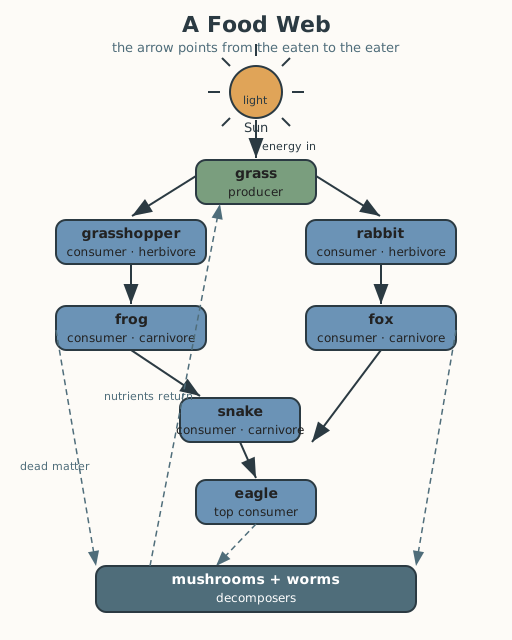
- Meet the pieces (10 min). Look at the diagram. Find the three kinds of organisms: producers (plants and algae — they make their own food using the Sun’s light), consumers (animals — they eat other living things), and decomposers (mushrooms, worms, and tiny living things — they break down dead matter and return nutrients to the soil). Point to one of each.
- The arrow rule (10 min). Trace one chain: Sun → grass → grasshopper → frog → snake → eagle. Notice the arrow always points from the eaten to the eater, because that is the direction the energy moves. Say it aloud for one link: “the energy flows from the grass to the grasshopper, so the arrow points at the grasshopper.” Many chains crossing together make a food web.
- Build your own web (20 min). On your blank page, place a producer, a few consumers, and a decomposer. Draw arrows between them. Then check every single arrow with a partner: does energy flow from the eaten to the eater? Fix any arrow that points the wrong way. Add a “nutrients return” arrow from the decomposer back to the producer.
- Close (5 min). Every arrow you drew is a story about where energy goes. The Sun starts it, plants catch it, animals pass it along, and decomposers send the matter back to begin again.
Differentiation
- Support: Provide a pre-drawn web with missing arrows; learners add only the arrowheads. Practice the arrow rule aloud on one chain first.
- Extension: Add a second chain that crosses the first (a true web) and explain what it means when one animal has arrows from two different foods.
Assessment
- Formative (observation): Does the learner point every arrow from eaten to eater, and name one producer, one consumer, and one decomposer?
- Self-check: The learner asks, “If I follow any arrow backwards, do I find where that energy came from?”
Home connection
At your next meal, trace one food on your plate back through its food web — the plant or animal, what it ate, and where the Sun comes in. Tell someone the story of your food.
Resources
- BBC Bitesize (KS2), “What is a food chain?” — producers, consumers, and how energy flows along a chain that joins into a web: https://www.bbc.co.uk/bitesize/topics/zcyycdm/articles/zww9r2p
- BBC Bitesize (KS2), “What is a microorganism?” — decomposers returning nutrients to the soil: https://www.bbc.co.uk/bitesize/topics/z6wwxnb/articles/zsgtrwx