Lesson 02 — What Happens When One Part of a Food Web Changes
Learners predict and model what happens when one part of a food web changes. They remove one organism from a web, trace the ripple in both directions, and practice separating what they predicted (an inference) from what their model shows (evidence).
Objectives
Objectives
- D06.S2.05.01 Explain how matter and energy move through a food web and what can happen when one part changes.
Essential question
What can happen to the rest of a food web when one part changes or disappears?
Key vocabulary
Materials
Standard materials
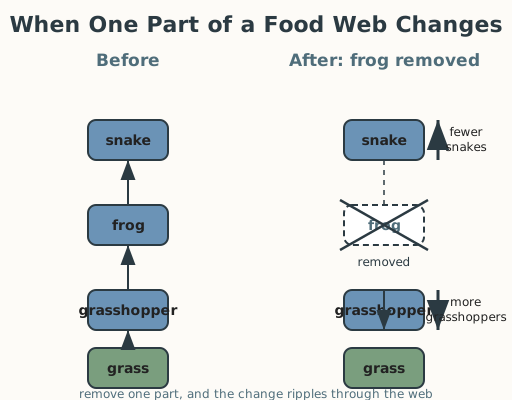
- Change-the-web diagram (before and after) · 1 per pair The two-panel graphic showing a chain before and after one part is removed
- Web cards from Lesson 1 (or rebuilt) · 1 set per pair The organism cards used to build a web
- Prediction-and-result recording page · 1 per learner Two columns for my prediction and what the model shows
Low-tech / no-cost
- Stones, string, and the Lesson 1 ground web Remove one "organism" (a stone) and trace which strings now hang loose; rebuild the web to see the ripple
- Voice and body Stand in the yarn web from Lesson 1, sit down when "your food disappears," and see who else must let go of the yarn
Enriched / lab & device
- A short video or article about a real ecosystem change · 1 per group For example, sea otters returning to a kelp forest, or wolves returning to a forest
- A digital food-web simulator · 1 per group To remove one species and watch populations change over several rounds
Works in different contexts
- large-group Remove one card from the class web and hold a class vote on the prediction before tracing the ripple together
- multi-age Younger learners predict "who loses food and who gets crowded"; older learners add numbers (up/down) and connect it to a real-world example
- self-directed A learner removes one card from their own web, writes a prediction, then checks it against the before/after diagram
- level-grouped Learners ready to extend remove a *producer* and a *top predator* in two separate trials and compare which ripple is bigger
- outdoor-only Use a real patch of ground, find a producer and its eaters, then imagine (and discuss) what would change if the producer were gone
Lesson 2 — What Happens When One Part of a Food Web Changes
Summary
Learners discover that a food web is connected, so a change in one part ripples through the rest. They remove one organism from a model web, predict what will happen to the other populations, then check the prediction against what the model shows — the same predict → test → observe loop that runs all science.
Objectives
- Explain how matter and energy move through a food web and what can happen when one part changes. (D06.S2.05.01)
Connection
When the frogs in a pond disappear, something else changes too: the insects they ate become very many, and the birds that ate the frogs go hungry. This is a ripple effect — one change moves through the whole web. It happens in the sea too: when sea otters returned to some kelp forests, the sea urchins they eat were kept in check, and the kelp grew back. One part changed, and everything around it answered.
Materials
- Change-the-web diagram (before and after)
- Web cards (from Lesson 1 or rebuilt)
- Prediction-and-result recording page
Preparation
- Print or draw the before/after diagram and a recording page for each learner.
- Have the Lesson 1 web cards ready to rebuild.
- Prepare one or two “what if” scenarios (remove the frog; remove the grass).
Facilitator note
Written to the learner (“you”). The key distinction this lesson practices is
prediction (inference) versus result (evidence): learners write what they think
will happen before they move a card, then compare it to what the model actually
shows. Insist on the prediction being written first — a correct guess is not the
point; the habit of predicting and checking is. Keep the ripple simple for Grade 5:
removing a predator lets its prey grow; removing a producer shrinks everything above
it. Avoid the word “balance” as if nature were a steady machine — webs shift, and
that is normal. The ethics lens (should we care for the living systems we depend on?)
is a value we hold, distinct from the evidence of how webs respond
(docs/facilitation.md).
Procedure
- Gather (5 min). Recall your web from Lesson 1. Ask: what do you think happens if one animal in the web disappears? Say your guess out loud — that is a prediction.
- Meet the change (10 min). Look at the before/after diagram. In the first panel, grass feeds the grasshopper, the grasshopper feeds the frog, and the frog feeds the snake. In the second panel, the frog is gone. What changed? The grasshoppers have one fewer eater (their numbers rise), and the snake has lost its food (its numbers fall). That is the ripple.
- Predict, then test (20 min). Rebuild your Lesson 1 web. Choose one organism to remove. First, write your prediction on the recording page: which populations will go up, which will go down, and why. Only then remove the card and trace the arrows. Compare: did the model match your prediction?
- Separate evidence from inference (10 min). For each change, sort the statements: evidence (what the model actually showed — “the snake has no food”) versus inference (what you reason — “so the snakes will become fewer”). Which is which, and how do you know?
- Close (5 min). A food web is a web because every thread is connected. Pull one, and the whole thing moves. Predicting first, then checking, is how scientists learn what those threads do.
Differentiation
- Support: Remove a single, obvious link (the frog) and provide a fill-in sentence frame: “If the frog disappears, then ___, because ___.”
- Extension: Remove a producer in a second trial and explain why the ripple is larger; then add one real-world example (a species returning or leaving) and trace it.
Assessment
- Formative (observation/peer): Can the learner predict a ripple before testing, and name at least one population that rises and one that falls?
- Self-check: The learner asks, “Did my prediction come from reasoning (an inference), and did I check it against what the model showed (evidence)?”
Home connection
Think of a small change in a place you know — a pond emptied, a field planted, a tree cut down. Predict what might change for the living things there, and tell someone your prediction and your reasoning.
Resources
- BBC Bitesize (KS2), “What is a food chain?” — how chains link into webs: https://www.bbc.co.uk/bitesize/topics/zcyycdm/articles/zww9r2p
- The sea-otter–urchin–kelp example is a well-documented ecological chain — a keystone-predator / trophic-cascade case (see National Geographic Education, “Role of Keystone Species in an Ecosystem”: https://education.nationalgeographic.org/resource/role-keystone-species-ecosystem/).