Lesson 04 — Traits Vary Within a Family
Learners explain that offspring of the same parents share family traits yet vary from one another — variation is normal and real within every family. They observe real variation in seeds or leaves and connect it to the idea that every living thing is a unique mix.
Objectives
Objectives
- D06.S2.05.02 Describe how traits pass from parents to offspring and how some traits vary within a family.
Essential question
Why do brothers and sisters in one family share traits, yet still differ from each other?
Key vocabulary
Materials
Standard materials
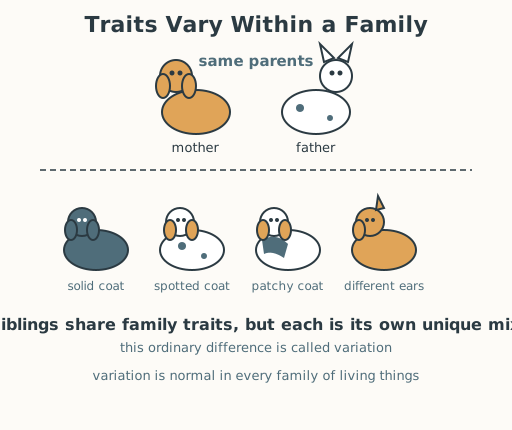
- Variation-in-a-family diagram · 1 per pair The graphic showing one set of parents and several different offspring
- A handful of seeds or beans of one kind · 1 set per pair Real seeds from one pod or packet, to sort and find small differences
- Variation observation page · 1 per learner A page with a table for each trait and how the siblings differ
Low-tech / no-cost
- Real found seeds, stones, or leaves of one kind Gather ten leaves from one tree or ten seeds of one plant and find how each differs slightly
- Voice and body Learners line up as "siblings" and each show one shared family trait and one trait of their own; no paper needed
Enriched / lab & device
- A photo set of one litter or one crop variety · 1 set per group To observe real variation within a single family or variety
- A simple simulation or sorting app showing offspring variation · 1 per group To see how traits shuffle within a family over generations
Works in different contexts
- large-group Show the diagram large and chart the class's own shared-and-different traits (respecting that sharing is optional) before pairs sort seeds
- multi-age Younger learners sort by one obvious trait; older learners list several traits and discuss why variation matters for survival
- self-directed A learner sorts seeds or leaves, records two ways the siblings are alike and two ways they differ, and writes a one-sentence explanation
- level-grouped Learners ready to extend connect variation to the next idea — that some differences help an organism survive — without needing the word evolution
- outdoor-only Collect ten leaves from one tree or plant and sort them; find the small differences between "siblings" from the same parent
Lesson 4 — Traits Vary Within a Family
Summary
Learners explain variation: offspring of the same parents share family traits but are not identical — each is a unique mix. They observe real variation (in seeds, leaves, or a litter) and connect it to the value that difference is ordinary and worthy of respect, in living things and in people.
Objectives
- Describe how traits pass from parents to offspring and how some traits vary within a family. (D06.S2.05.02)
Connection
Open a pod of beans or a handful of rice and look closely: the seeds all come from the same parent kind, and they all look alike in the big ways — yet each one is a little different in size, shade, or shape. The same is true of a litter of puppies, a clutch of chicks, and a human family. Brothers and sisters share a family, and still each one is their own. That ordinary difference is called variation, and it appears in every family of living things on Earth.
Materials
- Variation-in-a-family diagram
- A handful of seeds or beans of one kind
- Variation observation page
Preparation
- Print or draw the variation diagram and a table page per learner.
- Gather a handful of seeds, beans, or leaves of one kind per pair.
- Have the Lesson 3 diagram ready to recall how traits pass.
Facilitator note
Written to the learner (“you”). This lesson lands two ideas at once: variation is
real and normal (evidence), and every individual deserves respect regardless of
its traits (a value we hold). Keep those separate and say so. The scientific claim —
offspring of the same parents vary because each receives a different mix of the
parents’ instructions — is sound at this level; the fuller mechanism (genes shuffling
and combining) is Grade 8. Be careful with human comparisons: use seeds, leaves, and
animals for the evidence, and let learners share their own family traits only if they
choose. This is the “vary within a family” half of the standard; it sets up Grade 7’s
work on variation and natural selection (docs/facilitation.md).
Procedure
- Gather (5 min). Recall Lesson 3: traits pass from parents to offspring. Now ask: do two brothers and sisters in one family look exactly alike? Why do you think they differ? That difference is variation.
- Meet the diagram (10 min). Look at the family. All the puppies have the same parents — so they share the family’s general shape. But look again: one has a solid coat, one a spotted coat, one a patchy coat, and one has slightly different ears. Same family, different mixes. That is variation.
- Observe real variation (15 min). Take your handful of seeds or beans (all of one kind). Sort them, then record on your table two ways they are alike and two ways they differ. Are any two exactly the same? Talk with a partner: how do you know they all belong to the same kind even though they differ?
- Why it matters (10 min). Variation is not a mistake — it is normal. Because offspring differ, some may cope a little better when conditions change (a colder year, a drier season). That is an inference from what we observe, not something we can watch happen in one afternoon. Discuss: what is the difference between “these seeds differ” (evidence) and “some differences may help them survive” (inference)?
- Close (5 min). Every family — of beans, of puppies, of people — holds both sameness and difference. The sameness is inheritance; the difference is variation. Both are ordinary, and both deserve respect.
Differentiation
- Support: Sort seeds by one trait only (size), and use the sentence frame “They are alike because ___, and different because ___.”
- Extension: Measure one trait (length of seeds) and make a simple ordered line to show the range of variation, then predict how that range could help in a change of conditions.
Assessment
- Formative (observation/peer): Can the learner name one way siblings in a family are alike and one way they differ, and explain that variation is normal?
- Self-check: The learner asks, “Can I tell the difference between ‘these differ’ (evidence) and ‘differences may help survival’ (inference)?”
Home connection
Look at a family you know — people, pets, or plants — and name one trait the family shares and one way the members differ. Ask an adult whether they think the differences matter, and why.
Resources
- Encyclopaedia Britannica, “Heredity” — including how offspring vary within a family: https://www.britannica.com/science/heredity-genetics
- Variation within families is standard elementary life science; see the National Science Teaching Association’s “Next Generation Science Standards” life-science progression (heredity and variation of traits): https://www.nsta.org/