Lesson 03 — Traits Pass from Parents to Offspring
Learners explain how traits pass from parents to offspring: offspring receive the instructions for their traits from both parents, so they resemble their parents while still being their own unique living thing. They match offspring to parents and gather evidence from the living world around them.
Objectives
Objectives
- D06.S2.05.02 Describe how traits pass from parents to offspring and how some traits vary within a family.
Essential question
How do traits pass from parents to offspring?
Key vocabulary
Materials
Standard materials
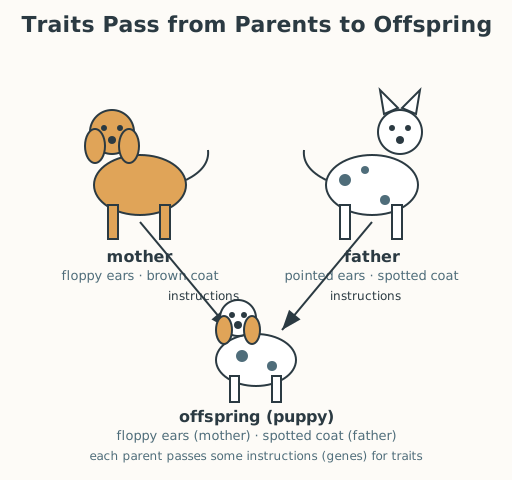
- Traits-from-parents diagram · 1 per pair The graphic showing two parents and an offspring, with arrows for the traits each parent passes on
- Family trait cards (plant and animal examples) · 1 set per pair Cards showing a parent pair and several offspring to match by inherited traits
- My traits page · 1 per learner A page to list a trait they share with a family member and guess where it came from
Low-tech / no-cost
- Real seeds or seedlings of one kind A handful of bean, maize, or rice seeds from one variety, to observe that offspring look like their parent kind
- Voice and body Learners act out "passing a trait" by miming a parent trait and having an offspring copy it; no paper needed
Enriched / lab & device
- A short video of a plant or animal family over generations · 1 per group For example, a crop variety or a family of animals showing resemblance across generations
- A set of plant or animal photos across generations · 1 set per group To compare parent and offspring traits and pick out which are inherited
Works in different contexts
- large-group Use one large diagram up front and have the whole group call out which trait came from which parent before pairs work
- multi-age Younger learners match "this offspring looks like this parent" by picture; older learners name the trait and explain inheritance
- self-directed A learner studies the diagram, matches offspring to parents on the cards, and writes one trait they share with a family member
- level-grouped Learners ready to extend discuss why offspring resemble but are not identical to their parents, setting up the next lesson
- outdoor-only Find a parent plant and its nearby young (or seeds) and list the traits the young share with the parent
Lesson 3 — Traits Pass from Parents to Offspring
Summary
Learners explain inheritance: how traits (features like coat color, ear shape, kernel color, or leaf shape) pass from parents to offspring through instructions carried in the parents’ cells. They match offspring to their parents and gather evidence that offspring resemble their parents — in every culture and ecosystem on Earth.
Objectives
- Describe how traits pass from parents to offspring. (D06.S2.05.02)
Connection
A litter of puppies looks like their parents, and a field of maize grows plants that look like the maize that came before. This has been noticed by people everywhere for thousands of years: rice farmers across Asia, maize growers in the Americas, and cattle herders across Africa and the Middle East all selected seeds and animals with traits they valued, because they knew those traits would pass to the young. Today you learn the how behind what every farmer and herder already knew.
Materials
- Traits-from-parents diagram
- Family trait cards
- My traits page
Preparation
- Print or draw the traits-from-parents diagram and copy a trait page per learner.
- Prepare family trait cards (a parent pair + several offspring to match).
- Have real seeds or seedlings on hand if available.
Facilitator note
Written to the learner (“you”). The idea to land is that offspring receive the
instructions for their traits from both parents — so they resemble their parents,
yet are not copies. The child-friendly word is “instructions”; the scientific name is
genes, and Grade 8 will open that box fully. Keep it faithful and simple: a trait
passes from a parent to an offspring through the parent’s cells, not through the
parent “teaching” it or the offspring “wanting” it. The claim that offspring resemble
their parents is evidence gathered over millennia; the claim that we ought to
respect every living thing regardless of its traits is a value — name that
distinction if it comes up (docs/facilitation.md).
Avoid comparing humans in ways that rank or shame; use plants and animals for the
worked examples, and let learners share their own family traits only if they wish.
Procedure
- Gather (5 min). Think of an animal or plant family you have seen — a litter, a nest, a garden. What do the young share with their parents? What you just named are traits.
- Meet the diagram (10 min). Look at the parents. The mother has floppy ears and a brown coat; the father has pointed ears and a spotted coat. The puppy has floppy ears (from the mother) and a spotted coat (from the father). Each parent passed some instructions for traits to the offspring. The scientific name for those instructions is genes.
- How do we know? (10 min). People did not need microscopes to notice this: for thousands of years, farmers and herders chose seeds and animals with useful traits and saw those traits appear again in the next generation. That repeated pattern is evidence. Ask: what is the difference between “offspring resemble their parents” (evidence we can see) and “so traits are carried in instructions” (an inference we make to explain it)?
- Match offspring to parents (15 min). With a partner, look at the family trait cards. Match each offspring to its parent pair, and name at least one trait each offspring inherited. Check your match: could this offspring have come from the other parents? Why or why not?
- Close (5 min). Every living thing you have ever seen got its traits the same way — instructions passed from two parents. Resemblance is not magic; it is inheritance, and it happens in a rice paddy, a coral reef, a savanna, and in you.
Differentiation
- Support: Use two very different parent pictures and one obvious trait; provide a sentence frame: “The puppy got its ___ from its ___.”
- Extension: List three traits in one organism and decide, with a partner, which likely came from each parent, then explain why resemblance is evidence of inheritance.
Assessment
- Formative (observation): Can the learner name one trait an offspring inherited from each parent, and explain that instructions (genes) carry the trait?
- Self-check: The learner asks, “Can I point to one trait in an offspring and say which parent it came from?”
Home connection
Look at a family of plants or animals near you — or a photo of your own family. Name one trait the young share with a parent, and one way each is still their own.
Resources
- Encyclopaedia Britannica, “Heredity” — how traits pass from parents to offspring (an age-appropriate overview): https://www.britannica.com/science/heredity-genetics
- The cross-cultural practice of selecting plants and animals with valued traits is a documented part of agricultural history worldwide (see FAO’s work on crop genetic resources: https://www.fao.org/cgrfa/en/).