Lesson 06 — Gravity: A Force That Acts at a Distance
Learners describe gravity as a force that pulls at a distance: Earth pulls every object toward its center, no touching needed. They predict and test how objects fall, explain why the Moon orbits without falling into us, and separate the evidence they can see from the invisible force they infer.
Objectives
Objectives
- D06.S3.05.02 Describe gravity and magnetism as forces that act at a distance.
Essential question
How can gravity pull on something it is not even touching?
Key vocabulary
Materials
Standard materials
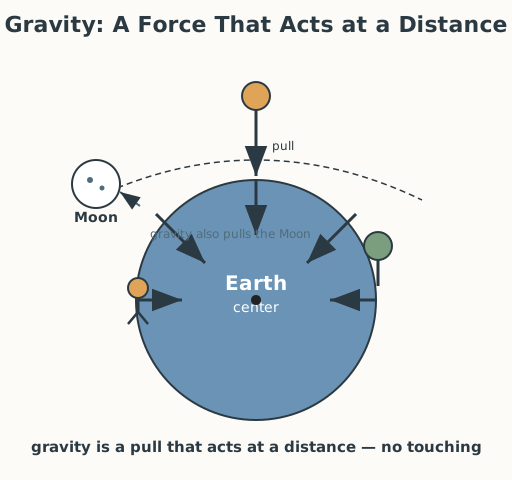
- Gravity diagram · 1 per pair The graphic showing Earth's pull toward its center and the Moon orbiting at a distance
- Two different small objects to drop · 1 set per pair A stone and a leaf (or a ball and a feather) to predict and test how they fall
- Gravity prediction page · 1 per learner A page with columns for my prediction and what I observed
Low-tech / no-cost
- Any two objects and a clear space Drop a stone and a leaf (or a seed and a feather) and watch; no printed page needed
- Voice and body Jump in place and feel gravity pull you back down; talk through "what pulled me down without touching me?"
Enriched / lab & device
- A short video of astronauts on the Moon · 1 per group To see the weaker pull of a smaller world and how gravity still acts there
- A spring scale or simple balance · 1 per group To measure that more massive objects are pulled more strongly (weight)
Works in different contexts
- large-group Do the drop test as one shared demonstration, collecting the whole group's predictions before each drop
- multi-age Younger learners describe "things fall down"; older learners explain that gravity is a pull toward Earth's center and weaker with distance
- self-directed A learner drops two objects, records predictions and observations, and writes why the leaf fell differently (air) while gravity pulled on both
- level-grouped Learners ready to extend test "heavier falls faster" by dropping a heavy and a light compact object, and explain the result
- outdoor-only Drop stones, seeds, and leaves from a height outdoors and observe; discuss why "down" is the same direction everywhere
Lesson 6 — Gravity: A Force That Acts at a Distance
Summary
Learners describe gravity as a force that acts at a distance: Earth pulls every object toward its center without touching it. They predict and test how objects fall, discover that air — not gravity — is why a leaf falls slowly, and explain how gravity reaches the Moon across empty space to hold it in orbit.
Objectives
- Describe gravity as a force that acts at a distance. (D06.S3.05.02)
Connection
Drop a stone anywhere on Earth — in a market in Lagos, a field in the Andes, a village in the Himalayas — and it falls the same way: down. “Down” means toward Earth’s center, which is why people on opposite sides of the planet both stand firmly on the ground instead of sliding off. The Moon never falls on us, yet it stays near us, pulled the whole time. Something invisible is at work. That something is gravity.
Materials
- Gravity diagram
- Two different small objects to drop (a stone and a leaf, or a ball and a feather)
- Gravity prediction page
Preparation
- Print or draw the gravity diagram and a prediction page per learner.
- Have clear floor space and two objects per pair to drop.
- Recall Grade 3: a push or pull is a force that changes motion.
Facilitator note
Written to the learner (“you”). Two ideas to land: (1) gravity is a pull toward
Earth’s center that acts at a distance — no contact; (2) the drop test separates
gravity (pulls on everything) from air resistance (why a leaf falls slowly).
The worked example here is the classic one: predict “heavier falls faster,” then
drop a heavy and a light compact object (same air effect) and observe they hit
together — the habit of predicting before testing is the point. Gravity being
stronger for more massive objects is a Grade 7 topic; keep it simple now: everything
is pulled, and the pull is toward the center, and it reaches across space. The claim
that gravity pulls on all objects is evidence-based science; the idea that “down” is
the same direction for every human being can also seed a gentle global/egalitarian
reflection — but keep that as a value, not a science claim
(docs/facilitation.md).
Procedure
- Gather (5 min). Jump in place. What pulled you back down? Nothing touched you. Write your first guess: that guess is a prediction about an invisible force.
- Meet gravity (10 min). Look at the diagram. Gravity is a force — a pull — that acts between any two objects at a distance, without touching. Earth pulls every object toward its center. That is why “down” points to the center everywhere on Earth, and why the Moon, far away in space, is still pulled into an orbit around us.
- Predict, then test (15 min). On your page, write your prediction: which falls faster, a stone or a leaf — and why? Now drop both from the same height and observe. What did you see? The stone and the leaf are both pulled by gravity; the leaf falls slowly because air pushes back on it more. Now drop two compact objects of different mass (a big stone and a small stone) — predict first. What happened?
- Evidence and inference (10 min). You can see things fall (evidence). You cannot see gravity itself — you infer it from what falls, from the Moon orbiting, from the tides. Sort these: “the stone fell” (evidence); “an invisible pull made it fall” (inference); “the Moon is pulled by Earth” (inference from orbit). Which is which?
- Close (5 min). Gravity is the reason your feet stay on the ground, rain falls, and the Moon keeps circling. It pulls on everything, everywhere, all the time — and it never needs to touch.
Differentiation
- Support: Do the drop test together and provide a two-box record (predict | saw). Focus on “down = toward Earth’s center” with the diagram.
- Extension: Explain why astronauts on the Moon can jump much higher (the Moon is smaller, so its pull is weaker), and predict what gravity would feel like on a much larger planet.
Assessment
- Formative (observation): Can the learner state that gravity pulls toward Earth’s center at a distance, and explain the leaf result using air (not gravity)?
- Self-check: The learner asks, “Can I name one thing I saw (evidence) and one thing I inferred (gravity)?”
Home connection
Drop two small, compact objects of different weights from the same height (outside, with permission). Predict first, then watch. Tell someone what happened and what it shows about gravity.
Resources
- NASA Space Place, “What is gravity?” — an age-appropriate explanation of gravity as a force that pulls and acts at a distance: https://spaceplace.nasa.gov/what-is-gravity/en/