Lesson 07 — Magnetism: A Force That Acts at a Distance
Learners describe magnetism as a force that acts at a distance: like poles repel, unlike poles attract, and a magnet can pull a metal object across a gap without touching. They test attract and repel, and connect magnetism to the compass that has guided travelers for centuries.
Objectives
Objectives
- D06.S3.05.02 Describe gravity and magnetism as forces that act at a distance.
Essential question
How can a magnet push or pull on something it is not even touching?
Key vocabulary
Materials
Standard materials
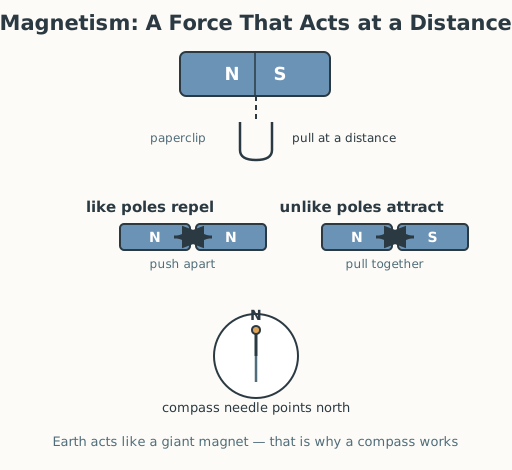
- Magnetism diagram · 1 per pair The graphic showing attract, repel, and a magnet pulling a paperclip across a gap
- Two bar (or any) magnets and a paperclip or small nail · 1 set per pair To feel push and pull and test "acts through air and paper"
- Magnet prediction page · 1 per learner A page to record predictions and results for attract and repel
Low-tech / no-cost
- Any two magnets and small metal objects Test what a magnet pulls without touching; if no magnet, a magnetized needle floated on a leaf in water can act as a compass
- Voice and body Learners hold out their palms and "push" or "pull" across a gap to feel the idea of a force at a distance; no magnet needed
Enriched / lab & device
- Iron filings in a sealed clear sleeve and a magnet · 1 per group To reveal the invisible field pattern around a magnet
- A small compass and a world map or globe · 1 per group To connect the magnet's poles to Earth's magnetic field and navigation
Works in different contexts
- large-group Demonstrate attract and repel up front with two strong magnets, then have pairs test and record; collect predictions before each test
- multi-age Younger learners sort "push" and "pull"; older learners explain poles, attract/repel, and how a compass works
- self-directed A learner tests two magnets end to end, records which ends attract and repel, and checks against the diagram
- level-grouped Learners ready to extend map the field with iron filings and explain why the force weakens with distance
- outdoor-only Test whether a magnet still pulls a paperclip through a leaf or a thin piece of wood, and discuss the compass as a tool used by travelers
Lesson 7 — Magnetism: A Force That Acts at a Distance
Summary
Learners describe magnetism as a force that acts at a distance: a magnet can push or pull another magnet or a metal object across empty space, with no touching. They test attract and repel, meet the two poles, and connect the magnet to the compass — a tool that has guided sailors, travelers, and traders across the world for centuries.
Objectives
- Describe magnetism as a force that acts at a distance. (D06.S3.05.02)
Connection
A magnet stuck to a metal door or a fridge holds on without glue and without touching anything but the door. Put two magnets near each other and one may leap to the other — or twist away before they meet. And for hundreds of years, a small magnetized needle floating in water has told travelers which way is north, from the Arabian sea routes to the Pacific voyages. All of this is one thing: magnetism, a force that works across a distance.
Materials
- Magnetism diagram
- Two magnets and a paperclip or small nail
- Magnet prediction page
Preparation
- Print or draw the magnetism diagram and a prediction page per learner.
- Give each pair two magnets and a paperclip or small nail.
- Recall Lesson 6: gravity was a force at a distance; today’s force is magnetism.
Facilitator note
Written to the learner (“you”). Two ideas to land: (1) magnetism acts at a
distance — through air, and even through paper, wood, or water; (2) like poles
repel, unlike poles attract. This is a hands-on predict-and-test lesson: learners
write a prediction before each test (attract? repel?) and then check. Safety note:
keep magnets away from phones, cards with magnetic strips, and medical devices, and
never swallow small magnets. The compass is a natural global/technology tie-in: it
was developed and used by many cultures (the magnetic needle appears in Chinese,
Arab, and European navigation histories), and Earth itself behaves like a giant
magnet. The claim that magnets attract and repel is evidence; the claim that tools
like the compass should be available to everyone is a value — separate them
(docs/facilitation.md).
Procedure
- Gather (5 min). Hold a paperclip near a magnet — but not touching. What happens? Write your prediction first: will it move?
- Meet the magnet (10 min). Look at the diagram. A magnet has two ends, called poles — north (N) and south (S). Like poles repel (push apart); unlike poles attract (pull together). And a magnet can pull a metal object across a gap, through air — even through paper — without touching. That is a force acting at a distance.
- Predict, then test (15 min). On your page, write predictions for each pair of ends: N–N, S–S, N–S. Then bring the ends near each other, not touching, and record what you feel and see. Did any result surprise you? Now place a sheet of paper between the magnet and the paperclip — does the pull still work?
- Evidence and inference (10 min). You can see the paperclip jump and feel the push (evidence). You cannot see the magnetic force itself — you infer it from the jump. Which is which? How is this like what you learned about gravity in Lesson 6?
- Close (5 min). A compass works because Earth itself behaves like a giant magnet, pulling a small needle to point north. Magnetism is a force that reaches across empty space — the same kind of “acts at a distance” as gravity, but with push and pull, two poles, and a long history of helping people find their way.
Differentiation
- Support: Test only N–S (attract) first with a visual record; feel the push and pull with hands before naming poles.
- Extension: Map the field with iron filings in a sealed sleeve and predict where the force is strongest; then explain why a compass needle points north.
Assessment
- Formative (observation/peer): Can the learner predict attract vs. repel, and state that magnetism acts at a distance through air or paper?
- Self-check: The learner asks, “Did I predict before each test, and can I name which poles attract and which repel?”
Home connection
With permission, test a fridge magnet or any magnet on different things at home — metal, wood, paper, cloth. Predict which it will pull before you test, and tell someone what you found.
Resources
- BBC Bitesize (KS2, NI), “What is a force?” and magnetism (an age-appropriate overview of pushes/pulls and magnets): https://www.bbc.co.uk/bitesize/topics/zvr3nrd
- BBC Bitesize (KS2, NI), “What is a magnet?” — how magnets attract and repel, their two poles, and how a freely moving magnet (a compass needle) points north: https://www.bbc.co.uk/bitesize/articles/zpvcrdm