Lesson 10 — Slow and Fast Changes to Earth's Surface
Learners synthesize the unit: Earth's surface is changed by slow processes (weathering, erosion, deposition, rivers, glaciers) and fast ones (earthquakes, eruptions, landslides), and most earthquakes and volcanoes happen where plates meet. They model both speeds of change, revisit the unit's big ideas, and separate what we can watch from what we must infer.
Objectives
Objectives
- D06.S4.05.02 Explain how Earth's surface is changed by slow and fast processes, and where earthquakes and volcanoes occur.
- D06.S2.05.01 Explain how matter and energy move through a food web and what can happen when one part changes.
- D06.S3.05.01 Explain that matter is made of particles too small to see and use this idea to explain changes of state.
Essential question
How is Earth's surface changed by slow and fast processes, and where do earthquakes and volcanoes happen?
Key vocabulary
Materials
Standard materials
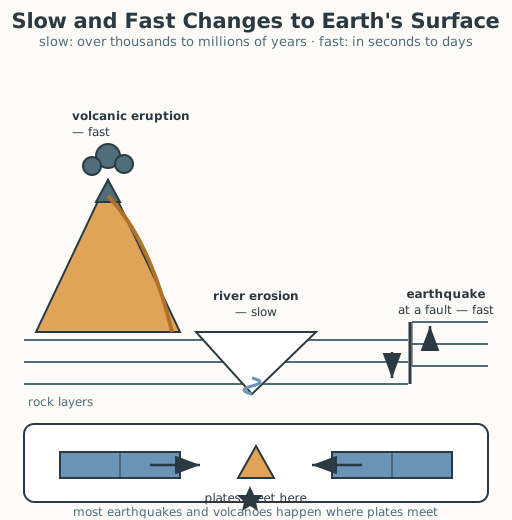
- Earth's-surface diagram · 1 per pair The graphic showing slow processes (river, glacier) and fast processes (volcano, fault), with a plate-boundary inset
- A tray of damp sand or soil and a cup of water · 1 set per group To model slow erosion and a sudden change
- Unit reflection page · 1 per learner A page to record one slow process, one fast process, and a "how do we know" sentence
Low-tech / no-cost
- Damp soil, a slope, and water Pour water slowly to make gullies (slow), then collapse a sand pile suddenly (fast); no printed page needed
- Voice and body Learners act out slow changes (sagging, creeping) and fast changes (a sudden jump), then point to real landforms they know
Enriched / lab & device
- A world map or globe with plate boundaries marked · 1 per group To locate the Ring of Fire and match earthquakes and volcanoes to plate edges
- A short video of an eruption, an earthquake simulation, or a time-lapse of erosion · 1 per group To compare fast and slow changes in real time
Works in different contexts
- large-group Build one big sand model at the front and have the group predict what the water will do before pouring, then point out fast vs. slow on the map
- multi-age Younger learners sort changes into "slow" and "fast"; older learners explain why earthquakes and volcanoes cluster at plate boundaries
- self-directed A learner studies the diagram, models erosion with sand and water, and writes one slow process, one fast process, and where most earthquakes occur
- level-grouped Learners ready to extend research one real landform (a canyon, a volcano, a mountain range) and explain whether slow or fast processes built it
- outdoor-only Find a real slope, gully, or rock face and identify signs of slow change; discuss what a sudden earthquake would do to the same spot
Lesson 10 — Slow and Fast Changes to Earth’s Surface
Summary
Learners bring the unit together around one last question: how does Earth’s surface change? They learn that slow processes — weathering, erosion, and deposition by rivers, glaciers, wind, and waves — shape the land over long times, while fast processes — earthquakes, eruptions, and landslides — change it suddenly. They discover that most earthquakes and volcanoes happen where plates meet, and they revisit the whole unit’s through-line: predict, test, observe, and separate evidence from inference.
Objectives
- Explain how Earth’s surface is changed by slow and fast processes, and where earthquakes and volcanoes occur. (D06.S4.05.02)
- Revisit how matter and energy move through a food web (D06.S2.05.01) and how matter is made of particles (D06.S3.05.01) to connect Earth’s changing surface to the living and physical systems of this unit.
Connection
The land under your feet looks still, but it is always changing. A river carves a valley so slowly you cannot see it move — yet over thousands of years it digs a canyon, like the Blue Nile gorge or the Yangtze’s gorges. An earthquake or a volcanic eruption, by contrast, changes the ground in seconds — as people in Chile, Japan, Indonesia, and Iceland know well. Both speeds shape the places we live, farm, and build. Today you learn to read the land’s story in both its slow and its sudden chapters.
Materials
- Earth’s-surface diagram
- A tray of damp sand or soil and a cup of water
- Unit reflection page
Preparation
- Print or draw the Earth’s-surface diagram and a reflection page per learner.
- Prepare a sand tray and water cup per group (or a safe outdoor slope).
- Have the unit’s earlier diagrams handy for the recall at the start.
Facilitator note
Written to the learner (“you”). This capstone has two jobs: teach the last standard
(slow vs. fast surface change, and the plate-boundary pattern), and close the unit’s
through-line (predict → test → observe → separate evidence from inference). Two key
distinctions: slow vs. fast (time scale), and evidence vs. inference (we can
watch a flood or a sand model erode; we infer that a canyon took very long
because we cannot watch it form). The plate idea is introduced lightly: Earth’s
surface is broken into large plates that move slowly, and most earthquakes and
volcanoes happen where plates meet — the “Ring of Fire” around the Pacific is the
clearest example, but plate boundaries circle the whole Earth. The ethics lens:
knowing where earthquakes and volcanoes happen helps people choose safer places to
build and prepare — a real, hopeful use of science. Keep heavy disaster content
gentle and connect it to agency (docs/facilitation.md).
Procedure
- Gather and recall (5 min). Quick review of the unit: what moves through a food web? (matter and energy — Lesson 1). What is everything made of? (particles — Lesson 5). What two forces act at a distance? (gravity and magnetism — Lessons 6–7). Today’s question is the last one: how does the land itself change?
- Meet slow and fast (10 min). Look at the diagram. Slow processes — water, wind, and ice weather and erode rock and carry it away, building valleys and canyons over thousands to millions of years. Fast processes — earthquakes, eruptions, and landslides — change the surface in seconds to days. A volcano erupts fast; a river carves slow. Both are real, and both shape the land.
- Model it (15 min). In a tray of damp sand, tilt it into a slope. Predict: what will a slow pour of water do? Pour slowly and watch it cut small gullies — that is erosion (slow). Now make a sudden change: drop a handful of sand or collapse a pile — that is a fast change. Record what you saw.
- Where earthquakes and volcanoes happen (10 min). Earth’s surface is broken into huge plates that move very slowly. Most earthquakes and volcanoes happen where plates meet — like the Ring of Fire around the Pacific, home to volcanoes in Indonesia, Japan, and the Andes and to many strong earthquakes. Find a plate boundary on the diagram.
- Separate evidence from inference (10 min). Sort these: “water cut gullies in the sand” (evidence — we saw it); “a canyon took millions of years to form” (inference — we reason it from the shape); “we should build carefully near faults” (a value — a choice about what is right). Which is which?
- Close (5 min). The land is a slow story with sudden moments, and science is the habit of reading both: predict, test, observe, and know the difference between what you see and what you infer. That habit now belongs to you — in a kitchen, a field, a mountain, or under the stars.
Differentiation
- Support: Sort picture cards into “slow” and “fast” first; use the sand model with a partner and a two-word record (slow | fast).
- Extension: Choose one landform (a canyon, a volcano, a mountain range) and explain, with reasons, whether slow or fast processes — or both — built it.
Assessment
- Summative (portfolio): The unit reflection page, showing one slow process, one fast process, a plate-boundary location for earthquakes/volcanoes, and a “how do we know” sentence that separates evidence from inference.
- Observation: Can the learner explain both speeds of change and state that most earthquakes and volcanoes occur where plates meet?
Home connection
Find a place near home where the land shows change — a gully, a cracked wall, a riverbank, a hill. Tell someone whether you think it was made by a slow process or a fast one, and what evidence you used.
Resources
- National Geographic Education, “Erosion” and “Plate Tectonics” — slow surface change and where earthquakes and volcanoes occur: https://education.nationalgeographic.org/resource/erosion/ and https://education.nationalgeographic.org/resource/plate-tectonics/
- BBC Bitesize (Scotland), “Coastlines: erosion” — how water wears away the land: https://www.bbc.co.uk/bitesize/articles/z7rwdp3