Lesson 09 — Eclipses: When Shadows Meet
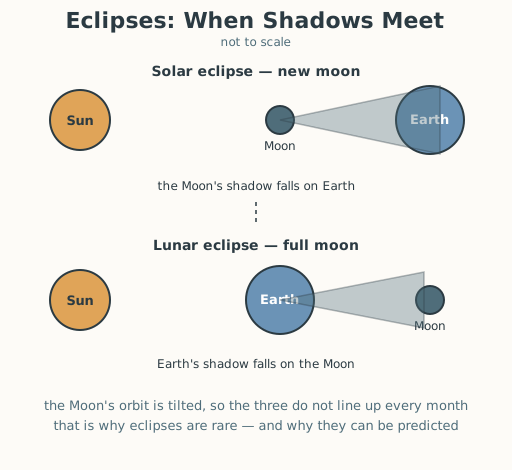
Learners explain the two eclipses as shadow events in the Earth–Moon–Sun system: a solar eclipse happens when the Moon's shadow falls on Earth (at new moon), and a lunar eclipse when Earth's shadow falls on the Moon (at full moon). They model both, connect them to the phases, and learn why eclipses are rare and safe to watch only in special ways.
Objectives
Objectives
- D06.S4.05.01 Describe the Earth, Moon, and Sun system and explain day length, moon phases, and eclipses.
Essential question
What makes a solar eclipse and a lunar eclipse, and why are they rare where we live?
Key vocabulary
Materials
Standard materials
- Eclipse diagram · 1 per pair The graphic showing solar and lunar eclipse geometry
- A lamp (Sun), a small ball (Moon), and a larger ball (Earth) · 1 set per group To cast the two kinds of shadows and see who falls in each
- Eclipse prediction page · 1 per learner A page to record predictions for the solar and lunar cases
Low-tech / no-cost
- The Sun, a small stone (Moon), and your own head (Earth) Outdoors, hold the stone up between the Sun and your eye to model a solar eclipse's tiny shadow
- Voice and body Three learners stand in a row (Sun, Moon, Earth) and cast "shadows" with their arms to act out each eclipse; no objects needed
Enriched / lab & device
- A short eclipse video or animation · 1 per group To watch the shadow move across the Earth or the Moon over minutes
- A safe eclipse viewer or a pinhole projector plan · 1 per group To model how we safely watch the Sun without looking at it directly
Works in different contexts
- large-group Model both eclipses up front with three learners, then have the group vote on which shadow falls where before pairs test with the lamp
- multi-age Younger learners act out "who is in the shadow"; older learners explain the new-moon and full-moon requirement and why eclipses are rare
- self-directed A learner studies the diagram and, with a lamp and balls if available, casts both shadows and records which one is the solar and which the lunar
- level-grouped Learners ready to extend explain the tilted orbit and why we do not get an eclipse every new and full moon
- outdoor-only Model the solar eclipse with the real Sun — hold a small stone up between the Sun and your eye and observe the tiny shadow; but never look at the Sun directly
Lesson 9 — Eclipses: When Shadows Meet
Summary
Learners explain eclipses as moments when one world’s shadow falls on another: a solar eclipse happens at new moon, when the Moon passes between the Sun and Earth and its shadow falls on a small spot of Earth; a lunar eclipse happens at full moon, when Earth’s shadow falls on the Moon. They model both and learn why eclipses are rare and how to watch safely.
Objectives
- Describe the Earth, Moon, and Sun system, and explain eclipses. (D06.S4.05.01)
Connection
An eclipse is one of the most astonishing sights in the sky: the Sun seems to vanish in the middle of the day, or the full Moon turns a deep red. People have recorded eclipses for thousands of years, across China, West Asia, Mesoamerica, and Europe — and because the pattern repeats, they could predict them long before telescopes existed. Today you learn the simple geometry behind the wonder: it is all shadows.
Materials
- Eclipse diagram
- A lamp (Sun), a small ball (Moon), a larger ball (Earth)
- Eclipse prediction page
Preparation
- Print or draw the eclipse diagram and a prediction page per learner.
- Set up a lamp and two balls per group (or use the real Sun outdoors).
- Recall Lesson 8: the Moon’s phases, and that phases are not Earth’s shadow.
Facilitator note
Written to the learner (“you”). Two ideas to land: (1) a solar eclipse = the
Moon’s shadow falls on Earth (only at new moon); a lunar eclipse = Earth’s
shadow falls on the Moon (only at full moon). (2) This corrects the common
misconception from Lesson 8 — only an eclipse is a shadow event; ordinary phases
are not. The ball-and-lamp model is the worked example: shine the lamp, and have
learners find the one position where the small ball’s shadow falls on the big ball
(solar) and the one where the big ball’s shadow falls on the small ball (lunar).
Why rare: the Moon’s orbit is slightly tilted, so the three do not line up perfectly
every month — most months the shadow misses. Safety is essential: never look
directly at the Sun, even during a solar eclipse; use a pinhole projector or proper
solar viewer. Treat cultural records of eclipses with respect — they are real
historical evidence of careful observation, not “superstition”
(docs/facilitation.md).
Procedure
- Gather (5 min). Have you seen a shadow today? Now imagine a shadow big enough to cover a whole world. That is an eclipse. Write your guess: what has to line up?
- Meet the two eclipses (10 min). Look at the diagram. In a solar eclipse, the Moon moves exactly between the Sun and Earth, and the Moon’s shadow falls on a small spot of Earth — people there see the Sun blocked. This happens at new moon. In a lunar eclipse, Earth moves between the Sun and the Moon, and Earth’s shadow falls on the Moon — the full Moon turns dark, sometimes reddish. This happens at full moon.
- Model it (15 min). With a lamp (Sun) and two balls, find the positions. First, predict: where must the small ball (Moon) be for its shadow to fall on the big ball (Earth)? Test it. Then predict the reverse: where must the big ball (Earth) be for its shadow to fall on the small ball (Moon)? Test it. Record both on your page.
- Why rare? (5 min). The Moon’s orbit is slightly tilted, so the three bodies do not line up perfectly every month. That is why we do not get an eclipse at every new and full moon — and why a solar eclipse is a rare event for any one place.
- Safety and close (5 min). Never look straight at the Sun, even during a solar eclipse — it can hurt your eyes. People watch safely with a pinhole projector or special viewer. Remember: an eclipse is just a shadow — predictable, natural, and safe when you know how to look.
Differentiation
- Support: Focus on one eclipse (solar) with the lamp model and a two-box record (predict | saw); use the diagram with labels.
- Extension: Explain the tilted orbit and predict, for a given month, why some new and full moons pass with no eclipse; sketch the umbra (the darkest part of a shadow).
Assessment
- Formative (observation): Can the learner model both eclipses with the lamp and state which moon phase each requires (new moon for solar, full moon for lunar)?
- Self-check: The learner asks, “Can I say whose shadow falls on whom in each eclipse, and why we do not have one every month?”
Home connection
Look at shadows at home — a hand shadow, a tree’s shadow. Tell someone how a solar eclipse is the Moon’s shadow on Earth and a lunar eclipse is Earth’s shadow on the Moon. Remember: never look at the Sun directly.
Resources
- NASA Space Place, “Lunar Eclipses and Solar Eclipses” (age-appropriate solar and lunar eclipse explanation): https://spaceplace.nasa.gov/eclipses/en/
- NASA, “Eclipses” — the geometry and predictability of solar and lunar eclipses: https://science.nasa.gov/eclipses/