Lesson 02 — Complete My Planned Artwork
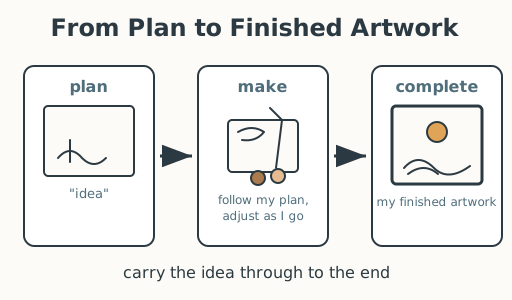
Learners carry last lesson's plan through to a finished artwork. They re-read their plan, gather materials, make with a long hands-on block, pause at a midpoint checklist to check they are still following their idea, then finish, title, and reflect. The lesson lands the second half of the standard: not just planning but *completing* an artwork with a clear idea.
Objectives
Objectives
- D07.S1.05.01 Plan and complete an artwork with a clear idea, choosing materials and techniques to fit the idea.
Essential question
How do I carry my plan through to a finished artwork?
Key vocabulary
Materials
Standard materials
- Learner's 'My Art Plan' page from Lesson 1 · 1 per learner The plan each learner wrote last lesson
- Art materials · per plan Whatever each learner's plan calls for — paper, paint, chalk, collage, found objects
- In-progress checklist · 1 per learner A small card with the check questions — did I keep my idea, are my materials doing what I planned, is anything missing, am I almost done
Low-tech / no-cost
- Paper, found objects, and natural materials Complete the artwork with what is at hand — paper, cloth, leaves, stones, clay, charcoal
- Voice and a partner Talk through the checklist aloud with a partner if writing is hard; no checklist card needed
Enriched / lab & device
- A camera or tablet · 1 per group To photograph the work at midpoint and finished, so learners can compare plan, progress, and result
- A class 'gallery wall' · 1 A space to display finished artworks with their one-line idea label
Works in different contexts
- large-group Run the making block in timed sections (setup, midpoint check, finish), circulating to keep learners moving through the plan
- multi-age Older learners pair with younger ones, reading the plan aloud and helping gather materials; both complete their own work
- self-directed A learner follows their own plan, pauses at the midpoint checklist, and finishes, then photographs or describes the result
- level-grouped Learners ready to extend write a two-sentence reflection comparing the finished work to the original plan and one change they made
- outdoor-only Complete a natural-materials artwork (leaf mosaic, sand drawing, stone pattern), following the plan and adjusting to what nature provides
Lesson 2 — Complete My Planned Artwork
Summary
Learners carry last lesson’s plan through to a finished artwork. They re-read their plan, gather materials, make during a long hands-on block, pause at a midpoint checklist to check they are still following their idea, then finish, title, and reflect. This lesson lands the second half of the standard: not just planning but completing an artwork with a clear idea.
Objectives
- Complete the artwork planned last lesson, carrying a clear idea through to a finished piece. (D07.S1.05.01)
Connection
Many starts are easy; finishing is the skill. A seed must be tended before it fruits. A cake must be baked after it is mixed. A story must reach its ending after its first page. Finishing asks you to keep the idea in your mind, adjust when something doesn’t work, and keep going until the work is whole. Today you do that: you turn the plan you wrote into something you can hold up and say “I made this.”
Materials
- Learner’s “My Art Plan” page from Lesson 1
- Art materials (per plan)
- In-progress checklist
Preparation
- Have each learner’s Lesson 1 plan ready to hand back.
- Lay out the art materials plans call for; keep a “found objects” box for unplanned needs.
- Post the in-progress checklist where all can see it.
Facilitator note
This lesson is written to the learner (“you”). The idea to land is follow-through:
completion is part of craft, not an afterthought. Keep the block mostly making — your
job is to keep learners moving and unblock them, not to direct every stroke. The midpoint
checklist is the key structure: it is a self-check that turns “am I done?” into “have I
kept my idea and am I almost there?” Honor every finish, however modest; a completed
artwork is a real achievement, never to be ranked against another’s. Some learners will
finish at very different times — have an extension ready (add a border, a title card, a
second smaller piece). See docs/facilitation.md on mastery and
docs/development.md on the grade-5 need for independence with adult safety nearby.
Procedure
- Gather (5 min). Last lesson you wrote a plan. Today you keep your promise to yourself and complete the artwork. Read your plan once, slowly. What is your idea? What materials and technique did you choose?
- Set up (5 min). Gather your materials. Lay them out so everything you need is within reach. If your plan needs something you didn’t list, you may swap one material — but keep the idea the same.
- Make (25 min). Work on your artwork. Follow your plan, but let your hands make small discoveries. If a material isn’t working, adjust the technique, not the idea. Work with care, as if this piece will be seen by people you respect.
- Midpoint check (5 min). Pause. Read the checklist: Did I keep my idea? Are my materials doing what I planned? Is anything missing? Am I almost done? Answer honestly, then return to work knowing what to do next.
- Finish and title (10 min). Complete the last parts — a background, a detail, a clean edge. Give your artwork a title that fits the idea. Write the title on a small card or on the back.
- Share and reflect (5 min). Hold up your work. Say your idea in one sentence and one choice you are proud of. Listen as others do the same. A finished artwork is worth a moment of honor.
Differentiation
- Support: Provide a pre-cut or simplified version of a tricky step; partner the learner with someone who can read the plan aloud; accept a smaller finished piece.
- Extension: Write a two-sentence reflection comparing the finished work to the plan and naming one change you made along the way and why.
Assessment
- Portfolio (observation/self): Is there a finished artwork that matches the stated idea, with materials and technique chosen to fit it? Does the learner’s reflection name the idea and at least one choice?
- Self-check: The learner asks, “Did I complete my artwork, did it keep my idea, and can I name one material or technique choice that helped?”
Home connection
Finish something at home that you started and left unfinished — a drawing, a model, a chore — and notice how it feels to complete it.
Resources
- For a classroom-friendly framing of finishing and reflecting on one’s own work, see The Metropolitan Museum of Art’s “MetKids” prompts for making and talking about art: https://www.metmuseum.org/art/online-features/metkids/