Lesson 01 — Fuel and Build: Carbohydrates, Proteins, and Fats
Learners meet the three nutrients that fuel and build the body: carbohydrates (fuel), proteins (build and repair), and fats (store energy and build cells). They sort everyday foods from many regions into the three jobs and connect each nutrient to what it does for the body. This opens the unit on how nutrients support different body parts.
Objectives
Objectives
- D03.S3.05.01 Explain how nutrients such as carbohydrates, proteins, fats, vitamins, minerals, and water support different parts of the body.
Essential question
How do carbohydrates, proteins, and fats give my body fuel and building blocks?
Key vocabulary
Materials
Standard materials
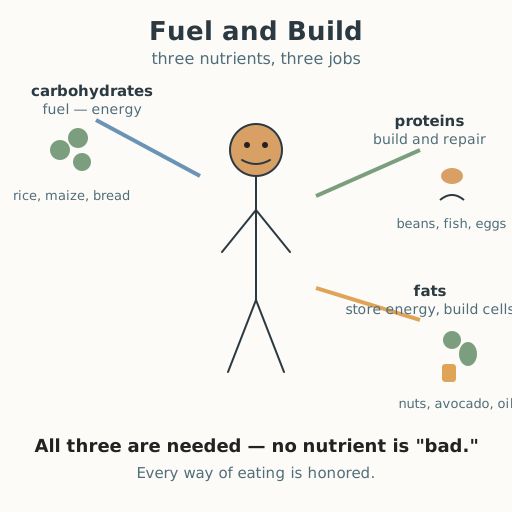
- Fuel and build poster · 1 A poster showing a body with three labeled arrows — carbohydrates give fuel (energy), proteins build and repair, fats store energy and build cells — with everyday food examples for each
- Nutrient sort page · 1 per learner A page with three columns (fuel, build, store/build) and a list of everyday foods to place
- Pencils · per learner
Low-tech / no-cost
- Chalk or sand circles Draw three circles on the ground — fuel, build, store — and place found food items or drawn cards into each; no page needed
- Voice sort Call out a food and learners move to a labeled corner (fuel, build, store) or call out the answer; bodies and voices only
Enriched / lab & device
- Food packages or labels · a small set Real or printed labels from several regions (rice, maize, beans, fish, nuts, oil) for learners to read and sort by nutrient
- A short nutrition animation · 1 A simple video showing how carbohydrates are broken down for energy and proteins for building, to reinforce the abstract idea
Works in different contexts
- large-group Introduce the three nutrients with the poster, then sort foods as a whole class on the board before learners complete the page in pairs
- multi-age Younger learners point to a food and say "fuel" or "build" while older learners name the nutrient and its job and lead the sort
- self-directed A learner reads the poster, sorts foods on their own page, and writes one sentence naming a fuel food and a build food and what each does
- level-grouped Learners ready to extend explain that a single food can give more than one nutrient (beans give protein and some carbohydrate) and name one example
- outdoor-only Sort real or drawn foods into three marked ground circles, then name the nutrient each circle stands for
Lesson 1 — Fuel and Build: Carbohydrates, Proteins, and Fats
Summary
Learners meet the three nutrients that fuel and build the body: carbohydrates (give fuel for energy), proteins (build and repair muscle, skin, and blood), and fats (store energy, build cells, and protect organs). They sort everyday foods from many regions into these three jobs and connect each nutrient to what it does. Every way of eating is honored; no food or body is judged.
Objectives
- Explain how nutrients such as carbohydrates, proteins, and fats support different parts of the body. (D03.S3.05.01)
Connection
Think of a cook fire and a builder. A cook fire needs fuel — wood or charcoal — to burn and make heat. A builder needs bricks to raise a wall. Your body needs both, every day. Carbohydrates are the body’s main fuel: they break down into energy that lets you run, think, and breathe. Proteins are the building blocks: they build and repair your muscles, skin, hair, and blood. Fats do a third job: they store energy for later, help build your brain and every cell, and cushion your organs. Whether your plate holds rice, cassava, or bread; beans, fish, or eggs; nuts, avocado, or oil — the same three nutrients are at work.
Materials
- Fuel and build poster
- Nutrient sort page
- Pencils
Preparation
- Print or draw the fuel and build poster (a body with three labeled arrows: carbohydrates → fuel, proteins → build, fats → store and build).
- Copy a nutrient sort page for each learner.
- Recall Grade 4: learners read simple nutrition labels and described how families eat different healthy foods; today they name the nutrients themselves.
Facilitator note
This lesson is written to the learner (“you”). The idea to land is that different nutrients
do different jobs, not that any food or body is “good” or “bad.” Carbohydrates, proteins, and
fats are all needed; there is no “bad” nutrient. Use food examples from many regions and ways
of eating — rice, maize, cassava, plantain, bread, beans, lentils, chickpeas, tofu, fish, eggs,
milk, nuts, seeds, avocado, olive and palm and coconut oils — so no learner’s home food is left
out or made to seem wrong. Sort by job, never by “healthy vs unhealthy.” Model the poster
once (a worked example) before independent sorting. See docs/facilitation.md and
docs/contexts.md.
Procedure
- Gather (5 min). Remember Grade 4, when you read nutrition labels and saw that families everywhere eat different healthy foods. Today you learn what is inside those foods: nutrients — the parts of food that fuel and build your body.
- Meet the three nutrients (10 min). Look at the poster. Here are the three big ones. Carbohydrates give fuel: your body breaks them into energy, like wood burning on a fire — for your legs, your arms, and your thinking brain. Proteins build and repair: they are the bricks for your muscles, skin, hair, and blood — like bricks for a wall. Fats store energy and build cells: they keep a spare supply of fuel, help build your brain and every cell, and cushion your organs. Three nutrients, three jobs.
- Sort together (10 min). Say a food out loud and name its main job. Rice, maize, bread, cassava, plantain — mostly fuel. Beans, lentils, fish, eggs, tofu, chickpeas, milk — mostly build. Nuts, seeds, avocado, oils — mostly store and build. Notice: many foods give more than one nutrient. Beans give build and a little fuel. That is normal and good.
- Sort on your page (15 min). On your page, place each food into its column — fuel, build, or store and build. Then write one sentence: name one fuel food and one build food and say what each does for your body.
- Close (5 min). Every day your body burns fuel, builds new parts, and stores a little for later — and the nutrients in your food make it all happen. Next time: the helpers that protect and regulate your body.
Differentiation
- Support: Provide a picture-word bank of the foods and pre-drawn columns; scribe the closing sentence.
- Extension: Explain that one food can give several nutrients at once — give an example (beans, fish, or an egg) and name two nutrients it provides.
Assessment
- Formative (observation): Can the learner name a fuel nutrient, a build nutrient, and a store-and-build nutrient, and give one food for each with its job?
- Self-check: The learner reads their sentence back and checks that each nutrient is matched to its real job (fuel, build, or store).
Home connection
At your next meal, name one food that gives fuel and one that gives building blocks — and share the three jobs with someone at home.
Resources
- Carbohydrates are the body’s main energy source, proteins build and repair tissues, and fats store energy, build cell membranes, and aid brain and cell function — this is established nutrition science. See the World Health Organization “Healthy diet” fact sheet (https://www.who.int/news-room/fact-sheets/detail/healthy-diet) and the Food and Agriculture Organization’s food-based dietary guidelines for how cultures worldwide build meals from these nutrients (https://www.fao.org/nutrition/education/food-dietary-guidelines/en/). These are evidence about what nutrients do — never a judgment about any body or way of eating.