Lesson 02 — Protect and Regulate: Vitamins, Minerals, and Water
Learners meet the nutrients that protect and regulate the body: vitamins (a shield that protects and helps healing), minerals (calcium that builds bones, iron that carries oxygen), and water (the river that carries everything and keeps the body cool). They match foods from many regions to these jobs and record what each nutrient does.
Objectives
Objectives
- D03.S3.05.01 Explain how nutrients such as carbohydrates, proteins, fats, vitamins, minerals, and water support different parts of the body.
Essential question
How do vitamins, minerals, and water protect and regulate my body?
Key vocabulary
Materials
Standard materials
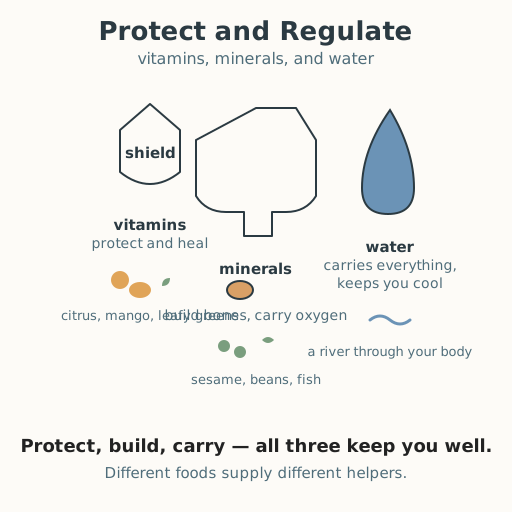
- Protect and regulate poster · 1 A poster showing vitamins as a shield (protect against sickness and help healing), minerals as a strong bone and a blood cell (build bones and carry oxygen), and water as a river carrying everything through the body
- Protect–build–carry page · 1 per learner A three-part page where learners record one vitamin, one mineral, and water with what each does
- Pencils and crayons · per learner
Low-tech / no-cost
- Act it out Three learners act as shield (vitamins), brick-layer (minerals), and river (water) moving among the group; no page needed
- Found-object roles A leaf or fruit as a vitamin, a small stone as a mineral, and a cup of water — hold each up and name its job
Enriched / lab & device
- A water-and-body diagram · 1 A chart showing that water is about 60% of a child's body and carries nutrients and waste, to make the abstract concrete
- Food pictures from many regions · a small set Photos of vitamin- and mineral-rich foods — leafy greens, citrus, mango, guava, sesame, beans, fish — to sort by the nutrient they are rich in
Works in different contexts
- large-group Act out the three roles as a whole class (shield, brick-layer, river), then have pairs complete the page and share one example each
- multi-age Younger learners match a food to a job (protect, build, carry) while older learners name the specific nutrient (vitamin C, iron, calcium) and what it does
- self-directed A learner reads the poster, completes the page, and writes one sentence each for a vitamin, a mineral, and water naming its job
- level-grouped Learners ready to extend name a specific vitamin (A, C, D) or mineral (calcium, iron, iodine) and the body part it supports
- outdoor-only Find or recall a local fruit, leaf, or seed and a water source, and name the vitamin, mineral, or water job each supplies
Lesson 2 — Protect and Regulate: Vitamins, Minerals, and Water
Summary
Learners meet the nutrients that protect and regulate the body: vitamins (a shield that protects against sickness and helps healing), minerals (calcium that builds bones and teeth, iron that carries oxygen in the blood), and water (the river that carries everything and keeps the body cool). They match foods from many regions to these jobs and record what each nutrient does.
Objectives
- Explain how nutrients such as vitamins, minerals, and water support different parts of the body. (D03.S3.05.01)
Connection
A village has more than builders and cooks — it has guards who protect it, repair workers who keep the walls and roads strong, and a river that carries water everywhere it is needed. Your body works the same way. Vitamins are the guards: they protect you from sickness and help cuts and scrapes heal. Minerals are the repair workers: calcium keeps your bones and teeth strong, and iron carries oxygen through your blood so your whole body can breathe. Water is the river: it carries nutrients to every cell, washes away waste, and keeps you cool when you sweat. From the mango and leafy greens to the sesame and beans to the cup of water — these are your body’s protectors and regulators.
Materials
- Protect and regulate poster
- Protect–build–carry page
- Pencils and crayons
Preparation
- Print or draw the protect and regulate poster (shield for vitamins, bone and blood cell for minerals, river/water drop for water).
- Copy a protect–build–carry page for each learner.
- Recall Lesson 1: carbohydrates fuel, proteins build, fats store and build — today’s nutrients protect and regulate.
Facilitator note
This lesson is written to the learner (“you”). The idea to land is that vitamins protect,
minerals build and regulate, and water carries — three more jobs, all needed. Keep it concrete
with a shield, a builder, and a river. Use food examples from many regions (citrus, guava, mango,
leafy greens, tomatoes, sesame, beans, lentils, fish, dairy or its plant alternatives) and honor
every way of eating. Water is available differently in different places; frame access to clean
water as a shared fairness issue, never a family’s failing. See docs/facilitation.md.
Procedure
- Gather (5 min). Last time you met the nutrients that fuel and build your body. Today, the nutrients that protect and regulate it: vitamins, minerals, and water.
- Meet the three helpers (10 min). Look at the poster. Vitamins are a shield: they protect you from sickness and help wounds heal — vitamin C in citrus and guava, vitamin A in mango, sweet potato, and dark leafy greens. Minerals build and regulate: calcium builds strong bones and teeth (in leafy greens, sesame, dairy, and fortified foods), and iron carries oxygen in your blood (in beans, lentils, and fish). Water is the river: your body is more than half water, and water carries nutrients in, waste out, and keeps you cool.
- Act the jobs (10 min). In a group, act out the three jobs. One of you is a shield (arms up, guarding), one is a builder (stacking motions for bones), one is a river (flowing arms, carrying). Say each job aloud: protect, build, carry.
- Record on your page (15 min). Draw or write one vitamin and what it protects, one mineral and what it builds or carries, and water and what it does. Use real foods you eat or know.
- Close (5 min). Fuel and build (Lesson 1), protect and regulate (today) — now you know all six nutrients and the jobs they do. Next time: what happens when the body gets too little of one of them, over time.
Differentiation
- Support: Provide a picture bank of foods and sentence starters (“Vitamin C helps my body ___”), and scribe as needed.
- Extension: Name a specific vitamin (A, C, D) or mineral (calcium, iron, iodine) and the exact body part it supports, and one food rich in it.
Assessment
- Formative (observation): Can the learner name one vitamin, one mineral, and water, and say what each does (protect, build/regulate, carry)?
- Self-check: The learner checks that their page matches each nutrient to its real job and uses at least one real food.
Home connection
Find one fruit or leafy green, one bean or seed, and a glass of water at home, and tell someone what each does for the body.
Resources
- Vitamins and minerals each have specific jobs — vitamin A for vision and immunity, vitamin C for healing, calcium for bones, iron for carrying oxygen — and water makes up a large share of the body and carries nutrients and waste. See the World Health Organization’s micronutrient fact sheets (https://www.who.int/health-topics/micronutrients) and its guidance on water as essential to health. These describe what nutrients do — never a judgment about any body or way of eating.