Lesson 04 — Too Much Over Time: Inside the Body, Never Judged
Learners discover what "too much over time" means for the inside of the body — too much added sugar, salt, or saturated fat, in a repeated pattern — while holding one central rule: this is about the inside of the body and its systems, never about a body's size or shape. They sort statements into "inside the body" and "never the point," and practice saying what is true without judging any body.
Objectives
Objectives
- D03.S3.05.02 Describe how having too little or too much of certain foods affects the body over time, without judging any body.
Essential question
How can having too much of some foods affect the inside of the body over time — without judging any body?
Key vocabulary
Materials
Standard materials
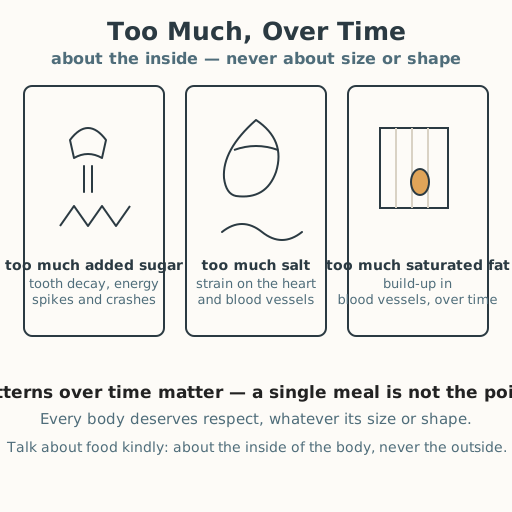
- Inside, never judged poster · 1 A poster with three panels showing what too much over time does inside the body — too much added sugar (tooth decay and energy spikes and crashes), too much salt (strain on the heart and blood vessels), too much saturated fat (build-up in blood vessels) — each labeled "about the inside of the body, never about size or shape"
- Inside or outside page · 1 per learner A page where learners sort statements into "about the inside of the body" and "about size or shape (never the point)," and write one true sentence about too much over time
- Pencils · per learner
Low-tech / no-cost
- Inside-the-body discussion Talk through the three effects aloud and sort spoken statements as "inside the body" or "never the point (size/shape)"; no page needed
- Water-glass and salt demo Stir a pinch of salt into water and talk about how a little changes taste but a lot, day after day, asks more of the body — a hands-on picture, no page needed
Enriched / lab & device
- Nutrition labels from many regions · a small set Labels showing added sugar, salt, and fat amounts so learners practice reading what is "a lot over time" on real packages
- A short video on how the body uses sugar and salt · 1 A child-friendly animation on blood sugar and the heart's response to salt over time, kept calm and factual
Works in different contexts
- large-group Sort statements as a whole class on the board ("inside the body" vs "never the point"), then learners complete the page in pairs and share one true sentence
- multi-age Younger learners sort simple statements while older learners explain the "inside, over time" mechanism and model non-judgmental language
- self-directed A learner reads the poster, completes the page, and writes one true sentence about too much over time that names an inside-the-body effect, never size or shape
- level-grouped Learners ready to extend explain why "over time" and "a pattern" matter more than any single meal, and why bodies of all sizes deserve respect
- outdoor-only Use the salt-and-water picture and a spoken sort to hold the same idea with no paper, emphasizing inside-the-body effects only
Lesson 4 — Too Much Over Time: Inside the Body, Never Judged
Summary
Learners discover what “too much, over time” means for the inside of the body — too much added sugar, salt, or saturated fat in a repeated pattern — while holding one central rule: this is about the body’s inside systems, never about a body’s size or shape. They sort statements into “inside the body” and “never the point,” and practice saying what is true without judging any body or any way of eating.
Objectives
- Describe how having too much of certain foods affects the body over time, without judging any body. (D03.S3.05.02)
Connection
Stir a pinch of salt into a cup of water and it tastes a little salty — the body can handle that. Stir in spoonful after spoonful, day after day, and you are asking a lot of the body. That is what “too much, over time” means: not one treat or one salty meal, but a pattern kept up for months and years. Too much added sugar, over time, can rot teeth and send your energy spiking up and crashing down. Too much salt, over time, can strain the heart and blood vessels. Too much saturated fat, over time, can build up inside blood vessels. Notice every one of these is about the inside of the body — never about how a body looks. Bodies come in every size and shape, and every one of them deserves respect.
Materials
- Inside, never judged poster
- Inside or outside page
- Pencils
Preparation
- Print or draw the inside-never-judged poster (three inside-the-body panels: added sugar → teeth and energy; salt → heart and vessels; saturated fat → vessel build-up).
- Copy an inside-or-outside page for each learner.
- Recall Lesson 3 (too little, over time); today is the other side — too much, over time.
Facilitator note
This lesson is written to the learner (“you”). The idea to land is “too much, over time”
affects the inside of the body — and this must never be used to judge a body’s size or shape.
This is the lesson’s moral heart, and it is non-negotiable. Never link food to weight, shape, or
attractiveness; never shame any body or any family’s food culture. Keep the language strictly
about systems: teeth, blood sugar, heart, blood vessels. A “treat” or a salty meal is fine
in a varied pattern; the concern is only a repeated excess over time. Affirm that bodies of all
sizes are healthy and worthy. Model the worked example once, then guide the sort. See
docs/facilitation.md and the unit’s “without judging any body” commitment.
Procedure
- Gather (5 min). Last time you saw what too little of a nutrient does over time. Today, the other side: what can too much of some things do, over time — and one big rule to carry the whole way.
- Meet the big rule (5 min). Here is the rule, said out loud and written down: this is about the inside of the body, never about size or shape. Bodies come in every size and shape, and every one deserves respect. Say it back to a partner.
- Meet the three effects (10 min). Look at the poster. Too much added sugar, over time: it can rot teeth and send energy spiking up and crashing down. Too much salt, over time: it can strain the heart and blood vessels. Too much saturated fat, over time: it can build up inside blood vessels. All three are inside effects. None of them is about how a body looks.
- Sort (15 min). On your page, sort each statement into “about the inside of the body” or “about size or shape — never the point.” “Too much salt can strain the heart” → inside. “This food makes a body look wrong” → never the point; cross it out. Then write one true sentence about too much over time that names an inside effect only.
- Close (5 min). You can talk about food and the body honestly and kindly. Too much, over time, has real effects — on the inside. And every body, at every size, is worthy of care and respect. Next time, we leave food for a while and learn to be safe: what to do in an emergency.
Differentiation
- Support: Provide a two-column sort with pictures and sentence starters; scribe the closing sentence.
- Extension: Explain why a pattern over time matters more than any single meal, and write one way to talk about food without ever mentioning a body’s size or shape.
Assessment
- Formative (observation): Can the learner describe one inside-the-body effect of too much added sugar, salt, or saturated fat over time — using only inside-the-body language, never size or shape?
- Self-check: The learner re-reads their sentence and checks that it names an inside effect and says nothing about how any body looks.
Home connection
With someone at home, name one thing that is fine sometimes but hard on the inside of the body when there is too much, over time — and say it the kind way, about the inside only.
Resources
- Repeatedly consuming too much added sugar is linked to tooth decay and, over time, to spikes and crashes in energy; too much salt (sodium) over time can raise blood pressure and strain the heart; and too much saturated fat over time is linked to build-up in blood vessels. See the World Health Organization “Healthy diet” fact sheet (https://www.who.int/news-room/fact-sheets/detail/healthy-diet), which advises limiting free sugars, salt, and saturated fat — as evidence about the body’s systems, never as a judgment about any body’s size or shape.