Lesson 03 — Too Little Over Time: What the Body Needs
Learners discover what happens when the body gets too little of some nutrients over time: too little iron brings tiredness, too little calcium and vitamin D weakens bones, and too little water brings thirst and headache. The lesson is framed as what every body needs — never as shame — and connects each shortage to foods that supply what is missing, with dignity for food insecurity as a fairness issue, not a person's fault.
Objectives
Objectives
- D03.S3.05.02 Describe how having too little or too much of certain foods affects the body over time, without judging any body.
Essential question
What happens to the body when it gets too little of some nutrients, over time?
Key vocabulary
Materials
Standard materials
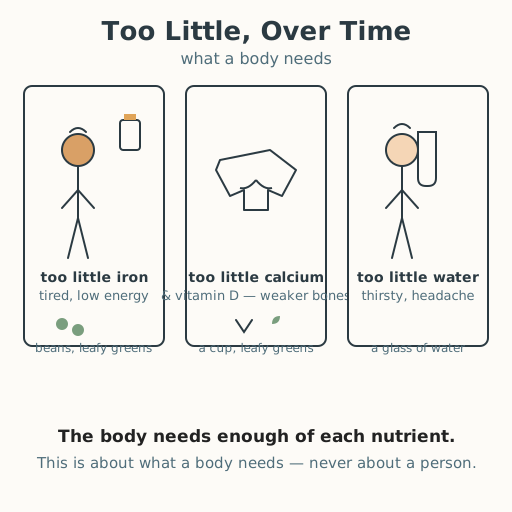
- Too little over time poster · 1 A poster with three panels — too little iron over time (tiredness, low energy), too little calcium and vitamin D over time (weak bones), too little water (headache, dry mouth) — each framed as what the body needs, never as shame
- What the body needs page · 1 per learner A three-question page (what happens with too little iron, too little calcium/vitamin D, and too little water over time), with room to write or draw
- Pencils · per learner
Low-tech / no-cost
- A wilting-plant comparison Show a well-watered plant and a wilted one — too little water over time weakens it, just as too little of a nutrient weakens a body; no page needed
- Three-signal role play Act out three body signals — a tired slump (iron), a soft-bone wobble (calcium), a thirsty tongue (water) — and name what is missing
Enriched / lab & device
- Nutrient-source cards · a small set Cards pairing a missing nutrient with foods that supply it (iron → beans, leafy greens; calcium → sesame, dairy or fortified foods; water → a cup) to connect problem to remedy
- A simple anemia or hydration fact chart · 1 A child-friendly chart on how common iron deficiency and dehydration are worldwide, to ground the lesson in real evidence
Works in different contexts
- large-group Present the three panels together, then have learners complete the page in pairs and share one "the body needs ___ so ___" sentence each
- multi-age Younger learners match a signal (tired, thirsty) to what is missing while older learners name the nutrient and the effect over time and lead the discussion
- self-directed A learner reads the poster, completes the page, and writes one sentence about what too little of one nutrient does over time and one food that supplies it
- level-grouped Learners ready to extend explain the difference between one missed meal and a nutrient shortage over weeks or months, and why "over time" matters
- outdoor-only Compare a healthy plant and a wilted one, name what the wilted one is missing, and connect it to what a body needs over time
Lesson 3 — Too Little Over Time: What the Body Needs
Summary
Learners discover what happens when the body gets too little of some nutrients over time: too little iron brings tiredness and low energy, too little calcium and vitamin D weakens bones, and too little water brings thirst and headache. The lesson is framed as what every body needs — never as shame — and connects each shortage to foods that supply what is missing, honoring the fact that some families have less because of unfair systems, not because of anything a person did.
Objectives
- Describe how having too little of certain foods affects the body over time, without judging any body. (D03.S3.05.02)
Connection
Water a plant too little, day after day, and it wilts — not because the plant is “bad,” but because it is missing something it needs. Your body is like that. Go too long with too little of a needed nutrient — over days, weeks, or months, not just one meal — and the body signals that something is missing. Too little iron and you feel tired and low on energy, because your blood has less of what carries oxygen. Too little calcium and vitamin D and your bones grow weaker. Too little water and you feel thirsty, with a dry mouth and sometimes a headache. None of this is about a person being “wrong” — it is simply what a body needs, the way a plant needs water.
Materials
- Too little over time poster
- What the body needs page
- Pencils
Preparation
- Print or draw the too-little-over-time poster (three panels: iron → tiredness, calcium and vitamin D → weak bones, water → thirst and headache).
- Copy a what-the-body-needs page for each learner.
- Recall Lessons 1–2: the six nutrients and their jobs; today is about what happens when there is too little of one, over time.
Facilitator note
This lesson is written to the learner (“you”). The idea to land is that a body needs enough
of each nutrient, and too little over time has real effects — described with care, never
shame. Keep the tone warm and factual. Be sensitive: some learners experience hunger or food
shortage. Always frame a shortage of food or nutrients as a fairness and systems issue
(food not being available or affordable where a family lives), never as a child’s or family’s
fault. Do not link any nutrient shortage to body size or shape. Connect every shortage to
agency — foods that supply what is missing — and to hope. See docs/facilitation.md on holding
difficulty with hope.
Procedure
- Gather (5 min). You now know the six nutrients and their jobs. Today’s question: what happens when the body gets too little of one of them, over time?
- Meet the three signals (10 min). Look at the poster. Too little iron, over time: your blood carries less oxygen, so you feel tired and low on energy. Too little calcium and vitamin D, over time: your bones grow weaker and can bend or break more easily. Too little water: you feel thirsty, your mouth is dry, and your head may ache. Notice the words: this is about what a body needs, never about a person being “wrong.”
- Think together (10 min). Why might a body get too little of a nutrient? Sometimes a person just needs to drink more water. Sometimes food that supplies a nutrient — beans and leafy greens for iron, milk or leafy greens and sesame for calcium — is hard to get or too costly where a family lives. That is a fairness problem in how food is shared, not anyone’s fault. What foods around you supply iron, calcium, and water?
- Record (15 min). On your page, answer: what happens with too little iron, too little calcium and vitamin D, and too little water, over time — and name one food or drink that supplies each. Write or draw.
- Close (5 min). A body sends signals when it is missing something — tired, weak, thirsty. Listening to those signals, and having enough of what the body needs, is a right every person deserves. Next time: the other side — too much of some things, over time.
Differentiation
- Support: Provide sentence starters (“Too little iron makes me feel ___. A food with iron is ___.”) and a picture bank; scribe as needed.
- Extension: Explain the difference between one missed meal and a nutrient shortage over weeks or months, and why the phrase “over time” matters.
Assessment
- Formative (observation): Can the learner describe one effect of too little iron, too little calcium/vitamin D, and too little water over time, and name a food that supplies each — without judging any body?
- Self-check: The learner checks that their page names the effect and the missing nutrient and a food remedy, and that no body is described with shame.
Home connection
Ask at home about foods that are easy or hard to get where you live, and share one nutrient a body needs enough of and a food that supplies it.
Resources
- Too little iron over time leads to iron-deficiency anaemia, whose main symptom is fatigue; too little calcium and vitamin D over time weakens bones; and too little water causes dehydration (thirst, headache, dry mouth). See the World Health Organization’s fact sheet on anaemia (https://www.who.int/news-room/fact-sheets/detail/anaemia) and its nutrition and hydration guidance. Food shortages are best understood as a food security issue — the UN Food and Agriculture Organization documents unequal access to food worldwide (https://www.fao.org/) — a fairness problem, not any person’s fault.