Lesson 06 — People on the Move: Tracing a Migration
Learners trace a real migration — the settlement of the Pacific by Polynesian voyagers over about three thousand years — and learn to separate push reasons (why people leave) from pull reasons (why they choose a new place). Using a route map and a push–pull chart, they record the movement and produce this unit's migration note, seeing migration as a story of skill, courage, and hope, not of conquest.
Objectives
Objectives
- D08.S3.05.01 Trace the migration of a specific people and explain the push and pull reasons for their movement.
Essential question
Why do people move — and what pushes them from home and pulls them to a new place?
Key vocabulary
Materials
Standard materials
- Migration route map · 1 A map of the Pacific showing the gradual settlement of islands by Polynesian voyagers over about three thousand years, with arrows of movement
- Push–pull chart · 1 per learner A two-column chart (push | pull) for recording the reasons a people left and the reasons they chose a new place
- Migration note page · 1 per learner A page for the unit portfolio where the learner traces one people's movement and names push and pull reasons
- Pencils · per learner
Low-tech / no-cost
- A spoken journey The facilitator tells the voyaging story aloud; learners retell the route and name one push and one pull; no map needed
- A stepping route Mark "islands" with stones or chalk and have learners step from one to the next, saying a push or pull reason at each stop
Enriched / lab & device
- A Pacific wall map with string · 1 A map where learners stretch yarn from island to island to trace the settlement route and label push and pull reasons
- A short film or recorded telling of Hōkūleʻa · 1 A respectful clip (if available) about the 1976 Hōkūleʻa voyage that re-created the ancient way, discussed with the same push–pull prompts
Works in different contexts
- large-group Trace the route together on a big map, calling out push and pull reasons, then have pairs complete their own charts
- multi-age Younger learners act out the stepping route while older learners write the push and pull reasons and explain the difference
- self-directed A learner reads the voyaging story, fills the push–pull chart, and writes the migration note for the portfolio
- level-grouped Learners ready to extend compare a second people's migration (for example, Bantu-speaking farmers' slow spread, or the peopling of the Americas) and name its push and pull
- outdoor-only Use the stepping route between stone "islands," and at each stop say a push or pull reason; no paper needed
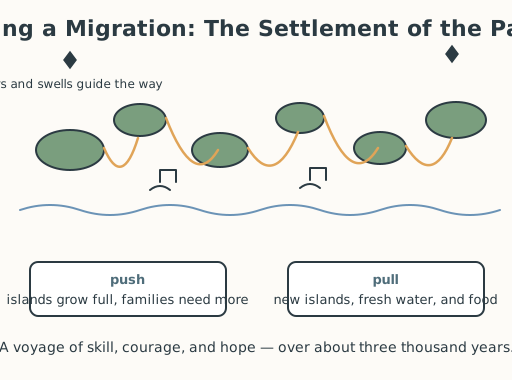
Lesson 6 — People on the Move: Tracing a Migration
Summary
Learners trace a real migration — the settlement of the Pacific by Polynesian voyagers over about three thousand years — and learn to separate push reasons (why people leave) from pull reasons (why they choose a new place). Using a route map and a push–pull chart, they record the movement and produce this unit’s migration note, seeing migration as a story of skill, courage, and hope, not of conquest.
Objectives
- Trace the migration of a specific people and explain the push and pull reasons for their movement. (D08.S3.05.01)
Connection
People move for reasons you can find in your own life. Push reasons make a person leave — a field that no longer feeds the family, a crowded home, a storm, a need for safety. Pull reasons draw a person to a new place — good land, clean water, work, family already there. When your own family or a neighbor’s moved, both pushes and pulls were at work. Today you trace how a whole people moved, step by step, across a vast ocean.
Materials
- Migration route map (Pacific)
- Push–pull chart
- Migration note page
- Pencils
Preparation
- Print or draw the Pacific route map showing islands settled in order over about three thousand years.
- Copy a push–pull chart and a migration note page for each learner.
- Have a stone or shell ready for the listening circle if you use the low-tech path.
Facilitator note
This lesson is written to the learner (“you”). The idea to land is that migration is a
human story of skill and hope, driven by pushes and pulls — not a tale of conquest or of
“discovering” empty land. The Polynesian settlement of the Pacific is a powerful example
precisely because it shows courage, navigation knowledge, and gradual settlement over
generations. Model the push–pull distinction explicitly (worked example) before learners
work alone. Be careful with any example that involves one people displacing another: keep
the focus on the moving people’s skill, reasons, and agency, and avoid framing any place as
“empty” or “waiting to be found.” This lesson produces the unit’s migration note
portfolio artifact. See docs/facilitation.md.
Procedure
- Gather (5 min). You have met achievements and stories. Today you trace movement — how a people crossed a vast ocean, and why.
- Meet the voyage (15 min). Look at the route map. Starting from islands in the western Pacific, voyagers sailed in double-hulled canoes, reading the stars, the swells, and the birds, to settle island after island — Tonga, Samoa, then farther to Hawaiʻi, Rapa Nui, and Aotearoa New Zealand — over about three thousand years. This was no accident: it was planned, skilled navigation, passed down through families.
- Separate push from pull (15 min). On your chart, list the reasons. Push (why leave): an island’s food and space grew full as families grew; a need for new gardens and fresh water. Pull (why go): new islands with fresh water, coconut, taro, breadfruit, and fish; the chance to start a new settlement. The same voyage had both.
- Write your migration note (10 min). On the note page, trace the route in one or two sentences and name one push and one pull reason. This note becomes part of your portfolio. Check with a partner: is the push really a push and the pull really a pull?
- Close (5 min). Migration is one of the oldest human stories — people moving with skill and hope. You can now trace a people’s movement and name the pushes and pulls behind it.
Differentiation
- Support: Provide a pre-drawn route and two labeled arrow cards (push, pull) to place at the right spots; scribe the note.
- Extension: Choose a second people’s migration (Bantu-speaking farmers’ slow spread across Africa, or the first peopling of the Americas) and name its push and pull reasons.
Assessment
- Formative (portfolio/observation): Can the learner trace the route and name at least one push and one pull reason, correctly distinguishing them?
- Self-check: The learner asks, “Did I separate the pushes (why they left) from the pulls (why they went there), and did I tell the story with respect?”
Home connection
Ask someone at home why your family or a neighbor’s family once moved — and see if you can name the push and the pull in their story.
Resources
- The settlement of the Pacific by Polynesian voyagers over roughly three thousand years, using double-hulled canoes and navigation by stars, swells, and birds, is documented by the Polynesian Voyaging Society (https://hokulea.com/) and by archaeological work across the Pacific. The 1976 voyage of the Hōkūleʻa re-created the ancient way and is a living continuation of that knowledge. The push–pull distinction is a standard framework in geography and migration study. Dates and routes are as scholars currently understand them and continue to be refined by new evidence.