Lesson 07 — Across Land and Sea: Trade Connected Peoples
Learners explore how trade and travel connected peoples across the Indian Ocean, riding the monsoon winds in dhows with lateen sails. They sort what moved along the route into four kinds — goods, ideas, plants, and animals — and see that trade carried far more than things: it carried ways of thinking, ways of farming, and ways of life, between peoples who met as equals.
Objectives
Objectives
- D08.S3.05.02 Explain how trade and travel connected peoples across land and sea and what moved with them, such as goods, ideas, plants, and animals.
Essential question
How did trade and travel connect peoples — and what moved with them, besides goods?
Key vocabulary
Materials
Standard materials
- Indian Ocean trade map · 1 A map of the Indian Ocean showing coasts connected by monsoon sailing — East Africa, Arabia, India, Southeast Asia, China — with arrows for what moved
- What-moved sorting cards · 1 set Cards naming things that traveled — spices, cloth, timber, gold, ideas, religions, numbers, coconuts, bananas, rice, cattle, horses — to sort into goods, ideas, plants, or animals
- What-moved chart · 1 per learner A four-column chart (goods | ideas | plants | animals) for recording what moved along a trade route
- Pencils · per learner
Low-tech / no-cost
- A spoken exchange The facilitator tells the monsoon-trade story; learners call out what moved and sort it by pointing to four corners of the room (goods, ideas, plants, animals)
- Four ground circles Draw four circles in the dirt and toss a pebble into the right one for each item that moved; no cards needed
Enriched / lab & device
- A world map and route cards · 1 A map where learners also place the Silk Roads (overland) and the Trans-Saharan gold-salt trade, building a picture of connected world routes
- Images of traded goods · 1 set Pictures of spices, cloth, a dhow with a lateen sail, coconuts, and a camel, to discuss what moved and how
Works in different contexts
- large-group Sort the "what moved" cards together on the board into four columns, then have pairs do a second route (Silk Roads or Trans-Saharan) and compare
- multi-age Younger learners sort picture cards into the four columns while older learners explain how an idea or a plant travels with people
- self-directed A learner reads the monsoon-trade story, sorts the cards into the four columns, and writes one sentence about each kind of thing that moved
- level-grouped Learners ready to extend compare two routes (sea and land) and explain what each moved and what connected them
- outdoor-only Use the four ground circles and toss a pebble into the right one for each item; then name one real thing you have seen travel between places
Lesson 7 — Across Land and Sea: Trade Connected Peoples
Summary
Learners explore how trade and travel connected peoples across the Indian Ocean, riding the monsoon winds in dhows with lateen sails. They sort what moved along the route into four kinds — goods, ideas, plants, and animals — and see that trade carried far more than things: it carried ways of thinking, ways of farming, and ways of life, between peoples who met as equals.
Objectives
- Explain how trade and travel connected peoples across land and sea and what moved with them, such as goods, ideas, plants, and animals. (D08.S3.05.02)
Connection
Think of the last thing you ate or wore that came from somewhere else — a spice, a fruit, a cloth. It did not grow in your pocket; it traveled. Long ago, before planes and trucks, people still moved things across oceans and deserts — and with the goods came ideas, plants, and animals. A single sailing route could carry a religion, a new crop, and a new way of counting, all at once. Today you see how much travels with trade.
Materials
- Indian Ocean trade map
- What-moved sorting cards
- What-moved chart
- Pencils
Preparation
- Print or draw the Indian Ocean trade map with the coasts connected by monsoon routes.
- Copy and cut the what-moved sorting cards, and copy a what-moved chart for each learner.
- Arrange four corners or circles for the sorting activity.
Facilitator note
This lesson is written to the learner (“you”). The idea to land is that trade connected
peoples as equals and moved goods, ideas, plants, and animals — not only things. Frame the
Indian Ocean network, the Silk Roads, and the Trans-Saharan gold-salt trade as networks of
mutual exchange between peoples who met as trading partners, never as a story of one
people “discovering” others. Model the four-category sort aloud (guided practice). Keep the
technology lens honest: the monsoon winds and the dhow’s lateen sail are real technologies
that made the route possible. See docs/philosophy.md §7 and docs/facilitation.md.
Procedure
- Gather (5 min). You have traced a migration across the sea. Today you meet the other reason people crossed oceans and deserts: trade.
- Meet the monsoon route (15 min). Look at the map. Sailors in dhows — boats with a triangular lateen sail — rode the monsoon winds, which blow one way for part of the year and the other way for the rest. This connected the coasts of East Africa, Arabia, India, Southeast Asia, and China. People learned the winds’ rhythm, and for centuries ships moved back and forth, carrying goods and much more.
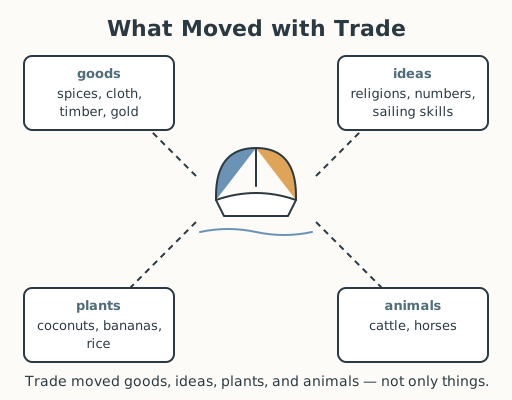
- Sort what moved (20 min). Take the cards and sort each into one of four columns: goods (spices, cloth, timber, gold); ideas (religions, ways of counting, sailing skills); plants (coconuts, bananas, rice); animals (cattle, horses). Check with a partner: does each card fit its column, and could some fit two? Notice how much is not a thing you can hold.
- See the meeting (10 min). With a partner, talk about what happened when these peoples met: they traded, but they also learned from each other — new numbers, new faiths, new crops. No one was “behind” anyone; each people brought something the others valued.
- Close (5 min). Trade is exchange between equals. What moved was not only goods but ideas, plants, and animals — the whole life of peoples, flowing across land and sea.
Differentiation
- Support: Provide picture cards for the sort and a four-column chart with images; scribe the learner’s sentences.
- Extension: Compare a sea route (the Indian Ocean) with a land route (the Silk Roads) or a desert route (the Trans-Saharan gold-salt trade) and name what each moved.
Assessment
- Formative (observation): Can the learner sort what moved into goods, ideas, plants, and animals, and explain that trade carried more than goods?
- Self-check: The learner asks, “Did I sort the items correctly, and did I name at least one idea, one plant, and one animal that moved — not only goods?”
Home connection
Look at one food or object in your home that came from another place, and ask someone at home how it got here — then name whether it is a good, an idea, a plant, or an animal.
Resources
- The Indian Ocean trade network, driven by the monsoon winds and sailed by dhows with lateen sails, connected East Africa, Arabia, India, Southeast Asia, and China for centuries and moved goods, ideas (including religions and number systems), plants, and animals — a widely documented pattern (UNESCO, “The Indian Ocean, a shared heritage”; and historical work on the dhow and monsoon sailing). The Silk Roads (overland) and the Trans-Saharan gold-salt trade (desert, by camel) are parallel networks of exchange. These are told as networks of mutual exchange between peoples, in line with the curriculum’s global and non-colonial framing.