Lesson 08 — Standing Up: People Who Resisted Unfairness
Learners meet three historical examples of people treated unfairly who resisted peacefully and helped one another: the 1930 Salt March in India, the 1929 Aba Women's War in southeastern Nigeria, and the 1966 Wave Hill walk-off by Gurindji stockworkers in Australia. They record one story with an unfairness–action–mutual aid frame, centering the people's dignity, agency, and courage — never victimhood.
Objectives
Objectives
- D08.S4.05.01 Describe a historical example of people treated unfairly, such as workers or people denied their rights, who resisted or helped one another.
Essential question
When people are treated unfairly, how have they resisted and helped one another — with dignity and courage?
Key vocabulary
Materials
Standard materials
- Resistance story cards · 1 set of 3 Three one-page stories told through the people's own courage — the 1930 Salt March in India, the 1929 Aba Women's War in southeastern Nigeria, and the 1966 Wave Hill walk-off by Gurindji stockworkers in Australia — each naming the unfairness, what people did, and how they helped one another
- Standing-up chart · 1 per learner A three-row chart (the unfairness | what people did | how they helped one another) for recording one story
- Pencils · per learner
Low-tech / no-cost
- A read-aloud and retell The facilitator tells the three stories aloud; learners retell one and say what people did and how they helped one another; no cards needed
- A 'standing up' circle In a circle, each learner names one way people can stand up for fairness, passing a stone or shell
Enriched / lab & device
- A world map and story cards · 1 A map where learners place each resistance story near its place, building a global picture of people standing up for fairness
- A short respectful clip or photographs · 1 set Photographs (the Salt March, the 1966 Wave Hill walk-off) or a short clip (if available) discussed with the same unfairness–action–mutual aid prompts
Works in different contexts
- large-group Read one story together and chart it, then have pairs work through the other two and share one each
- multi-age Younger learners retell one story while older learners write the unfairness, action, and mutual aid, and lead the discussion
- self-directed A learner reads the three cards, fills the standing-up chart for one, and writes one sentence about the courage and the helping
- level-grouped Learners ready to extend compare two stories — what the unfairness was, what the people did, and how the two acts of courage resemble each other
- outdoor-only Act out a peaceful march or walk-off together, then name a real unfairness people have stood up to and one way they helped one another; no paper needed
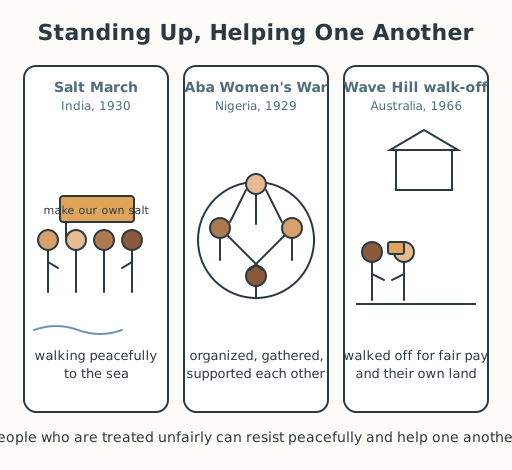
Lesson 8 — Standing Up: People Who Resisted Unfairness
Summary
Learners meet three historical examples of people treated unfairly who resisted peacefully and helped one another: the 1930 Salt March in India, the 1929 Aba Women’s War in southeastern Nigeria, and the 1966 Wave Hill walk-off by Gurindji stockworkers in Australia. They record one story with an unfairness–action–mutual aid frame, centering the people’s dignity, agency, and courage — never victimhood.
Objectives
- Describe a historical example of people treated unfairly, such as workers or people denied their rights, who resisted or helped one another. (D08.S4.05.01)
Connection
Think of a time a rule was unfair — everyone knew it, but one person spoke up, and others joined them, and together they changed it. That is what people have done in every time and place. Being treated unfairly does not make a person weak; resisting it — peacefully, and helping one another while doing so — is one of the bravest things humans do. Today you meet three groups of people who did exactly that.
Materials
- Resistance story cards (Salt March, Aba Women’s War, Wave Hill walk-off)
- Standing-up chart
- Pencils
Preparation
- Copy the three resistance story cards, written through the people’s courage and agency.
- Copy a standing-up chart for each learner.
- Review the note below on holding difficult topics with dignity and hope.
Facilitator note
This lesson is written to the learner (“you”). This is a difficult topic, held with dignity
and hope — never victimhood. The point is not to dwell on suffering but on agency: real
people saw unfairness, organized, helped one another, and acted. Tell each story with the
people as the heroes of their own history. Name the unfairness briefly and factually (an
unjust tax, an unjust rule, unfair pay and land) and spend most of the time on what they
did and how they helped one another. Connect difficulty to hope and to something the
learner can do (speak up, support, be fair). Respect a learner’s right to pause. This lesson
produces the unit’s resistance example portfolio artifact. See docs/facilitation.md on
holding difficult topics safely.
Procedure
- Gather (5 min). You have seen how people moved and traded. Today you meet something harder: what people did when they were treated unfairly — and how they stood up, together, with dignity.
- Meet three stories (20 min). Read the cards. The Salt March (India, 1930): a law said people had to buy salt only from the government, and taxed it — even though salt could be gathered free from the sea. Mohandas Gandhi and others walked for weeks to the coast and made their own salt, peacefully breaking an unjust law, with thousands joining and helping one another along the way. The Aba Women’s War (southeastern Nigeria, 1929): women organized against an unfair tax and unjust rule, gathering in the thousands, speaking out, and supporting each other until the rule was changed. The Wave Hill walk-off (Australia, 1966): Gurindji stockworkers, led by Vincent Lingiari, walked off a cattle station to demand fair pay and their own land, and held on together for years until their land was returned.
- Record one story (15 min). Choose one story. On your chart, write: What was the unfairness? What did the people do? How did they help one another? Notice that in every story the people did not give up — they organized, acted, and held each other up.
- Find the courage (5 min). With a partner, name one thing all three stories share: the people acted peacefully, they acted together, and they kept their dignity.
- Close (5 min). Being treated unfairly is not the end of a story. People resist, help one another, and change things — and that is part of the human story too.
Differentiation
- Support: Use one story at a time with a fill-in chart and picture prompts; scribe the learner’s words and keep the tone calm and hopeful.
- Extension: Compare two stories — the unfairness, the action, and how the two acts of courage resemble each other across different places and times.
Assessment
- Formative (portfolio/observation): Can the learner name the unfairness, what the people did, and how they helped one another, in one story — framing the people with dignity and agency?
- Self-check: The learner asks, “Did I center the people’s courage and helping, not only the unfairness — and did I hold the story with respect?”
Home connection
Ask someone at home about a time people stood up against something unfair and helped one another — in your community or family, or in a story they know.
Resources
- The 1930 Salt March, in which Mohandas Gandhi led a nonviolent march to the sea at Dandi to make salt in defiance of the salt tax, is documented by the Nobel Prize site and historical scholarship (https://www.nobelprize.org/). The 1929 Aba Women’s War, in which thousands of women in southeastern Nigeria organized against unfair taxation and unjust rule, is documented in Nigerian history (see the work of historians such as Adiele Afigbo and records of the time). The 1966 Wave Hill walk-off, led by Vincent Lingiari with Gurindji stockworkers seeking fair pay and land, is documented by the National Museum of Australia (https://www.nma.gov.au/) and led to the return of land. These are told as stories of dignity, agency, and mutual aid, in line with the curriculum’s commitment to center resistance and liberation, not victimhood.