Lesson 09 — Fairness and Dignity: Honored or Denied
Learners define fairness and dignity in plain, concrete terms and sort real-life scenes into where each is honored and where it is denied. They see that fairness means equal respect and a fair chance, and dignity means being treated as a person of worth — and they name one real example of each, preparing them for the unit's capstone.
Objectives
Objectives
- D08.S4.05.02 Explain what fairness and dignity mean using a concrete example of when they were honored or denied.
Essential question
What do fairness and dignity mean — and what does it look like when they are honored, and when they are denied?
Key vocabulary
Materials
Standard materials
- Fairness-and-dignity poster · 1 A poster defining fairness (everyone treated with equal respect and a fair chance; rules apply to all) and dignity (being treated as a person of worth, never less than others), with honored and denied examples side by side
- Honored or denied cards · 1 set of 8 Eight short scene cards — some where dignity is honored (a new family welcomed by name, everyone getting a turn and a share, equal pay for equal work) and some where it is denied (separate doors, being paid less for the same work, a name mocked) — for sorting
- Fairness–dignity page · 1 per learner A page for writing what fairness and dignity mean and one real example of each being honored or denied
- Pencils · per learner
Low-tech / no-cost
- A spoken sort The facilitator reads each scene aloud; learners raise a hand for "honored" and a fist for "denied" and say why; no cards needed
- Two ground circles Draw a circle for "honored" and one for "denied" in the dirt; call out a scene and learners step to the matching circle and explain
Enriched / lab & device
- A 'dignity in our class' chart · 1 A shared chart where learners add one way to honor everyone's dignity in their own group, building from the examples
- A historical photo or short clip · 1 A respectful image or clip (if available) showing dignity denied and then honored, discussed with the same prompts
Works in different contexts
- large-group Sort the eight cards together on the board, naming why each is honored or denied, then have pairs write their own examples
- multi-age Younger learners sort picture scenes while older learners write the definitions and lead a discussion of a real example
- self-directed A learner reads the definitions, sorts the cards, and writes what fairness and dignity mean with one example of each
- level-grouped Learners ready to extend connect a denied-dignity scene to a real historical example from this unit and explain how it was eventually honored
- outdoor-only Use the two ground circles to sort spoken scenes, then name one way the group can honor everyone's dignity today; no paper needed
Lesson 9 — Fairness and Dignity: Honored or Denied
Summary
Learners define fairness and dignity in plain, concrete terms and sort real-life scenes into where each is honored and where it is denied. They see that fairness means equal respect and a fair chance, and dignity means being treated as a person of worth — and they name one real example of each, preparing them for the unit’s capstone.
Objectives
- Explain what fairness and dignity mean using a concrete example of when they were honored or denied. (D08.S4.05.02)
Connection
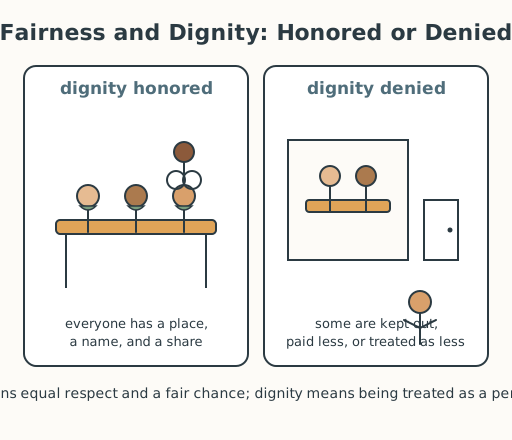
Picture a shared table. When everyone has a place, a name that is said correctly, and a fair share, something good is happening — that is dignity honored. Now picture a doorway where some people are kept out, or paid less for the same work, or treated as if they matter less — that is dignity denied. You already know these two feelings. Today you learn their names and how to tell them apart in the world.
Materials
- Fairness-and-dignity poster
- Honored or denied cards
- Fairness–dignity page
- Pencils
Preparation
- Print or draw the fairness-and-dignity poster (definitions plus honored and denied examples).
- Copy and cut the eight honored-or-denied scene cards, and copy a page for each learner.
- Arrange a circle or two ground circles for sorting.
Facilitator note
This lesson is written to the learner (“you”). The idea to land is the definitions, made
concrete: fairness = equal respect and a fair chance, with rules applying to all; dignity =
being treated as a person of worth, never less than others. Use everyday, recognizable scenes
so the concepts stay concrete before any abstraction. Some learners may have experienced
denied dignity personally; keep the tone calm, name feelings, and connect to what learners can
do (welcome, include, speak up, be fair). Never imply any group “deserves” less. This lesson
produces the unit’s fairness-and-dignity example portfolio artifact. See
docs/facilitation.md on holding topics safely.
Procedure
- Gather (5 min). You have met people who stood up to unfairness. Today you name the two big ideas behind it: fairness and dignity — and what it looks like when they are honored or denied.
- Meet the words (15 min). Look at the poster. Fairness means everyone is treated with equal respect and gets a fair chance, and the rules apply to everyone — not just some. Dignity means being treated as a person of worth, never as less than others. Honored: a new family is welcomed by name, everyone gets a turn and a share, equal pay for equal work. Denied: separate doors for some people, being paid less for the same work, a name mocked instead of said with respect.
- Sort the scenes (20 min). Take the eight cards and sort each into honored or denied, and say why. Check with a partner: do you agree? Notice that denied dignity is not “someone’s fault” — it is a wrong that can be set right, as the people in our last lesson showed.
- Write your example (10 min). On your page, write in your own words what fairness and dignity mean, and one real example of each being honored and one being denied — from your life, your reading, or this unit. This page becomes part of your portfolio.
- Close (5 min). Fairness and dignity are not fancy words — they are the measure of how we treat one another. You now carry both, and you can name when they are honored or denied.
Differentiation
- Support: Use picture scenes and sentence frames (“This shows dignity honored because…”), and scribe the learner’s example.
- Extension: Connect one denied-dignity scene to a real historical example from this unit (the salt tax, unfair pay, being shut out) and explain how people eventually worked to honor dignity.
Assessment
- Formative (portfolio/observation): Can the learner state what fairness and dignity mean and give a concrete example of each being honored and denied?
- Self-check: The learner asks, “Did I define both words in my own words, and did I give a real example of each — honored and denied?”
Home connection
Ask someone at home what “dignity” means to them, and share your definition and one example from today.
Resources
- Fairness and dignity are widely shared ethical concepts; the curriculum teaches them as values (how things ought to be) rather than as facts, and distinguishes the two (docs/philosophy.md §5). The concrete examples (equal pay for equal work, being welcomed by name, being shut out or treated as less) are drawn from everyday life so the concepts stay concrete. The historical links — the salt tax, unfair pay, and being shut out — connect to the unit’s resistance examples (the Salt March, the Aba Women’s War, the Wave Hill walk-off), each documented in the previous lesson’s Resources.