Lesson 10 — The Long Story, and Our Part in It
The capstone gathers the unit's threads into one long human story. Learners assemble their portfolio artifacts — the comparing timeline, the origin-story comparison, the migration note, the achievement page, and the fairness-and-dignity example — and, in a gallery walk and closing circle, connect each to the big question and name their own part in the unfinished story of fairness and dignity.
Objectives
Objectives
- D08.S4.05.02 Explain what fairness and dignity mean using a concrete example of when they were honored or denied.
- D08.S1.05.01 Build a timeline that compares two cultures or civilizations and identify what changed and what stayed the same in each.
- D08.S2.05.01 Compare origin stories from two or more peoples and explain how each reflects the people who tell it.
- D08.S3.05.01 Trace the migration of a specific people and explain the push and pull reasons for their movement.
Essential question
How do timelines, stories, movements, trade, and the struggle for fairness all join into one long human story — and where do I stand in it?
Key vocabulary
Materials
Standard materials
- Portfolio pages · 1 set per learner The learner's own artifacts from this unit — the two-civilization timeline, the origin-story comparison, the migration note, the achievement page, and the fairness-and-dignity example
- Long-story web poster · 1 A poster showing the unit's big ideas as connected threads — time, tools, stories, achievements, movement, trade, and fairness — all tied to one shared human story
- Capstone card · 1 per learner A card with the prompts — choose one artifact, say how it connects to the big question, and name one thing you can do to honor fairness and dignity
- Pencils and art supplies · per learner
Low-tech / no-cost
- A portfolio circle Each learner holds one artifact and tells the circle how it connects to the shared story; no poster or cards needed
- A spoken capstone The learner answers the capstone prompts aloud, choosing one artifact and one action for fairness; voice only
Enriched / lab & device
- A class museum wall · 1 A wall or table where every learner's artifacts are displayed as a "museum of the human story," walked and admired together
- A digital gallery (if devices are available) · 1 A simple slideshow or shared document where learners post a photo of one artifact and one sentence on how it connects to the big question
Works in different contexts
- large-group Do a gallery walk where learners move between displayed artifacts, then share one connection each in a closing circle
- multi-age Younger learners show one artifact and say what it is; older learners explain its connection to the big question and lead the closing discussion
- self-directed A learner gathers their own artifacts, answers the capstone card prompts, and writes a short reflection on their part in the long story
- level-grouped Learners ready to extend write a one-paragraph synthesis linking two or more strands (time, story, movement, trade, fairness) with an example from the unit
- outdoor-only Lay the artifacts on a cloth on the ground as a "story path," and walk it together, each learner saying one connection aloud; no poster needed
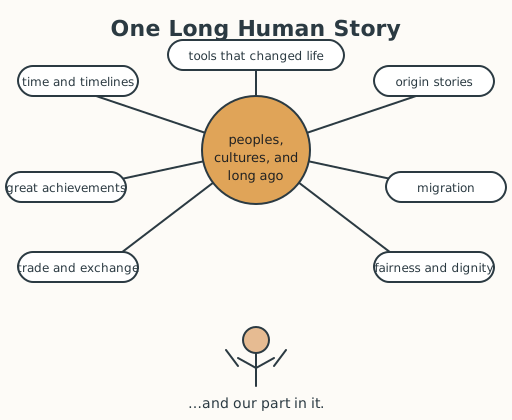
Lesson 10 — The Long Story, and Our Part in It
Summary
The capstone gathers the unit’s threads into one long human story. Learners assemble their portfolio artifacts — the comparing timeline, the origin-story comparison, the migration note, the achievement page, and the fairness-and-dignity example — and, in a gallery walk and closing circle, connect each to the big question and name their own part in the unfinished story of fairness and dignity.
Objectives
- Explain what fairness and dignity mean using a concrete example of when they were honored or denied. (D08.S4.05.02)
- Revisit the unit’s threads — timelines, tools, origin stories, migration, and trade — and connect them into one shared story. (D08.S1.05.01, D08.S2.05.01, D08.S3.05.01)
Connection
A story is not one page but a whole book — and the human story is the longest book of all. You have been collecting its pages all unit: a timeline of two rivers, a tool that changed life, a story of beginnings, a great achievement, a voyage, a trade route, and people who stood up for fairness. Today you bind those pages together, walk through them like a museum, and find where your page fits — because the story is still being written, and you are part of it.
Materials
- Portfolio pages (the learner’s own artifacts)
- Long-story web poster
- Capstone card
- Pencils and art supplies
Preparation
- Have each learner gather their own artifacts from this unit (timeline, origin-story comparison, migration note, achievement page, fairness-and-dignity example).
- Print or draw the long-story web poster.
- Copy a capstone card for each learner, and arrange a gallery wall or story path.
Facilitator note
This lesson is written to the learner (“you”). This is the unit’s capstone and summative
assessment, and also a moment of retrieval and synthesis — learners recall the whole unit
and connect it, rather than re-reading it. Keep the tone celebratory and collective: success is
shared, mastery is individual, and no one is ranked. The closing should land on hope and
agency — the learner’s own part in the unfinished story. If a learner’s artifacts are
incomplete, let them finish one now rather than be judged “done” or “not done.” This lesson
completes the unit’s portfolio. See docs/facilitation.md on assessing without ranking.
Procedure
- Gather (5 min). Look back with a partner: what did we learn this unit? Take turns recalling one thing each — a timeline, a tool, a story, an achievement, a voyage, a trade route, a stand for fairness. This is retrieval: pulling it out of memory, not re-reading it.
- Assemble your pages (15 min). Lay out your own artifacts in order: your two-civilization timeline, your origin-story comparison, your migration note, your achievement page, and your fairness-and-dignity example. Check each is complete; finish any that need it.
- Walk the museum (20 min). Display the artifacts and walk the gallery. At each page, notice what it shows about the long human story. Then, on your capstone card, answer three prompts: Choose one artifact you are proud of. Say how it connects to the big question — how peoples lived, knew, moved, traded, and stood for fairness. Name one thing you can do to honor fairness and dignity in your own life.
- Close the circle (15 min). Gather. Each learner shares their chosen artifact and their one action for fairness — one sentence is enough. Listen to how many different pages make up this one story.
- Look forward (5 min). The story is not finished. You are not only reading the human story — you are writing the next line of it.
Differentiation
- Support: Choose one artifact with the learner and scribe their capstone card; celebrate completion of a single page rather than all five.
- Extension: Write a one-paragraph synthesis linking two or more threads (time, story, movement, trade, fairness) with an example from the unit and one from your own life.
Assessment
- Summative (portfolio): The learner’s assembled artifacts — the comparing timeline, the origin-story comparison, the migration note, the achievement page, and the fairness-and-dignity example — together show mastery of the unit’s standards.
- Peer/self: In the circle, learners listen and each names one connection they heard and one action they can take for fairness.
- Self-check: The learner asks, “Did I connect my artifact to the big question, and did I name a real thing I can do to honor fairness and dignity?”
Home connection
Share your whole portfolio with someone at home — walk them through your pages like a museum — and tell them the one action for fairness you chose.
Resources
- This capstone synthesizes the unit’s documented content: the two-civilization timeline and change-and-continuity work (British Museum, UNESCO); the tool-effect chains (British Museum, Smithsonian); the origin-story comparisons (Te Ara, National Museum of the American Indian, British Museum); the non-European achievements (UNESCO World Heritage listings); the Pacific migration (Polynesian Voyaging Society); the trade networks (UNESCO Indian Ocean shared heritage); and the resistance and fairness-and-dignity examples (Nobel Prize site, National Museum of Australia). Each is cited in its own lesson. The closing commitment to “our part in the story” follows the curriculum’s aim that learners become agents of care and justice, not only readers of the past.