Lesson 04 — Rights Belong to Every Child
Learners explain **why rights apply to every child, everywhere** — because the needs they protect (play, learn, be safe, be heard) belong to every child, no matter who or where. They test the idea against scenarios that vary one feature at a time, and distinguish the promise that rights *apply to all* from the fact that they are *not yet honored everywhere*.
Objectives
Objectives
- D09.S2.05.01 Explain what a right is, where some rights come from (such as the UN Convention on the Rights of the Child), and why they apply to all children.
Essential question
Why do rights apply to every child, everywhere?
Key vocabulary
Materials
Standard materials
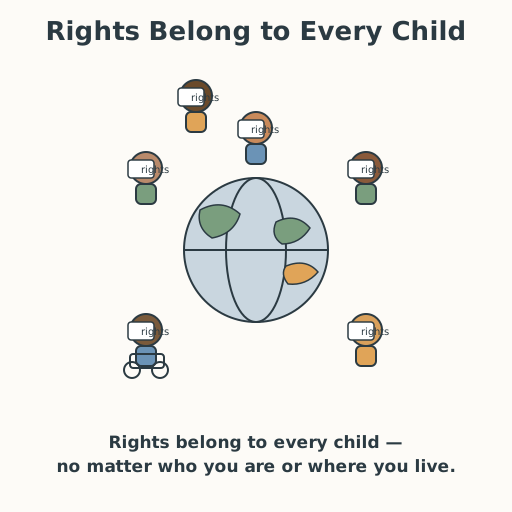
- Rights-for-every-child poster · 1 A poster showing diverse children in a circle, each holding the same rights card, with the caption 'rights apply to every child, no matter who or where'
- Every-child scenario cards · 1 set per pair Cards naming a child by one feature (place, ability, language, family, gender) with the question 'do the same rights still apply?' to test universality
- Every-child promise page · 1 per learner A page to write why rights apply to every child and to list one right that belongs to each child in the scenarios
Low-tech / no-cost
- A standing circle Stand in a circle and pass one 'right' (a stone or a word) around so each child holds the same right in turn; no cards needed
- Spoken scenarios Name a child by one feature and ask aloud whether the same rights still apply; learners answer and give a reason
Enriched / lab & device
- A world map with child-life photographs · 1 Photographs of children in different countries doing ordinary things, to notice that the same rights apply to each
- A short film or read-aloud on children's rights · 1 A brief video or picture book about children in different places having the same rights, discussed as a group
Works in different contexts
- large-group Pass a single right around a large circle so many children hold it in turn, then chart the features that do not change it
- multi-age Younger learners answer 'still applies?' for each scenario; older learners explain why the feature does not remove the right
- self-directed A learner reads the scenarios, answers 'does the same right apply?' for each, and writes why on the promise page
- level-grouped Learners ready to extend connect the 'applies to all' promise with a real case where a right is not yet honored, and say what that means
- outdoor-only Form a circle outdoors and pass a natural object as the 'right'; each learner says one thing that does not take the right away
Lesson 4 — Rights Belong to Every Child
Summary
Learners explain why rights apply to every child, everywhere. They see that the needs rights protect — play, learn, be safe, be heard — belong to every child, no matter who or where, so the promise that protects them must belong to every child too. They test this against scenarios that vary one feature at a time, and separate the promise (rights apply to all) from the fact (not everywhere honors them yet).
Objectives
- Explain why rights apply to all children, everywhere. (D09.S2.05.01)
Connection
A child in a tall city building, a child in a fishing village, a child who uses a wheelchair, a child who speaks a language few others know — different lives, same needs. Each one needs to play, learn, be safe, and be heard. Because the need belongs to every child, the right that protects it belongs to every child too. Your rights do not depend on who you are or where you live.
Materials
- Rights-for-every-child poster
- Every-child scenario cards
- Every-child promise page
Preparation
- Print or draw the rights-for-every-child poster (diverse children, same rights card).
- Copy scenario cards for each pair and a promise page for each learner.
- Arrange a circle for the standing version if going low-tech.
Facilitator note
This lesson is written to the learner (“you”). The idea to land is universality:
rights apply to every child because the needs they protect are shared by every child.
Two careful distinctions keep the lesson honest. First, evidence vs. values
(docs/philosophy.md §5): that the UNCRC says rights apply to every child is a fact;
that they should is a value held by the countries that signed — teach it as a shared
promise, not a law of nature. Second, and crucially for emotional safety: “applies to
all” is not the same as “is honored everywhere.” A right can be real and still be
broken somewhere; that is exactly why people keep working. Name this gently and attach
it to hope and agency, never to a child’s shame. See docs/facilitation.md.
Procedure
- Gather (5 min). Last time you learned what a right is. Try to recall it in your own words. (Pause.) Now a new question: who does a right belong to?
- Meet universality (10 min). Look at the poster. Six children, all different, all holding the same card: rights. Why the same card? Because the needs a right protects — to play, learn, be safe, and be heard — belong to every child. So the promise that protects those needs belongs to every child too. That is what universal means: for every one.
- Test it: does the right still apply? (15 min). Take your scenario cards. Each names a child by one feature — where they live, how their body works, what language they speak, who their family is. Ask: does the right to learn (or play, or be safe) still apply to this child? If you say yes, say why: because they are a child, and the need belongs to every child. Notice which features change nothing about the right.
- Two different things (10 min). Here is a careful idea. “Rights apply to all” is a promise — the countries that signed the UNCRC agreed it. “Rights are honored everywhere” is a fact about the world — and it is not fully true yet. A right can be real even where it is still being broken. That gap is not a reason to give up; it is the reason people keep working.
- Write your promise page (5 min). Finish the sentence: “Rights belong to every child because ___.” Then list one right that belongs to each child in your scenarios.
Differentiation
- Support: Provide the sentence starter and three right-word choices (play, learn, be safe); answer scenarios aloud before writing.
- Extension: Find a real example where a right is not yet honored somewhere, and say what “still applies” means in that case.
Assessment
- Formative (observation): Can the learner say why a right applies to a child who differs from them, using the “shared need” reason?
- Self-check: The learner asks, “Did I confuse ‘applies to all’ with ‘honored everywhere’? Can I tell them apart?”
Home connection
Talk with someone at home about one right every child has, and one place where it is still not honored — and one thing people do to help close that gap.
Resources
- UNICEF — Convention on the Rights of the Child (Article 2: rights apply to every child without discrimination): https://www.unicef.org/child-rights-convention
- Full treaty text (Articles 2, 31, 28, 12, 19): UN OHCHR: https://www.ohchr.org/en/instruments-mechanisms/instruments/convention-rights-child