Lesson 03 — What Is a Right?
Learners define a **right** — a shared promise to protect something every child needs — and learn that some rights are written down in an agreement many countries made together, the **UN Convention on the Rights of the Child**.
Objectives
Objectives
- D09.S2.05.01 Explain what a right is, where some rights come from (such as the UN Convention on the Rights of the Child), and why they apply to all children.
Essential question
What is a right, and where do rights come from?
Key vocabulary
Materials
Standard materials
- What-is-a-right poster · 1 A poster with the definition of a right and three icons (play, learn, be safe) labeled as things a right protects
- Rights, wants, and needs cards · 1 set per group Cards to sort into 'things every child needs protected' (rights) versus 'things some may want' (wants), to feel the boundary of a right
- A right card · 1 per learner A blank card for each learner to write one right in their own words and what it protects
Low-tech / no-cost
- A spoken definition circle Build the definition of a right aloud, one idea at a time, and have learners echo it back; no cards needed
- Body statues Learners freeze into a shape for one thing every child needs protected (playing, learning, being safe) and name it
Enriched / lab & device
- A child-friendly UNCRC summary · 1 A printed or projected child-friendly summary of the UN Convention on the Rights of the Child for learners to browse
- A class rights chart · 1 A shared display where learners post their right cards and group them under 'play, learn, be safe, be heard'
Works in different contexts
- large-group Build the definition together on the board, then have groups sort a few cards each and share one boundary they noticed
- multi-age Younger learners sort a card as 'every child' or 'some may want'; older learners state the definition in their own words
- self-directed A learner reads the definition, sorts the cards alone, and writes one right in their own words on their card
- level-grouped Learners ready to extend debate a hard card (is this a right, a need, or a want?) and defend the placement
- outdoor-only Use two patches of ground as 'every child needs this protected' and 'some may want this'; stand a card (spoken or drawn in the dirt) in the right patch
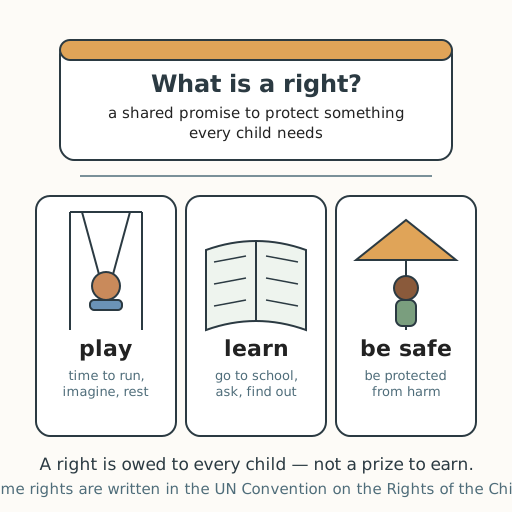
Lesson 3 — What Is a Right?
Summary
Learners define a right — a shared promise to protect something every child needs, simply because they are a child. They sort needs and wants to feel the boundary of a right, and learn that many rights are written down in an agreement countries made together, the United Nations Convention on the Rights of the Child (UNCRC).
Objectives
- Explain what a right is and where some rights come from — such as the UN Convention on the Rights of the Child. (D09.S2.05.01)
Connection
You need to play, to learn, and to be safe. Those are not rewards you earn by being good — they are things you need just because you are a child. A right is a promise that these needs should be protected for you. Some rights are written down in an agreement that many countries of the world made together, so that every child — not just some — is meant to be protected.
Materials
- What-is-a-right poster
- Rights, wants, and needs cards
- A right card
Preparation
- Print or draw the what-is-a-right poster (definition + play/learn/be-safe icons).
- Copy card sets for each group and a right card for each learner.
- Have a child-friendly UNCRC summary on hand (print or projected) for the enriched path.
Facilitator note
This lesson is written to the learner (“you”). The ideas to land: (1) a right is a
shared promise to protect something every child needs, and (2) some rights are written
in the UN Convention on the Rights of the Child, an agreement many countries made.
Frame the UNCRC as a shared human agreement, not a revealed truth or a dogma — people
wrote it, people can improve it, and it exists because adults agreed children should be
protected. Distinguish evidence from values (docs/philosophy.md §5): that the
Convention exists and what it says are facts we can check; that children’s needs
should be protected is a value, held widely but still a value. This honors the unit’s
rule: questions are held as questions, not answered as dogma. See docs/facilitation.md.
Procedure
- Gather (5 min). You have been thinking about values and choices. Now a new word: right. Try to remember — have you heard it before? What do you think it might mean? (Pause to recall.)
- Meet the definition (10 min). Look at the poster. A right is a shared promise to protect something every child needs — like playing, learning, and being safe. A right is not a prize you earn. It is owed to you because you are a child, just as clean air is owed to every living thing because it needs to breathe.
- Sort: need or want? (15 min). Take your cards. Sort each into one of two piles: every child needs this protected (a right), or some children may want this, but it is not a need every child has (a want). For example: food and safety — every child. A new toy — nice, but not a need. Talk over the hard ones with your group. There may be more than one reasonable answer — say your reason.
- Where rights come from (10 min). Rights do not appear by magic. People noticed that children were not always protected, so adults from many countries talked together and agreed on a list: the United Nations Convention on the Rights of the Child (UNCRC). It names rights like to learn, play, be safe, rest, and be heard. It is a promise countries made — and a promise is only as real as people keeping it.
- Write your right card (5 min). On your card, write one right in your own words and what it protects. Share with a partner.
Differentiation
- Support: Offer a sentence starter (“Every child has the right to ___ because ___”) and a smaller card set with clear needs vs. wants.
- Extension: Find a second right in the child-friendly UNCRC summary and explain why it is a need every child has, not a want.
Assessment
- Formative (observation): Can the learner say what a right is in their own words and name where some rights come from (an agreement many countries made, the UNCRC)?
- Self-check: The learner reads their right card and asks, “Is this something every child needs — or only something some might want?”
Home connection
Ask someone at home: “What does every child need to be safe and to grow?” Then tell them what a right is and one right from the UNCRC.
Resources
- UNICEF — Convention on the Rights of the Child (child-friendly summary): https://www.unicef.org/child-rights-convention
- The full treaty text: UN Office of the High Commissioner for Human Rights: https://www.ohchr.org/en/instruments-mechanisms/instruments/convention-rights-child