Lesson 06 — What Is Government?
Learners explain **what government is** — the people and groups who make and carry out decisions and rules for a whole community or country — and **what it does**: make rules and laws, provide services, settle disputes, and protect people and rights. They meet government at several scales and note that governments take many different forms around the world.
Objectives
Objectives
- D09.S3.05.01 Explain what government is and what it does, and compare how decisions are made in more than one country.
Essential question
What is government, and what does it do?
Key vocabulary
Materials
Standard materials
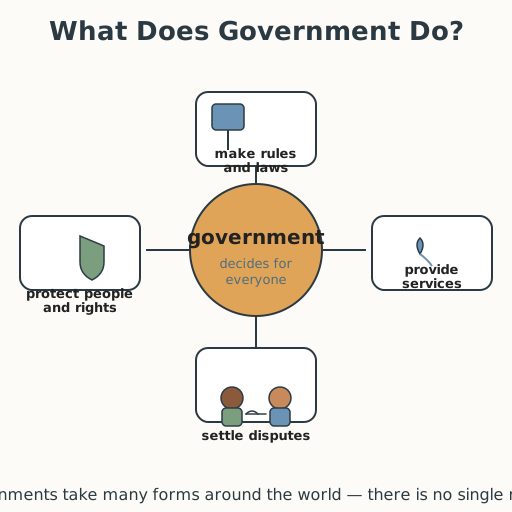
- What-government-does poster · 1 A diagram with 'government' at the center and four branches — make rules, provide services, settle disputes, protect people and rights — each with a simple icon
- Who-does-what cards · 1 set per group Cards naming everyday things (a road, a school, a park, a water tap, a disagreement about a fence) to sort by whether a government typically helps provide or settle it
- Levels of government page · 1 per learner A page showing government at several scales — class, village, town, country — with one thing each level helps decide or do
Low-tech / no-cost
- A spoken walk of examples Walk through a day together naming things a government helps provide or decide (the road, the school, the water), building the idea aloud
- A sorting line on the ground Draw two areas — 'a government helps with this' and 'families and neighbors do this' — and stand each spoken example in the right area
Enriched / lab & device
- A short reading or film about a local service · 1 A brief account (text or video) of how one public service — water, a road, a school — is decided and provided, discussed as a group
- A class 'government in a day' chart · 1 A shared display where learners post one thing a government helped provide or decide in a single day and at what level
Works in different contexts
- large-group Build the poster together, then have groups sort a few cards each and share one example per branch
- multi-age Younger learners point to who fixes a road or runs a school; older learners name the four things government does
- self-directed A learner reads the poster, sorts the cards alone, and fills the levels page with one example per level
- level-grouped Learners ready to extend name a need a government should help meet and one it should not decide, and give a reason
- outdoor-only Use the sorting line outdoors; name real things around you (a path, a tap, a gate) and stand where each belongs
Lesson 6 — What Is Government?
Summary
Learners explain what government is — the people and groups who make and carry out decisions and rules for a whole community or country — and what it does: make rules and laws, provide services, settle disputes, and protect people and rights. They sort everyday examples, meet government at several scales (class, village, town, country), and notice that governments take many different forms around the world.
Objectives
- Explain what government is and what it does. (D09.S3.05.01)
Connection
Who makes sure the road is repaired, the school runs, and clean water reaches the tap? Not one person, but a group whose job is to make and carry out decisions for everyone in a place — a government. It is at work all around you, every day, in quiet ways: a rule about traffic, a shared water supply, a place to learn. Understanding it is understanding how a whole community lives together.
Materials
- What-government-does poster
- Who-does-what cards
- Levels of government page
Preparation
- Print or draw the what-government-does poster (center + four branches).
- Copy card sets for each group and a levels page for each learner.
- Prepare one local example (a road, a school, a water supply) to open the discussion.
Facilitator note
This lesson is written to the learner (“you”). The ideas to land: government is the
people and groups who make and carry out decisions/rules for a whole community or
country, and it does four kinds of things — make rules and laws, provide services,
settle disputes, and protect people and rights. Teach this descriptively, not as one
model: governments around the world take many forms, and none is assumed to be “the”
right one (this is the unit’s no-single-model commitment). Distinguish evidence from
values: what governments do and what forms they take are facts we can observe and
compare; what they should do — including this curriculum’s egalitarian view that they
should serve everyone — is a value. Hold it open. See docs/facilitation.md.
Procedure
- Gather (5 min). You have learned how to see fairness. Now a bigger question: who looks after the whole community — the rules, the roads, the schools? That is the idea of government. Try to recall: what do you already think it is? (Pause.)
- Meet the idea (10 min). A government is the people and groups who make and carry out decisions and rules for a whole community or country. It is not one person, and it is not the same everywhere — but every large group of people needs some way to decide together, and that way is called government.
- What it does (15 min). Look at the poster. Government does four kinds of things: make rules and laws (so people know how to live together safely); provide services (roads, schools, clean water, health care, safety); settle disputes (help people resolve disagreements fairly); and protect people and rights (so every person is safe and treated with worth). Sort your cards: which of these four does each example belong to?
- Many levels, many forms (10 min). Government is not only national. It works at many scales: your class makes rules together; a village or town decides about a shared well or path; a country makes laws for everyone. And around the world, governments take many different forms — some are led by councils, some by assemblies, some by a single leader. Next lesson you will compare a few.
- Record (5 min). On your page, name one thing each level of government helps decide or do — class, village, town, country.
Differentiation
- Support: Provide a word bank (rule, service, dispute, protect) and picture prompts for the four branches.
- Extension: Name one need a government should help meet, and one thing it should not decide, with a reason for each.
Assessment
- Formative (observation): Can the learner say what government is in their own words and name at least two things it does?
- Self-check: The learner asks, “Can I name the four things government does, and give a real example of each?”
Home connection
On the way home or nearby, notice one thing a government helps provide (a road, a tap, a school) and one rule it makes — and tell someone what you found.
Resources
- Responsible decision-making and social awareness framing: CASEL: https://casel.org/fundamentals-of-sel/
- For comparing how decisions are made, see the next lesson (L.05.011.07).