Lesson 07 — How Decisions Get Made: Comparing Countries
Learners compare **how decisions are made in more than one country**. They meet three real ways — talking together until people agree (consensus), direct votes, and choosing representatives — with examples from different countries, and record how two places are alike and different.
Objectives
Objectives
- D09.S3.05.01 Explain what government is and what it does, and compare how decisions are made in more than one country.
Essential question
How do different countries make decisions?
Key vocabulary
Materials
Standard materials
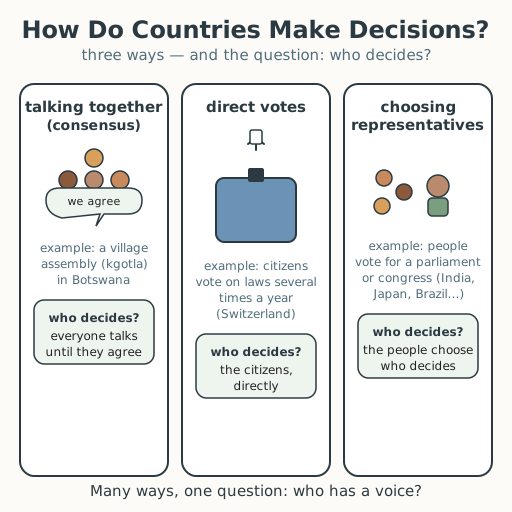
- Three-ways comparison chart · 1 A chart with three columns — talking together to agree (consensus), direct votes, choosing representatives — each with a country example and a 'who decides?' line
- Decision-making example cards · 1 set per group Short descriptions of how a decision gets made in different places, to sort into the three ways and compare
- Compare page · 1 per learner A page to record how decisions are made in two places and one way they are alike and one way they differ
Low-tech / no-cost
- A spoken comparison Describe each of the three ways aloud with a country example, and have learners repeat back who decides in each
- Three corners Mark three corners as the three ways; for each example, learners walk to the corner that matches and say who decides
Enriched / lab & device
- A short film or reading on a real assembly · 1 A brief account of a real decision-making body (a kgotla, a referendum, a parliament) to watch or read together
- A class comparison wall · 1 A shared display where learners post their compare pages and read each other's country pairs
Works in different contexts
- large-group Fill the three-way chart together, then have groups sort example cards and report one comparison in a sentence
- multi-age Younger learners match an example to a way; older learners name who decides and one strength or limit of the way
- self-directed A learner reads the chart, sorts the cards alone, and completes the compare page for two ways
- level-grouped Learners ready to extend weigh a strength and a limit of each way and say which gives more people a voice and why
- outdoor-only Use the three corners outdoors; name examples and move to the matching corner, then say who decides and how
Lesson 7 — How Decisions Get Made: Comparing Countries
Summary
Learners compare how decisions are made in more than one country. They meet three real ways — talking together until people agree (consensus), direct votes, and choosing representatives — each with examples from different countries, and record how two places are alike and different. The point is global comparison, not ranking one way as “the best.”
Objectives
- Compare how decisions are made in more than one country. (D09.S3.05.01)
Connection
Every family and class has a way to decide: one person decides, or everyone talks it out, or people raise hands. Whole countries have ways too, and they are not all the same. In one place, people gather and talk until they agree; in another, citizens vote directly on a law; in another, they choose representatives to decide for them. Seeing the different ways — and who gets a voice in each — is how we understand our own.
Materials
- Three-ways comparison chart
- Decision-making example cards
- Compare page
Preparation
- Print or draw the three-ways comparison chart (consensus / direct votes / representatives, with country examples).
- Copy example cards for each group and a compare page for each learner.
- Prepare one short spoken description per way if going low-tech.
Facilitator note
This lesson is written to the learner (“you”). The skill to land is comparing how
decisions are made in more than one country, with three real, observable ways:
consensus (talking until people agree — for example, the kgotla, a community
assembly in Botswana where people gather and speak until a decision is reached);
direct votes (for example, Switzerland, where citizens vote on many laws several
times a year in referendums); and choosing representatives (as in many countries,
including India, Japan, Brazil, and others, where adults vote for representatives who
then decide in a parliament or congress). Present these descriptively and
non-hierarchically — no single model is “the” right one (the unit’s commitment).
Distinguish evidence from values: how decisions are made in each place is
observable fact; whether everyone should have a voice is a value this curriculum
holds. Hold questions open. See docs/facilitation.md.
Procedure
- Gather (5 min). Last time you learned what government is. Now: how do the decisions actually get made? Try to recall one thing government does. (Pause.) Today you compare the ways different countries decide.
- Meet three ways (15 min). Look at the chart. Talking together (consensus): people gather and discuss until they agree — for example, a kgotla in Botswana, a village assembly where anyone may speak. Direct votes: citizens vote on laws themselves — for example, Switzerland, where people vote on many questions several times a year. Choosing representatives: citizens vote for people who then decide for them — as in India, Japan, Brazil, and many other countries, whose parliaments or congresses pass laws. For each, ask the same question: who decides? who has a voice?
- Sort and compare (15 min). Take your example cards. Each describes a decision being made somewhere. Sort each into one of the three ways. Then compare two of them: who decides in each? Who gets a voice? What is one way they are alike, and one way they differ?
- Weigh, but don’t rank (10 min). Each way has strengths and limits. Consensus lets everyone speak but can be slow; direct votes give people a direct say but not everyone always knows the details; representatives can work quickly but must be trusted to listen. Notice: there is no single “best” way — but the question who has a voice? is always worth asking.
- Record (5 min). On your compare page, write two ways, one example of each, and one likeness and one difference.
Differentiation
- Support: Provide the chart with a sentence starter (“In ___, decisions are made by ___; in ___, they are made by ___.”).
- Extension: Name a strength and a limit of each way, and argue which gives more people a voice and why.
Assessment
- Formative (observation): Can the learner name two ways decisions are made in different countries and say who decides in each?
- Peer check: Partners check each other’s compare page: “Did you name who decides in each place, not only the country name?”
Home connection
Ask someone at home how decisions are made in your household or community — one person, a talk, or a vote? — and compare it with one of the ways you learned today.
Resources
- For global, non-hierarchical comparison of how societies make decisions, the framing in this lesson is a value of the curriculum (compare, don’t rank), grounded in widely documented examples; see the next grade’s D09.S3.06.01 for democracy and its alternatives.
- Social awareness framing: CASEL: https://casel.org/fundamentals-of-sel/