Lesson 01 — An Everyday Tool, Before and After
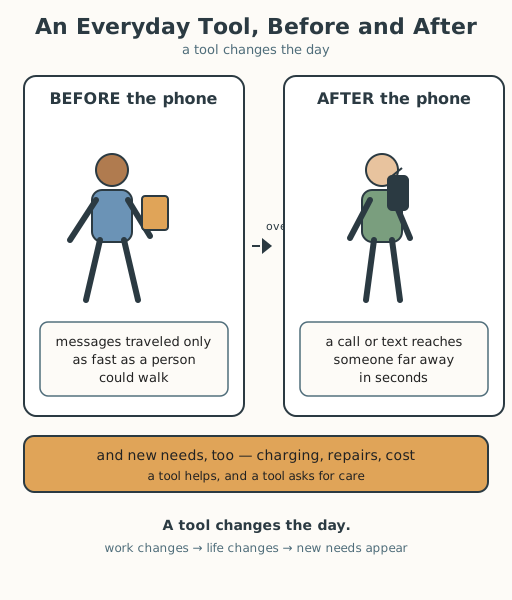
Learners trace how one everyday technology changed daily life over time. A worked example follows the mobile phone — before it, messages traveled only as fast as a person could walk; after it, a call or text reaches someone far away in seconds, with new needs (charging, repairs, cost) too. Learners then choose a tool — a water pump, a refrigerator, a sewing machine, or a radio — and trace its own before–after chain, seeing technology as something people use and shape, with helpful and complicated effects.
Objectives
Objectives
- D10.S1.05.01 Explain how a technology people use every day, such as a phone or a water pump, has changed daily life over time.
Essential question
How has a technology people use every day changed daily life over time?
Key vocabulary
Materials
Standard materials
- Before–after chain poster · 1 A poster tracing the mobile phone — before (messages traveled as fast as a person could walk) to after (a call or text reaches someone far away in seconds), plus new needs (charging, repairs, cost)
- Tool menu cards · 1 set per pair Cards for the water pump, refrigerator, sewing machine, and radio, each naming what the tool does and a before/after hint
- Before–after page · 1 per learner A two-column page (before | after) with a line for one effect on daily life and one new need
Low-tech / no-cost
- Act out before and after Mime carrying a message on foot, then mime making a call; mime drawing water by hand, then working a pump handle; no paper needed
- A spoken before–after chain The facilitator names a tool and learners call out what daily life was like before and after it; voice only
Enriched / lab & device
- A short photo set of the same task, then and now · 1 set Photographs of fetching water by hand vs. a pump, or of a market before and after mobile money, to discuss what changed
- A device for a quick image search or a short video · 1 per group To watch or find one more everyday tool changing life, where devices are available
Works in different contexts
- large-group Do the phone chain together on the board, then have pairs each trace a different tool and report one before-and-after aloud
- multi-age Younger learners act out before and after; older learners write the chain and add a second effect and a new need
- self-directed A learner reads the tool menu, chooses one tool, fills the before–after page, and writes one sentence on how it changed daily life
- level-grouped Learners ready to extend compare two tools and explain which they think changed daily life more, with reasons — no single "right" answer
- outdoor-only Try carrying water by hand versus with a simple lever or pulley outside, then talk about before and after; no paper needed
Lesson 1 — An Everyday Tool, Before and After
Summary
Learners trace how one everyday technology changed daily life over time. A worked example follows the mobile phone — before it, messages traveled only as fast as a person could walk; after it, a call or text reaches someone far away in seconds, with new needs (charging, repairs, cost) too. Learners then choose a tool — a water pump, a refrigerator, a sewing machine, or a radio — and trace its own before–after chain, seeing technology as something people use and shape, with helpful and complicated effects.
Objectives
- Explain how a technology people use every day, such as a phone or a water pump, has changed daily life over time. (D10.S1.05.01)
Connection
Think of the last message you received — a text, a call, a note. Now imagine the same message before phones existed: someone would have had to walk or ride all the way to you to tell you. That one difference — before and after a tool — is what we study today. A tool changes the day, the work changes, and new needs appear along with the new ease.
Materials
- Before–after chain poster (the phone)
- Tool menu cards (water pump, refrigerator, sewing machine, radio)
- Before–after page
- Pencils
Preparation
- Print or draw the before–after chain poster for the phone.
- Copy the tool menu cards and a before–after page for each learner.
- If doing the acted version, gather a prop or two (a stick to “pump,” a pretend message).
Facilitator note
This lesson is written to the learner (“you”). The idea to land is a tool changes daily
life, with effects both helpful and complicated — not that tools are simple “good” or
“bad.” Model the phone chain fully (worked example) before learners trace their own tool
(Kirschner, Sweller & Clark, 2006). Keep it honest and global: the phone and the water pump
did not arrive everywhere the same way or do the same job everywhere — that is the next
lesson. Distinguish evidence from values: what changed is something we can investigate;
that ease is good and that care for new costs matters are values we hold. Choose examples
that include the learner’s own region and others, without ranking any as “behind” or
“ahead.” See docs/philosophy.md §7 and docs/facilitation.md.
Procedure
- Gather (5 min). Recall from Grade 4: people design tools to meet a need. Ask: what is one tool you used today? What did it help you do?
- Meet the phone chain (12 min). Look at the poster. Before the phone: messages traveled only as fast as a person could walk, and news waited for a traveler. After the phone: a call or a text reaches someone far away in seconds, and families separated by distance can stay in touch. And new needs: the phone must be charged, repaired, and paid for. Say it as a chain: “before… after… and also…”.
- Trace your own tool (18 min). Choose a tool from the menu — the water pump (before: people drew water by hand or carried it from a river; after: a handle brings water up with less effort, but the pump needs parts and fuel), the refrigerator (before: food spoiled quickly and had to be eaten or preserved; after: food lasts days, but fridges use electricity), the sewing machine (before: clothes were sewn slowly by hand; after: many more garments, made faster, but the work changed), or the radio (before: news traveled with people; after: one voice could reach a whole region). On your page, write or draw what daily life was like before the tool and after it, and name one effect and one new need.
- Check with a partner (10 min). Swap pages. Ask each other: “Does the chain make sense? Did you show both a helpful effect and a new need?” Fix anything that is unclear.
- Close (5 min). A tool is not magic — it is a choice people made that changed their days, for easier and for needing care. You can now trace that change from before to after.
Differentiation
- Support: Provide picture prompts for one tool’s before and after, and scribe the learner’s chain as they say it aloud.
- Extension: Choose a second tool, write its before–after chain, and compare which tool you think changed daily life more — with reasons, and no single “right” answer.
Assessment
- Formative (observation): Can the learner trace one tool from before to after and name a real effect on daily life — including a new need?
- Self-check: The learner asks, “Did I show both the before and the after, and did I name at least one helpful effect and one new need?”
Home connection
Choose one tool your family uses every day (a phone, a stove, a bicycle, a pump) and ask someone at home what daily life or work was like before it was common.
Resources
- The mobile phone spread worldwide and reshaped daily communication — an evidence-based
overview of how phones changed how people connect and work is summarized by the World Bank
and the International Telecommunication Union (ITU). Water pumps, refrigeration, and sewing
machines each have documented before-and-after histories (hand-drawn wells to mechanical
pumps; ice and preservation to electric refrigeration; hand-sewing to the machine that
changed garment work). The framing that tools have both helpful and complicated effects
follows the curriculum’s “honest about technology” commitment (
docs/philosophy.md).