Lesson 04 — When Sources Agree and Disagree
Learners learn what to do when sources agree — and when they disagree. A worked example compares two sources on how much of Earth the oceans cover: they agree on "about seven-tenths" and disagree only on the exact number, so the claim is likely true but the number stays open. Learners then sort source pairs into "overlap" and "gap," learning that disagreement is information — a sign to say "not sure yet" and look for a third source, never to hide the gap.
Objectives
Objectives
- D10.S2.05.01 Evaluate whether a claim is likely true by checking more than one source and noting where they agree or disagree.
Essential question
What do I do when sources agree, and what do I do when they disagree?
Key vocabulary
Materials
Standard materials
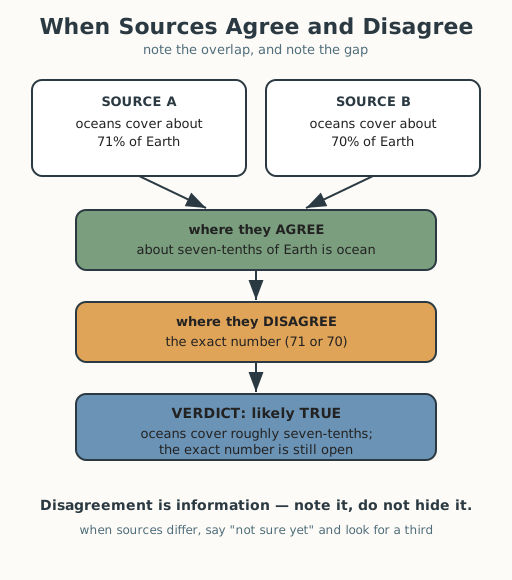
- Agree–disagree poster · 1 A poster comparing two sources on ocean coverage — Source A says about 71%, Source B about 70% — showing where they agree (about seven-tenths) and where they disagree (the exact number), with a verdict
- Source-pair cards · 1 set per pair Cards with two short sources on one topic — how much sleep children need; whether eating breakfast helps focus — each with an agree line and a disagree line to find
- Agree–disagree page · 1 per learner A page with "Source A" and "Source B" columns, an "overlap (agree)" band, a "gap (disagree)" band, and a verdict line
Low-tech / no-cost
- A spoken agree–disagree Read two sources aloud; learners raise one hand for "agree," two for "disagree," and say the verdict; voice only
- Two circles in the dirt Draw two overlapping circles; put the agreement in the overlap and the disagreement outside it; no paper needed
Enriched / lab & device
- A device to compare two live sources · 1 per group To look up one fact on two trusted sites and note where they agree and differ, where devices are available
- A printed source sampler · 1 set Short passages from two reference works on the same topic, to practice finding overlap and gap in real text
Works in different contexts
- large-group Do the ocean example together on the poster, then have pairs work a card and report "they agree on ___, they disagree on ___, so ___" in one sentence
- multi-age Younger learners point to the overlap and the gap; older learners state the verdict and say when to say "not sure yet"
- self-directed A learner works a source-pair card alone, fills the agree–disagree page, and writes a one-sentence verdict
- level-grouped Learners ready to extend find a third source on the topic and explain whether it tips the verdict toward "true" or "still open"
- outdoor-only Use two remembered or spoken sources on something observable nearby and sort them into overlap and gap aloud; no paper needed
Lesson 4 — When Sources Agree and Disagree
Summary
Learners learn what to do when sources agree — and when they disagree. A worked example compares two sources on how much of Earth the oceans cover: they agree on “about seven-tenths” and disagree only on the exact number, so the claim is likely true but the number stays open. Learners then sort source pairs into overlap and gap, learning that disagreement is information — a sign to say “not sure yet” and look for a third source, never to hide the gap.
Objectives
- Evaluate whether a claim is likely true by checking more than one source and noting where they agree or disagree. (D10.S2.05.01)
Connection
Two friends both watched the same football match. One says the score was 3–1; the other says 3–2. They agree someone won by a goal or two, but they disagree on the exact score. When you notice where sources overlap and where they split, you can say what you are sure of, what you are not, and when to look for a third voice. That is today’s skill.
Materials
- Agree–disagree poster (ocean coverage)
- Source-pair cards
- Agree–disagree page
- Pencils
Preparation
- Print or draw the agree–disagree poster.
- Copy source-pair cards for each pair and an agree–disagree page for each learner.
Facilitator note
This lesson is written to the learner (“you”). The skill to land is the overlap-and-gap
move: name where sources agree (the overlap), name where they disagree (the gap), then
state a verdict that respects both — and say “not sure yet” when the gap matters. Model the
ocean example fully as a worked example. Teach that disagreement is normal and useful, not a
failure: honest sources often differ on details, and a learner who notices the gap is thinking
well, not badly. Keep the tone non-cynical: the goal is careful, fair judgment, not
suspicion of everything. Distinguish evidence from values: where sources overlap and where
they split is evidence; that we should be honest about both is a value we hold. See
docs/philosophy.md §5 and docs/facilitation.md.
Procedure
- Gather (5 min). Recall last lesson: two sources that agree are stronger than one. But what if they do not agree? Today you learn what to do.
- Meet the overlap and the gap (12 min). Look at the poster. Source A: “oceans cover about 71% of Earth.” Source B: “oceans cover about 70% of Earth.” Where they agree: about seven-tenths of Earth is ocean. Where they disagree: the exact number — 71 or 70. Verdict: likely true — oceans cover roughly seven-tenths; the exact number is still open. Notice you did not throw the claim away because of a tiny difference, and you did not pretend the difference was not there.
- Practice with a partner (20 min). Take a source-pair card. One pair is about how much sleep children need (Source A says about 9 hours; Source B says 9–11 hours). Another is about whether eating breakfast helps school focus (Source A says “studies show it helps”; Source B says “the evidence is mixed”). On your page, fill the overlap (where they agree) and the gap (where they disagree), then write a verdict. When the gap matters, write “not sure yet — I would check a third source.”
- Peer check (8 min). Swap pages. Ask: “Did you name both the overlap and the gap? Does the verdict match — or honestly say ‘not sure yet’?”
- Close (5 min). Disagreement is information, not a problem. Note it, name it, and when it matters, say “not sure yet.”
Differentiation
- Support: Provide a card where the overlap is partly filled in and a verdict sentence starter; work one pair aloud first.
- Extension: Find a third source on the topic and explain whether it tips the verdict toward “likely true” or keeps it “still open.”
Assessment
- Formative (observation): Can the learner name where two sources agree, where they disagree, and give a verdict that respects both — including “not sure yet” when needed?
- Peer check: Partners ask each other, “Did you name both the overlap and the gap, and did you say ‘not sure yet’ when the gap mattered?”
Home connection
When two people at home tell you slightly different versions of the same event, name what they agree on and where they differ — and ask whether the difference matters enough to check a third source.
Resources
- Oceans cover roughly 70–71% of Earth’s surface — a figure that appears in slightly different forms across references (NASA, USGS, NOAA), which is exactly why it makes a good worked example of agreement-with-a-small-gap. Children’s sleep recommendations are given as a range by health bodies (for example, WHO and national sleep foundations), and the breakfast–focus question is genuinely “mixed evidence” in the research literature — useful real cases where honest sources differ. The “overlap and gap” routine follows the standard’s “noting where they agree or disagree”; on modeling before practice, see Kirschner, Sweller & Clark (2006), https://doi.org/10.1207/s15326985ep4102_1.