Lesson 03 — Check Before You Believe: Two Sources
Learners learn to check a claim across more than one source before believing it. A worked example follows the claim "camels store water in their humps" through a book and a wildlife website — both say the hump stores fat, not water — to the verdict "likely false." Learners then check safe, fun claims on cards, filling a five-box claim-check page and stating a verdict grounded in where the sources agree.
Objectives
Objectives
- D10.S2.05.01 Evaluate whether a claim is likely true by checking more than one source and noting where they agree or disagree.
Essential question
How do I evaluate whether a claim is likely true by checking more than one source?
Key vocabulary
Materials
Standard materials
- Claim-check flow poster · 1 A poster tracing one claim — "camels store water in their humps" — through two sources to a verdict, showing the claim-check routine
- Claim cards · 1 set per pair Cards with checkable, safe claims — "goldfish only remember for three seconds," "lightning never strikes the same place twice," "cracking knuckles causes arthritis" — plus two mini-source notes for each
- Claim-check page · 1 per learner A page with boxes for claim → source 1 → source 2 → where they agree → verdict
Low-tech / no-cost
- A spoken claim-check The facilitator says a claim aloud and reads two sources; learners call out the agreement and the verdict; voice only
- A claim-check in the dirt Draw the five boxes (claim, source 1, source 2, agree, verdict) in the dirt and fill them with a stick; no paper needed
Enriched / lab & device
- A device to look up a real second source · 1 per group To practice finding a second source for a claim on a trusted site, where devices and connectivity are available
- A printed set of trustworthy source examples · 1 set A child-friendly encyclopedia page, a wildlife page, and a health page, to use as real sources to check claims against
Works in different contexts
- large-group Do the camel claim together on the poster, then have pairs work a claim card and report their verdict in one sentence
- multi-age Younger learners say "same or different" for the two sources; older learners state the verdict and name where the sources agree
- self-directed A learner works a claim card alone, fills the claim-check page, and writes a one-sentence verdict with a reason
- level-grouped Learners ready to extend find their own second source for a claim and explain which source they trust more and why
- outdoor-only Use a claim about the natural world you can partly observe (e.g., "ants follow trails"); check it against two remembered or spoken sources; no paper needed
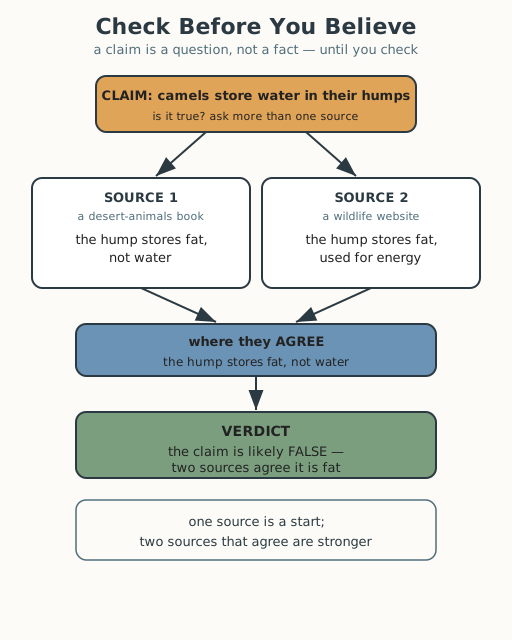
Lesson 3 — Check Before You Believe: Two Sources
Summary
Learners learn to check a claim across more than one source before believing it. A worked example follows the claim “camels store water in their humps” through a book and a wildlife website — both say the hump stores fat, not water — to the verdict likely false. Learners then check safe, fun claims on cards, filling a five-box claim-check page and stating a verdict grounded in where the sources agree.
Objectives
- Evaluate whether a claim is likely true by checking more than one source and noting where they agree or disagree. (D10.S2.05.01)
Connection
Have you ever heard something and wondered, “is that really true?” — a friend says a rumor, a screen shows a surprising fact, a post makes a big promise. One source is a start, but two that agree are stronger. Checking a claim is not about distrusting people; it is about being careful with what we believe — a habit that protects us and everyone we share information with.
Materials
- Claim-check flow poster
- Claim cards
- Claim-check page
- Pencils
Preparation
- Print or draw the claim-check flow poster for the camel claim.
- Copy claim cards for each pair and a claim-check page for each learner.
Facilitator note
This lesson is written to the learner (“you”). The routine to land is the five-box
claim-check: claim → source 1 → source 2 → where they agree → verdict. Model it fully as a
worked example before independent practice (Kirschner, Sweller & Clark, 2006). Teach
checking without cynicism or fear: the tone is “be careful, not suspicious,” and the goal
is to become harder to fool while staying open-hearted. The camel claim is true-to-evidence
(a camel’s hump stores fat, an energy reserve) and age-safe. Keep all practice claims
non-frightening. Distinguish evidence from values: what the sources say and whether they
agree is evidence; that we should check before we believe is a value this curriculum holds.
See docs/philosophy.md §5 and §7 and docs/facilitation.md.
Procedure
- Gather (5 min). Ask: has someone ever told you a surprising fact, and you were not sure it was true? Today you learn the routine that settles it: check more than one source.
- Meet the claim-check (12 min). Look at the flow poster. Claim: “camels store water in their humps.” Source 1 — a desert-animals book: “the hump stores fat, not water.” Source 2 — a wildlife website: “the hump stores fat, used for energy.” Where they agree: the hump stores fat, not water. Verdict: the claim is likely false. Notice the claim did not pass just because one source said so — it failed because two agreed on something else.
- Practice with a partner (20 min). Take a claim card — “goldfish only remember for three seconds,” “lightning never strikes the same place twice,” or “cracking your knuckles causes arthritis.” Read the claim, then the two mini-sources on the card. On your claim-check page, fill the five boxes: claim → source 1 → source 2 → where they agree → verdict. State your verdict with the reason: “likely ___ because both sources say ___.”
- Peer check (8 min). Swap pages. Ask: “Did you fill all five boxes, and does your verdict match where the sources agreed?” Help fix any mismatch.
- Close (5 min). A claim is a question until you check it. Two sources that agree are stronger than one — and you are now harder to fool.
Differentiation
- Support: Provide a claim-check page with two boxes pre-filled, and a sentence starter for the verdict; work one claim aloud first.
- Extension: Find your own second source for a claim (a book, an adult, a trusted site) and explain which source you trust more and why.
Assessment
- Formative (observation): Can the learner state a verdict for a claim and point to where two sources agreed to support it?
- Self-check: The learner asks, “Did I check more than one source, and did my verdict follow from what they agreed on?”
Home connection
Hear a surprising claim at home? Check it with a second source (a book, a grown-up, another site) and tell someone what you found and why you now believe or doubt it.
Resources
- The camel’s hump stores fat (an energy reserve), not water — widely documented in children’s science references (for example, BBC Bitesize and Britannica Kids). The “goldfish memory” and “lightning never strikes twice” claims are common myths corrected by science-education sources. The five-box claim-check routine (claim → source 1 → source 2 → agreement → verdict) operationalizes the standard’s “checking more than one source”; on modeling the routine before practice, see Kirschner, Sweller & Clark (2006), https://doi.org/10.1207/s15326985ep4102_1.