Lesson 06 — Water's Long Journey: A Cycle
Learners trace water through its cycle — ocean to evaporation to clouds to rain to rivers, ground, plants, animals, and people, and back. They learn the one rule every arrow follows (the direction water actually travels) and why the cycle turns: the Sun's heat pushes water up, gravity pulls it down, and water is reused, not made new. They build a labeled cycle diagram and connect it to the water in their own lives.
Objectives
Objectives
- D10.S3.05.01 Trace the path of energy or matter, such as water, through a simple cycle or food web, and explain why it cycles.
Essential question
How does water cycle through the world, and why does it cycle?
Key vocabulary
Materials
Standard materials
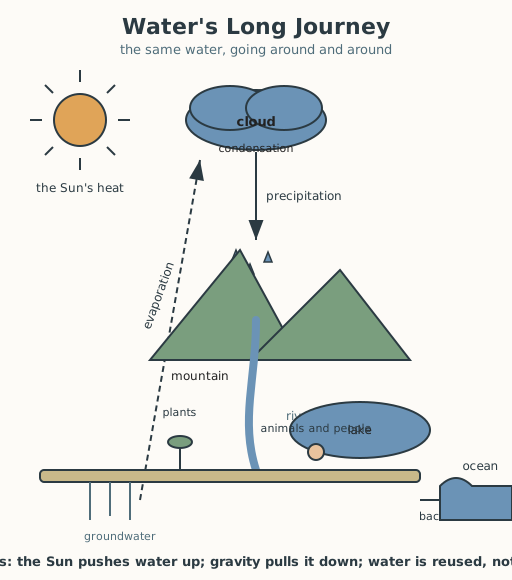
- Water-cycle poster · 1 A labeled water-cycle diagram — the Sun, evaporation, clouds, precipitation, mountains, rivers, lakes, groundwater, plants, animals, people, and the ocean — with arrows showing the flow
- Blank cycle-builder page · 1 per learner Empty boxes and arrows for the learner to fill in the water's journey and label each step
- Arrow cards · 8 per learner To place arrows in the direction the water travels
Low-tech / no-cost
- A drawn cycle in the dirt Draw the Sun, cloud, mountain, river, and ocean in the dirt and trace the water's path with a stick; no paper needed
- A body cycle Learners stand as Sun, ocean, cloud, rain, river, plant, and animal, and pass a ball of yarn (the water) around the cycle; no paper needed
Enriched / lab & device
- A simple water-cycle demonstration · 1 set A warm bowl of water, a clear cover, and a cool spot to watch evaporation and condensation happen in the classroom
- A device with a short water-cycle animation · 1 per group To watch the cycle in motion where devices are available
Works in different contexts
- large-group Build one large cycle on the board or floor together; learners take turns placing a labeled arrow and naming the step
- multi-age Younger learners name the steps (rain, river, ocean); older learners explain *why* it cycles (the Sun pushes it up, gravity pulls it down)
- self-directed A learner fills the blank cycle-builder page and checks each arrow to see whether the water really travels that way
- level-grouped Learners ready to extend add a second loop (water through a plant and an animal) and explain how it rejoins the main cycle
- outdoor-only After rain or near a puddle, river, or wet ground, trace where the water came from and where it will go next; no paper needed
Lesson 6 — Water’s Long Journey: A Cycle
Summary
Learners trace water through its cycle — ocean to evaporation to clouds to rain to rivers, ground, plants, animals, and people, and back. They learn the one rule every arrow follows (the direction water actually travels) and why the cycle turns: the Sun’s heat pushes water up, gravity pulls it down, and water is reused, not made new. They build a labeled cycle diagram and connect it to the water in their own lives.
Objectives
- Trace the path of water through a simple cycle and explain why it cycles. (D10.S3.05.01)
Connection
The water in your cup has been on a very long journey. It may have fallen as rain on a mountain, run into a river, soaked into the ground, and risen again into a cloud — long before it reached you. Whether you live by the sea, in a dry land, or beside a river, the same rule holds: water keeps moving, and the same water has been going around for a very long time. Today you learn to trace that journey.
Materials
- Water-cycle poster
- Blank cycle-builder page
- Arrow cards
- Pencils
Preparation
- Print or draw the water-cycle poster and a blank cycle-builder page for each learner.
- Cut arrow cards.
- If doing the demonstration, set out a warm bowl, a clear cover, and a cool surface.
Facilitator note
This lesson is written to the learner (“you”). The ideas to land are the path (ocean →
evaporation → cloud → precipitation → river/ground → plants, animals, people → back) and the
why (the Sun’s heat lifts water up; gravity pulls it down; water is reused, not created
new). Model the path once, then have learners build and check their own arrows. The water
cycle is evidence-based science (USGS, NASA document it); the gentle wonder that “the water
you drink has been around for ages” is a way to make it memorable, not a religious claim. Keep
the tone safe and curious, and name that water is not the same amount everywhere — some places
are dry and some wet, which the next lessons on care will return to. See docs/facilitation.md.
Procedure
- Gather (5 min). Recall from earlier grades: living things need water. Ask: where does water come from — and where does it go? Today you trace its whole journey.
- Meet the cycle (12 min). Look at the poster. Start at the ocean. The Sun’s heat turns some water into vapor that rises — evaporation. High and cool, the vapor gathers into clouds — condensation. When the drops grow heavy, they fall as rain or snow — precipitation. The water runs into rivers and lakes, soaks into the ground, and is taken up by plants, drunk by animals and people — collection. Then it flows back to the ocean, and the journey begins again. Trace it once with your finger.
- Build your own cycle (20 min). On your blank page, place the Sun, the ocean, a cloud, a mountain, a river, the ground, a plant, and a person. Draw arrows the way the water travels, and label each step — evaporation, condensation, precipitation, collection.
- Check your arrows (10 min). With a partner, follow every arrow and ask: “does water really travel that way?” Fix any arrow that points the wrong way. Then answer together: why does it cycle? (The Sun’s heat pushes water up; gravity pulls it down; water is reused, not made new.)
- Close (5 min). The water you drink has made this journey many times. It is never “used up” — it keeps going around. That is what a cycle is.
Differentiation
- Support: Provide a pre-drawn cycle with missing labels; learners add only the step names and arrowheads. Practice one loop aloud first.
- Extension: Add the water’s journey through a plant and an animal and explain how that water rejoins the main cycle (through breath, sweat, and waste).
Assessment
- Formative (observation): Can the learner place the steps of the water cycle in order and name why it cycles (Sun’s heat up, gravity down)?
- Self-check: The learner asks, “If I follow my arrows around, do I get back to where I started — and can I say what drives the cycle?”
Home connection
At home, notice water: rain, a tap, a puddle drying, steam from cooking. Pick one and tell someone where that water was before and where it will go next.
Resources
- The water cycle — evaporation, condensation, precipitation, and collection, driven by the
Sun’s energy and gravity — is documented by the U.S. Geological Survey (USGS, “The Water
Cycle”) and NASA Earth science, and is standard elementary science worldwide. The framing
that water is reused rather than created new follows the conservation-of-matter idea taught
in this grade band (
docs/development.md).