Lesson 10 — Our Earth Home: A Year-End Celebration
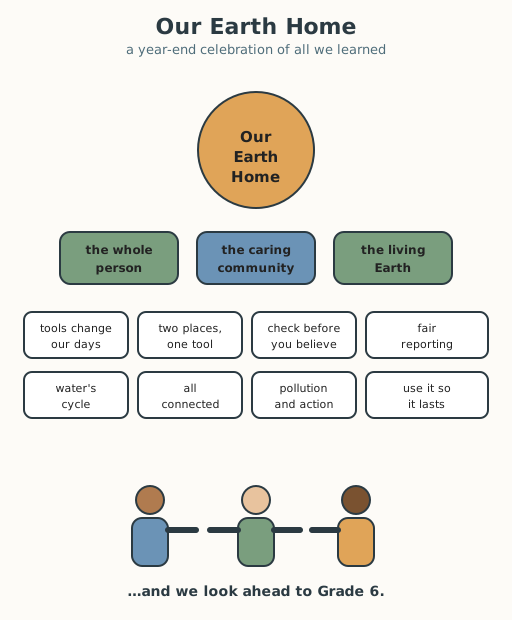
The capstone closes the unit — and the grade-5 year — in a celebration of the whole person, the caring community, and the living Earth. Learners assemble their eight portfolio artifacts, walk a gallery, and connect each to the big question, then name one thing they will do as stewards. The celebration is retrieval and synthesis, not re-reading, and it ends on joy and agency: looking ahead to Grade 6.
Objectives
Objectives
- D10.S1.05.01 Explain how a technology people use every day, such as a phone or a water pump, has changed daily life over time.
- D10.S1.05.02 Compare how people in two different places in the world use a similar technology differently, and suggest why.
- D10.S2.05.01 Evaluate whether a claim is likely true by checking more than one source and noting where they agree or disagree.
- D10.S2.05.02 Recognize when a message favors one side, and explain what fair reporting would include.
- D10.S3.05.01 Trace the path of energy or matter, such as water, through a simple cycle or food web, and explain why it cycles.
- D10.S3.05.02 Explain how living things in an ecosystem depend on one another and what can happen when one part changes.
- D10.S4.05.01 Describe a form of pollution or habitat loss and one thing people can do to reduce it.
- D10.S4.05.02 Explain what it means to use a resource carefully so it lasts, and give one example from their own life.
Essential question
How do tools, media, and the living Earth come together in one caring home — and where do I stand in it?
Key vocabulary
Materials
Standard materials
- Portfolio artifacts · 1 set per learner The learner's artifacts from this unit — the before–after chain, the two-places comparison, the claim-check page, the fair-reporting page, the water-cycle diagram, the ripple page, the pollution-and-action page, and the my-resource page
- Earth-home celebration web poster · 1 A poster showing the unit's threads joined to the whole person, the caring community, and the living Earth
- Capstone card · 1 per learner A card with prompts — choose one artifact, say how it connects to the big question, and name one thing you will do as a steward
- Pencils and art supplies · per learner
Low-tech / no-cost
- A portfolio circle Each learner holds one artifact and tells the circle how it connects to our Earth home; no poster or cards needed
- A spoken capstone The learner answers the capstone prompts aloud, choosing one artifact and one steward action; voice only
Enriched / lab & device
- A class celebration wall · 1 A wall or table where every learner's artifacts are displayed as a "gallery of our Earth home," walked and celebrated together
- A digital gallery (if devices are available) · 1 A simple slideshow or shared document where learners post a photo of one artifact and one sentence on how it connects to the big question
Works in different contexts
- large-group Do a gallery walk where learners move between displayed artifacts, then share one connection each in a closing celebration circle
- multi-age Younger learners show one artifact and say what it is; older learners explain its connection to the big question and lead the closing celebration
- self-directed A learner gathers their own artifacts, answers the capstone card prompts, and writes a short reflection on their place in our Earth home
- level-grouped Learners ready to extend write a one-paragraph synthesis linking two or more threads (tools, media, cycles, interdependence, care) with an example from the unit and one from their own life
- outdoor-only Lay the artifacts on a cloth on the ground as a "story path," walk it together, and each learner names one connection and one steward action aloud; no poster needed
Lesson 10 — Our Earth Home: A Year-End Celebration
Summary
The capstone closes the unit — and the grade-5 year — in a celebration of the whole person, the caring community, and the living Earth. Learners assemble their eight portfolio artifacts, walk a gallery, and connect each to the big question, then name one thing they will do as stewards. The celebration is retrieval and synthesis, not re-reading, and it ends on joy and agency: looking ahead to Grade 6.
Objectives
- Revisit and connect the unit’s eight threads — tools changing daily life, two places using a tool differently, checking claims, fair reporting, the water cycle, interdependence, pollution and action, and careful resource use — into one caring picture. (D10.S1.05.01, D10.S1.05.02, D10.S2.05.01, D10.S2.05.02, D10.S3.05.01, D10.S3.05.02, D10.S4.05.01, D10.S4.05.02)
Connection
A home is not one room but many rooms under one roof. All year, and all through this unit, you have been building rooms of your own — a tool traced from before to after, two places compared with respect, a claim checked, a message made fair, a water cycle drawn, a ripple traced, a problem named with a fix, and a resource used carefully. Today you walk through your whole home, admire every room, and see how it all fits together — because you are not just a guest in this world; you are someone who helps care for it.
Materials
- Portfolio artifacts (the learner’s own pages)
- Earth-home celebration web poster
- Capstone card
- Pencils and art supplies
Preparation
- Have each learner gather their artifacts from this unit (before–after chain, two-places comparison, claim-check page, fair-reporting page, water-cycle diagram, ripple page, pollution-and-action page, my-resource page).
- Print or draw the Earth-home celebration web poster.
- Copy a capstone card for each learner, and arrange a gallery wall or story path.
Facilitator note
This lesson is written to the learner (“you”). This is the unit’s capstone and summative
assessment, and the year-end celebration — a moment of retrieval and synthesis, not
re-reading. Keep the tone joyful, collective, and hopeful: success is shared, mastery is
individual, and no one is ranked. Land on agency and celebration — the learner is a whole
person in a caring community on a living Earth, and a steward who can act. If a learner’s
artifacts are incomplete, let them finish one now rather than be judged “done” or “not done.”
This lesson completes the unit’s portfolio and looks ahead to Grade 6. See
docs/facilitation.md on assessing without ranking.
Procedure
- Gather (5 min). Look back with a partner: what did we learn this unit? Take turns recalling one thing each — a tool’s before and after, two places using one tool, a claim checked, a fair message, water’s cycle, a ripple, a problem with a fix, a careful use. This is retrieval: pulling it out of memory, not re-reading it.
- Assemble your rooms (15 min). Lay out your eight artifacts in order: your before–after chain, two-places comparison, claim-check page, fair-reporting page, water-cycle diagram, ripple page, pollution-and-action page, and my-resource page. Check each is complete; finish any that need it.
- Walk the gallery (20 min). Display the artifacts and walk the gallery. At each page, notice what it shows about our Earth home. Then, on your capstone card, answer three prompts: Choose one artifact you are proud of. Say how it connects to the big question — how tools, media, and the living Earth come together in one caring home. Name one thing you will do as a steward.
- Close the circle (15 min). Gather. Each learner shares their chosen artifact and their one steward action — one sentence is enough. Listen to how many rooms make up this one home.
- Look ahead (5 min). The year is not the end of the story. In Grade 6, you will go deeper into all of it — who designs technology, how to read a flood of information, and how living systems recover. You are not only learning about the world; you are learning to care for it.
Differentiation
- Support: Choose one artifact with the learner and scribe their capstone card; celebrate completion of a single page rather than all eight.
- Extension: Write a one-paragraph synthesis linking two or more threads (tools, media, cycles, interdependence, care) with an example from the unit and one from your own life.
Assessment
- Summative (portfolio): The learner’s assembled artifacts — the before–after chain, the two-places comparison, the claim-check page, the fair-reporting page, the water-cycle diagram, the ripple page, the pollution-and-action page, and the my-resource page — together show mastery of the unit’s eight standards.
- Peer/self: In the circle, learners listen and each names one connection they heard and one steward action they will take.
- Self-check: The learner asks, “Did I connect my artifact to the big question, and did I name a real thing I will do to care for people and the Earth?”
Home connection
Share your whole portfolio with someone at home — walk them through your rooms like a gallery — and tell them the one steward action you chose for the year ahead.
Resources
- This capstone synthesizes the unit’s documented content: technology’s before-and-after effects
(World Bank, ITU); mobile money and the many uses of bicycles and water pumps (CGAP, UN
Water); claim-checking and fair reporting (UNESCO Media and Information Literacy; Common
Sense Media); the water cycle (USGS, NASA); ecosystem interdependence and ripples (BBC
Bitesize, NOAA, UNESCO); plastic and air pollution and habitat loss with actions (UNEP, WHO,
FAO); and careful resource use (UNESCO ESD). Each is cited in its own lesson. The closing
commitment to the whole person, caring community, and living Earth — and to acting as a
steward — follows
docs/philosophy.md§12 anddocs/vision.md.