Lesson 09 — Use It Carefully So It Lasts
Learners explain what it means to use a resource carefully so it lasts and give one example from their own life. A worked example contrasts careless water use (tap left running) with careful use (tap off, a bucket, leaks fixed), landing the rule: use less than comes back, and it lasts. Learners then choose water, food, paper, electricity, or fuel/wood and write one careful use from their own life, connecting it to fairness for people today and for people not born yet.
Objectives
Objectives
- D10.S4.05.02 Explain what it means to use a resource carefully so it lasts, and give one example from their own life.
Essential question
What does it mean to use a resource carefully so it lasts, and what is one example from my own life?
Key vocabulary
Materials
Standard materials
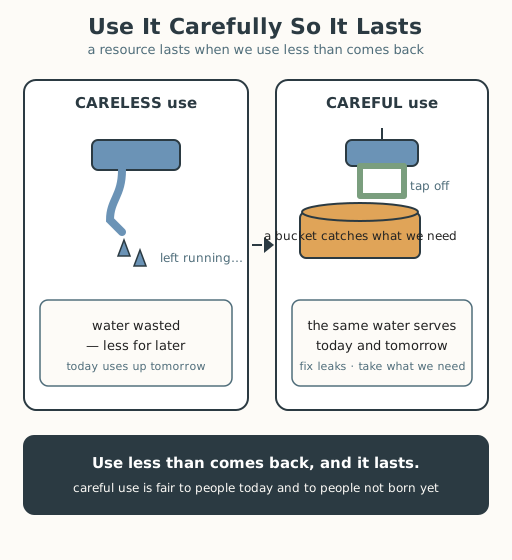
- Careful-use poster · 1 A poster contrasting careless water use (tap left running, water wasted) with careful use (tap off, a bucket, leaks fixed), with the line "use less than comes back, and it lasts"
- Resource cards · 1 set per pair Cards for water, food, paper, electricity, and fuel/wood, each naming one careless use and one careful use
- My-resource page · 1 per learner A page to choose one resource the learner uses every day and write or draw one careful use and why it matters
Low-tech / no-cost
- A spoken careful-use chain Name a resource and learners call out a careless use and a careful use for it; voice only
- A two-column page in the dirt Draw "careless" and "careful" columns and place a stone or leaf under each for one resource; no paper needed
Enriched / lab & device
- A short set of images of careful resource use · 1 set Photographs of a drip-irrigation line, a refill station, a recycled-paper pile, and a solar cooker, to show careful use in action
- A device to log one week of careful use · 1 per learner A simple note app or photo log to record one careful action each day, where devices are available
Works in different contexts
- large-group Do the water example together on the poster, then have pairs work a resource card and report "careless use ___, careful use ___" in one sentence
- multi-age Younger learners name one careful use; older learners explain why it matters for people today and in the future
- self-directed A learner chooses one resource, fills the my-resource page, and writes one careful use from their own life and why it matters
- level-grouped Learners ready to extend compare two resources and explain which one needs more careful use, with reasons
- outdoor-only Find one resource in use nearby (water, wood, soil, plants) and name a careless and a careful way to use it; no paper needed
Lesson 9 — Use It Carefully So It Lasts
Summary
Learners explain what it means to use a resource carefully so it lasts and give one example from their own life. A worked example contrasts careless water use (tap left running) with careful use (tap off, a bucket, leaks fixed), landing the rule: use less than comes back, and it lasts. Learners then choose water, food, paper, electricity, or fuel/wood and write one careful use from their own life, connecting it to fairness for people today and for people not born yet.
Objectives
- Explain what it means to use a resource carefully so it lasts, and give one example from their own life. (D10.S4.05.02)
Connection
If you eat the last of the rice today, there is none for tomorrow — unless more is growing. A resource lasts when we use less than comes back: we take what we need, we do not waste, and we leave some for later. The water you turn off, the paper you reuse, the food you do not throw away — each is a small choice that keeps a resource going for the next person, and the next generation. Today you name the choice you can make in your own life.
Materials
- Careful-use poster
- Resource cards
- My-resource page
- Pencils
Preparation
- Print or draw the careful-use poster.
- Copy resource cards for each pair and a my-resource page for each learner.
Facilitator note
This lesson is written to the learner (“you”). The idea to land is the “use less than comes
back” rule and its fairness reason: careful use is fair to people today and to future people.
Model the water example fully as a worked example, then have learners choose their own
resource and their own-life example. This builds on Grade 3 (renewable vs. non-renewable
resources) and on this unit’s cycle and stewardship lessons. Distinguish evidence from values:
that resources can be used up or wasted is observable; that we ought to use them fairly,
across today and tomorrow is a value we hold. Honor that careful use looks different in
different lives — a learner without a tap cannot “turn off the tap,” so keep examples broad
(water, food, paper, fuel, electricity) and let each learner pick what fits their life. See
docs/facilitation.md.
Procedure
- Gather (5 min). Recall the water cycle: water keeps going around. But what about the water you use — and food, paper, fuel, and electricity? Some can be used up if we are not careful. Today you learn what “careful” means.
- Meet careful use (12 min). Look at the poster. Careless use: the tap runs, water spills, less is left for later. Careful use: the tap is off, a bucket catches what we need, leaks are fixed — the same water serves today and tomorrow. The rule: use less than comes back, and it lasts. This is fairness too: careful use leaves something for the next person, and the next generation.
- Choose your own resource (18 min). Pick a resource you use every day — water, food, paper, electricity, or fuel/wood. On your my-resource page, write or draw one careless use and one careful use from your own life, and one sentence on why it matters. (If you have no tap, choose food or paper or fuel instead.)
- Share with a partner (10 min). Tell your partner: “I use ___; a careful way I can use it is ___, so it lasts for ___.” Ask: is the careful use real, and could you actually do it starting today?
- Close (5 min). Careful use is not about doing without — it is about leaving enough for everyone, now and later. One small careful choice, made again and again, is stewardship.
Differentiation
- Support: Provide a resource card with the two uses partly filled in and a sentence starter; work one resource aloud first.
- Extension: Compare two resources and explain which one needs more careful use, and how your own choice changes that.
Assessment
- Formative (observation): Can the learner state the “use less than comes back” idea and give one real, own-life example of careful use?
- Portfolio artifact: The my-resource page, kept for the year-end celebration.
Home connection
Choose one resource at home and make one careful-use choice each day this week — turn off a light, finish your food, reuse a bag. Tell someone why it matters for the future.
Resources
- The idea that a resource lasts when use stays below what renews or returns is the core of
sustainable use, taught in age-appropriate terms by UNESCO (Education for Sustainable
Development) and UNEP. The renewable/non-renewable distinction (Grade 3) and the
reduce-reuse-recycle ladder (Grade 4) lead into this lesson. The fairness-to-future-generations
framing follows
docs/philosophy.md§4 and §12.