Lesson 03 — What I Feel vs What I Show
Learners discover that what a person shows on the outside and what they feel on the inside can be different — sometimes on purpose, sometimes not. They learn that people manage their face for many good reasons, that both the outside and the inside are real, and that noticing the difference is a skill for understanding themselves and others without judging either side as fake.
Objectives
Objectives
- D01.S1.06.02 Distinguish what a person feels from what a person shows, and guess the feeling behind a behavior.
Essential question
Why can what I show on the outside be different from what I feel on the inside?
Key vocabulary
Materials
Standard materials
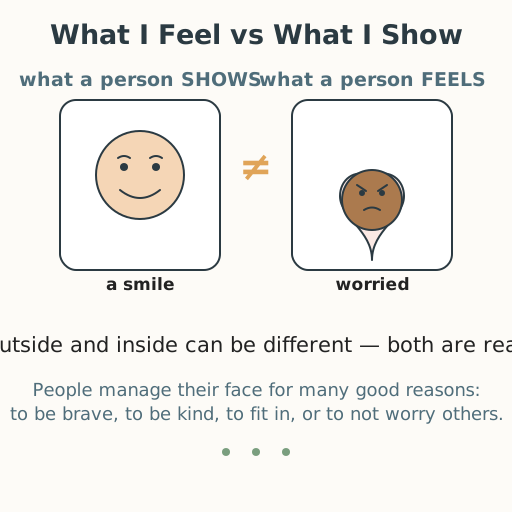
- Feel-vs-show poster · 1 A poster showing one face on the outside (a smile) and a different feeling on the inside (worried), side by side
- Inside/outside page · 1 per learner A page with an outline of a face (outside) and a heart (inside) for the learner to fill in two different things
- Pencils and crayons · per learner
Low-tech / no-cost
- A mask drawn or mimed Draw a face outline in the dirt, or mime holding a smiling mask over a worried face; no page needed
- Voice and body Say the outside and the inside aloud in two different tones to hear the difference; no poster needed
Enriched / lab & device
- Laminated inside/outside masks · 1 per pair Reusable two-sided face cards (smiling one side, worried the other) to flip and discuss
- A class 'faces we choose' photo set · 1 set A set of photos or drawings of the same person showing different faces in different moments, to discuss reasons
Works in different contexts
- large-group Show the poster large and discuss one worked example together, then have pairs fill in their own inside/outside page and share one reason each
- multi-age Younger learners point to the outside face and the inside feeling while older learners name a *reason* a person might manage their face
- self-directed A learner fills the inside/outside page for one real (small, safe) moment of their own and writes the reason for the difference
- level-grouped Learners ready to extend distinguish "managing my face for a good reason" from "hiding something I need help with," and name when to ask for help
- outdoor-only Mime a mask with your hands — a smile held over a worried face — and say the outside and inside aloud; no paper needed
Lesson 3 — What I Feel vs What I Show
Summary
Learners discover that what a person shows on the outside and what they feel on the inside can be different — sometimes on purpose, sometimes not. They learn that people manage their face for many good reasons (to be brave, to be kind, to fit in, to avoid worrying others), that both sides are real, and that noticing the difference is a skill for understanding themselves and others — without judging either side as “fake.”
Objectives
- Distinguish what a person feels from what a person shows, and guess the feeling behind a behavior. (D01.S1.06.02)
Connection
A dancer walks on stage looking calm and bright, while inside her chest is hammering. A friend smiles when you wave, though something inside them is heavy. An athlete at the starting line looks still, while inside there is a storm. The outside is what the world sees; the inside is what the person lives. Both are true at the same time. Learning to tell them apart helps you read a room, care for a friend, and understand your own face too — in a city, on a farm, or anywhere people are together.
Materials
- Feel-vs-show poster
- Inside/outside page
- Pencils and crayons
Preparation
- Print or draw the feel-vs-show poster (a smiling outside beside a worried inside).
- Copy an inside/outside page for each learner.
- Arrange a circle for discussion.
Facilitator note
This lesson is written to the learner (“you”). The idea to land is that the outside and
the inside can differ, and both are real — not that “hiding feelings is lying.” Managing
one’s face is a normal, often kind and necessary skill in every culture. Normalize it
without shame, and name that different families and cultures have different habits about
how much feeling to show — none “correct.” At the same time, gently flag the boundary a
learner should know: managing a face for a good reason is different from hiding something
they need help with. Invite only small, safe examples; never push a learner to reveal a
hidden pain. See docs/facilitation.md and docs/art-style.md.
Procedure
- Gather (5 min). Last time you named what sets a feeling off. Today you learn that the feeling a person has and the face a person shows can be two different things.
- Meet the two sides (10 min). Look at the poster. On the outside, a smile. On the inside, worried. The symbol between them means “not the same.” Why might a person do this? Worked example: to be brave before a test, to be kind so a friend doesn’t worry, to fit in, or simply because the face hasn’t caught up with the feeling yet. Managing our face is a real human skill — and it is not the same as being fake.
- Fill your own two sides (15 min). Think of one small, safe moment this week when your outside and inside were different. On your page, draw or write what you showed (outside) and what you felt (inside), and one sentence about why. Share with a partner if you are comfortable.
- The question that matters (10 min). Discuss together: when is managing your face helpful or kind, and when might it be a sign you need to talk to someone you trust? Write down one thing that helps you tell the difference.
- Close (5 min). Your outside and inside are both real. Noticing both is how you understand yourself — and how you begin to read the people around you.
Differentiation
- Support: Provide a word bank of inside feelings and outside faces, and sentence starters (“I showed ___, but inside I felt ___, because ___”).
- Extension: Write two moments — one where managing your face helped someone, and one where sharing the inside would have helped you more.
Assessment
- Formative (observation): Can the learner state an outside and a different inside, and give a reason for the difference?
- Self-check: The learner rereads their page and checks that they described both sides (not just one) and that the reason makes sense.
Home connection
Ask someone at home about a time they showed one face while feeling another — and share one small example of your own if you like.
Resources
- The distinction between felt emotion and outward display, and the social reasons people manage their expression, is studied in the psychology of emotion and emotion regulation (see the work of Paul Ekman on facial expression and James Gross on emotion regulation). For classroom framing, see CASEL’s self-awareness and social-awareness competencies: https://casel.org/fundamentals-of-sel/