Lesson 04 — Guessing the Feeling Behind a Behavior
Learners practice reading the feeling behind a behavior the way a fair detective would: a behavior is a clue, not a label. They guess several possible feelings behind it, then — crucially — they check with the person instead of assuming. This builds empathy and fairness: guessing generously and checking treats the other person as the expert on their own feelings.
Objectives
Objectives
- D01.S1.06.02 Distinguish what a person feels from what a person shows, and guess the feeling behind a behavior.
Essential question
How do I read the feeling behind a behavior — without assuming?
Key vocabulary
Materials
Standard materials
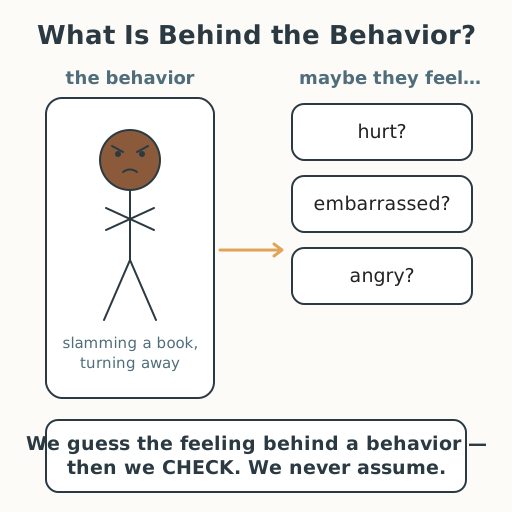
- Behavior detective poster · 1 A poster showing a behavior (slamming a book, turning away) with several possible feelings behind it, plus a "check" step
- Guess-then-check cards · 1 set per pair Cards describing a behavior; learners guess possible feelings behind it and write a check question
- Pencils · per learner
Low-tech / no-cost
- A guess-then-check path on the ground Draw two stones — guess and check — and step from one to the other while saying a behavior, a guess, and a check question aloud
- Role-play In pairs, act out a behavior, then practice a kind check question; no cards needed
Enriched / lab & device
- Laminated guess-then-check strips · 1 per pair Reusable strips with dry-erase markers to rehearse many behaviors, guesses, and check questions
- A class 'feeling detective' scenario bank · 1 A shared set of short invented scenes from many places and lives to practice reading feelings behind behaviors
Works in different contexts
- large-group Model one scenario together, then have small groups work through two scenarios and share out their check questions
- multi-age Younger learners name one possible feeling while older learners name two or three and write a kind check question
- self-directed A learner works through a scenario card alone, writing two guesses and a check question, then reads it back to check it is kind
- level-grouped Learners ready to extend compare "a guess" with "an assumption," and write why checking is fairer than assuming
- outdoor-only Step along a two-stone path — guess, then check — speaking a behavior, two guesses, and a check question aloud; no paper needed
Lesson 4 — Guessing the Feeling Behind a Behavior
Summary
Learners practice reading the feeling behind a behavior the way a fair detective would: a behavior is a clue, not a label. They guess several possible feelings behind it, then — crucially — they check with the person instead of assuming. This builds empathy and fairness: guessing generously and checking treats the other person as the expert on their own feelings.
Objectives
- Distinguish what a person feels from what a person shows, and guess the feeling behind a behavior. (D01.S1.06.02)
Connection
A classmate slams a book and turns away. Is she angry? Maybe. Or maybe she is hurt by a word she overheard, or embarrassed about a mistake, or simply tired after a sleepless night. The behavior is the same; the feeling behind it could be many things. If you assume you know, you might treat her wrong. If you guess and then check — “hey, you seem off — everything okay?” — you treat her as the expert on her own feelings. That is fairer, everywhere people live together.
Materials
- Behavior detective poster
- Guess-then-check cards
- Pencils
Preparation
- Print or draw the behavior detective poster (a behavior → several possible feelings → a “check” step).
- Prepare guess-then-check scenario cards.
- Arrange a circle and space for paired role-play.
Facilitator note
This lesson is written to the learner (“you”). The idea to land is guess, then check —
never assume. This is the unit’s clearest ethics moment: assuming a feeling can misjudge
and hurt a person; checking treats them with respect and fairness. Use invented
scenarios or story characters only — never real classmates — so no learner is analyzed or
labeled in front of peers. Emphasize that a behavior is a clue, not a verdict, and that
the person themselves is the best source. This aligns with the egalitarian lens: checking
is how we treat every person as their own expert. See docs/facilitation.md on holding
difficult topics safely and docs/contexts.md on cultural power dynamics (in some settings,
asking directly may need to be gentle and private).
Procedure
- Gather (5 min). Last time you saw that what a person shows can differ from what they feel. Today you become a feeling detective: you read the clue and you check your guess.
- Meet the detective’s rule (10 min). Look at the poster. A behavior — slamming a book, turning away — is a clue, not a label. A fair detective makes more than one guess: hurt? embarrassed? angry? tired? Then the detective checks — kindly asks or notices more — instead of deciding. Worked example: “She slammed the book. My guesses: hurt, embarrassed, or just having a rough morning. My check: ‘You seem upset — want to talk, or do you need a minute?’”
- Practice guess-then-check (15 min). With a partner, take two scenario cards. For each, name the behavior, offer two or three possible feelings behind it, and write or say a kind check question. Swap roles and notice: how does checking feel different from assuming?
- Guess vs assume (10 min). Discuss: what is the difference between a guess (I think it might be this, let me check) and an assumption (I know it is this)? Why is checking fairer to the other person — and why is it also fairer to you?
- Close (5 min). A clue is not a verdict. Guessing with more than one possibility and then checking is how we treat each person with respect.
Differentiation
- Support: Provide a word bank of feelings and pre-written check questions to choose from and read aloud.
- Extension: Write why checking is fairer to both people, and describe a time (real or invented) when a checked guess would have helped.
Assessment
- Formative (performance): In paired work, can the learner name a behavior, offer two or three possible feelings behind it, and give a kind check question?
- Self-check: The learner rereads their check question and asks, “Is this kind, and does it leave room for the person’s real answer?” and revises if not.
Home connection
This week, when someone’s behavior puzzles you, try the detective’s rule: make two guesses about the feeling behind it, then check kindly instead of assuming.
Resources
- “Guessing, then checking” is a practice of empathy and perspective-taking central to social awareness; assuming a feeling from a behavior can misjudge, which is why checking matters (CASEL social-awareness competency): https://casel.org/fundamentals-of-sel/