Lesson 05 — My Identity Is Many Parts
Learners map their identity as many connected parts — family, culture, language, interests, beliefs, place, and friendships — adding "beliefs" to the map they began in Grade 5. They honor that every family shape, culture, language, and belief system is ordinary and whole, and celebrate the many different maps in the room as a shared strength.
Objectives
Objectives
- D01.S2.06.01 Describe their identity as made of many parts that can shift by context, such as family, culture, language, interests, and beliefs.
Essential question
What are the many parts that make me, me — and why does every part belong?
Key vocabulary
Materials
Standard materials
- Many-parts identity map poster · 1 A poster of a center "me" with connected bubbles — family, culture, language, interests, beliefs, place, friendships
- Blank many-parts map page · 1 per learner A page with a center "me" and empty bubbles for the learner to fill in
- Pencils and crayons · per learner
Low-tech / no-cost
- A map drawn in the dirt or sand Draw a center "me" and bubbles on the ground, placing a stone in each while naming that part of you
- A spoken map Say your map aloud — center "me," then each part — no paper needed
Enriched / lab & device
- Laminated many-parts map with dry-erase markers · 1 per learner A reusable map to update as the learner's identity grows across the year
- A class identity-map gallery · 1 A wall of maps read side by side, celebrating the many family shapes, languages, and beliefs in the room
Works in different contexts
- large-group Build one shared map together, then have learners fill their own in small groups and post them for a gallery walk
- multi-age Younger learners draw each part while older learners label it and write a sentence about one part that matters most to them
- self-directed A learner fills their map, then writes two sentences — one naming their parts, and one naming a part they are proud of
- level-grouped Learners ready to extend connect two bubbles with a line and write how those two parts of their identity meet in their life
- outdoor-only Build the map on the ground with stones and sticks, each object standing for a part of you, then walk and name each part; no paper needed
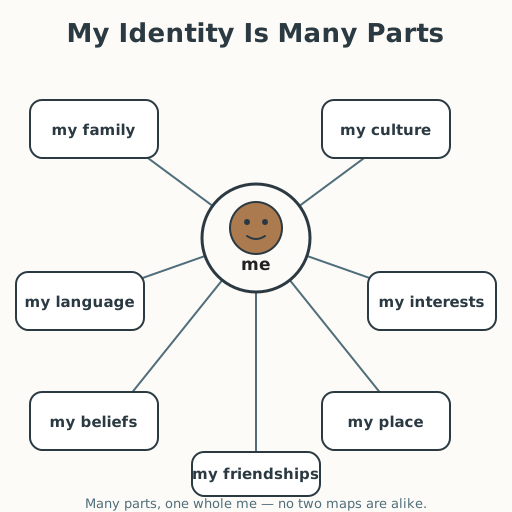
Lesson 5 — My Identity Is Many Parts
Summary
Learners map their identity as many connected parts — family, culture, language, interests, beliefs, place, and friendships. This grows the map they began in Grade 5 (family, culture, place, history) by adding beliefs — the ideas and values a person holds. They honor that every family shape, culture, language, and belief system is ordinary and whole, and celebrate the many different maps in the room as a shared strength.
Objectives
- Describe their identity as made of many parts that can shift by context, such as family, culture, language, interests, and beliefs. (D01.S2.06.01)
Connection
Draw a dot in the middle and call it me. Now draw a ring of bubbles around it — the people who care for you, the language(s) you speak, the food and music you love, the place you call home, the things you are interested in, the beliefs that guide you. That ring is your identity: not one single thing, but many parts at once. A child raised by grandparents, a child in a blended family, a child who moved across the sea, a child who speaks three languages — each has a map that is whole and true. No map is “more complete” than another.
Materials
- Many-parts identity map poster
- Blank many-parts map page
- Pencils and crayons
Preparation
- Print or draw the many-parts identity map poster (center “me,” ring of connected bubbles).
- Copy a blank many-parts map page for each learner.
- Arrange a space for a gallery walk at the end.
Facilitator note
This lesson is written to the learner (“you”). The idea to land is that identity has
many connected parts, and every shape of family, culture, language, and belief is whole
and worthy. This is the unit’s deepest “honor every family” moment: be explicit that
families come in many shapes — two parents, one parent, grandparents, adoptive or foster
parents, siblings, chosen family, blended families — and that all belong; model adoption,
moving, and multilingualism as ordinary, not “special cases.” Beliefs are personal and
optional to share — invite learners to include beliefs (values, faith, worldview) only if
they choose, and never rank any belief system. The gallery walk should celebrate
difference, never compare maps as better or worse. See docs/facilitation.md and
docs/art-style.md.
Procedure
- Gather (5 min). In Grade 5 you drew parts of you: family, culture, place, history. Today you add a new part — beliefs — and draw the whole map again, with everything on it.
- Meet the map (10 min). Look at the poster: a center me with bubbles around it — my family, my culture, my language, my interests, my beliefs, my place, my friendships. Worked example: one child’s map has “my grandmother” (family), “my two languages” (culture), “the village by the river” (place), “football” (interests), and “I believe people should be treated fairly” (beliefs). Every bubble is a real thread. Beliefs are the ideas and values you hold — and they are yours to include or keep private.
- Draw your map (20 min). On your page, write me in the center, then draw your own bubbles and fill each one. Add any part that matters — a friend, a faith, an ability, a dream. Your map is yours; there is no “right” way to be a family, to speak, or to believe.
- Gallery walk (10 min). Walk quietly and look at the maps around the room. Notice: how many family shapes? How many languages? How many beliefs? Each map is whole and true. Find one thing on someone else’s map you admire. (Learners who do not stand or walk can stay seated and have the maps passed hand to hand around the circle, or posted at seated height — everyone sees every map either way.)
- Close (5 min). You are many parts, one whole self — and every person’s map deserves honor. Carry that with you.
Differentiation
- Support: Provide pre-drawn bubbles with picture prompts to fill in; scribe labels as needed.
- Extension: Connect two bubbles with a line and write one sentence about how those two parts meet in your life (e.g., “my language and my beliefs meet at our family meals”).
Assessment
- Formative (observation): Can the learner produce a map with several connected parts and name how at least one part shapes who they are?
- Portfolio: The identity map, kept as a growing artifact to revisit in Lessons 6 and 10 and later in the year.
Home connection
Show someone at home your map and invite them to add one bubble you may not have thought of — a story, a place, a person, a belief, or a dream.
Resources
- A many-part identity and positive belonging connect to CASEL’s self-awareness and social-awareness competencies; the idea that identity includes multiple dimensions (family, culture, language, beliefs) is foundational in the study of identity development: https://casel.org/fundamentals-of-sel/