Lesson 07 — Peers and Media Shape My Self-Image
Learners examine two forces that shape self-image — peers and media — and learn to notice their influence without fear or shame. They see that peer opinions and media images are like mirrors, and that some mirrors are warped (edited, curated, partial). Noticing the influence — and asking who is left out of an image — turns a passive feeling of "less-than" into an active, critical skill.
Objectives
Objectives
- D01.S2.06.02 Examine how peers and media can influence self-image, and describe a healthy response to negative comparison.
Essential question
How do peers and media shape how I see myself — and how can I notice it?
Key vocabulary
Materials
Standard materials
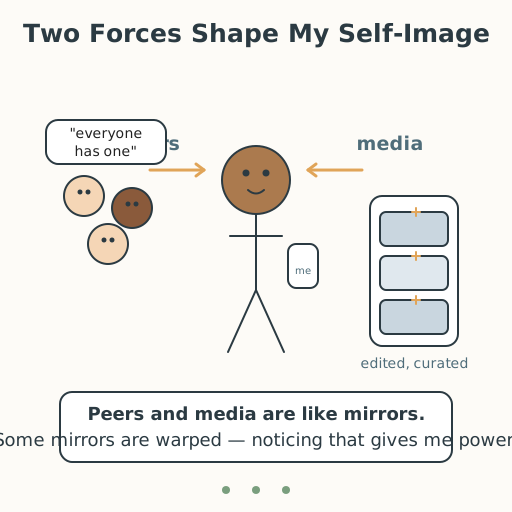
- Two-forces poster · 1 A poster showing a center "how I see myself" with two arrows coming in — peers (a group's opinion) and media (a screen of curated images)
- Notice the influence page · 1 per learner A page with two columns — what peers make me notice / what media makes me notice — for the learner to complete
- Pencils · per learner
Low-tech / no-cost
- Two arrows drawn on the ground Draw a center "me" and two arrows (peers, media) in the dirt, and stand on each while naming what it makes you notice
- Voice and body Say aloud a peer opinion and a media image, then name the feeling each stirs; no page needed
Enriched / lab & device
- A curated-image sorting set · 1 per group Printed images (magazine pages, ads) to sort into "whole picture" and "edited highlight" and discuss what is left out
- A class 'media lens' chart · 1 A shared chart where learners post one thing media made them notice about themselves, and one thing they know is real
Works in different contexts
- large-group Discuss the two forces together, then have small groups complete the page and share out one influence each
- multi-age Younger learners point to what a peer or a picture makes them notice while older learners explain how an image can be edited or partial
- self-directed A learner fills both columns for their own life and writes one sentence about how noticing an influence gives them power
- level-grouped Learners ready to extend ask "who is left out of this image, and who benefits?" — the egalitarian question — and write a short answer
- outdoor-only Walk between two arrows drawn on the ground — peers, media — naming what each makes you notice; no paper needed
Lesson 7 — Peers and Media Shape My Self-Image
Summary
Learners examine two forces that shape self-image — peers and media — and learn to notice their influence without fear or shame. They see that peer opinions and media images are like mirrors, and that some mirrors are warped: edited, curated, partial. Noticing the influence — and asking the egalitarian question, who is left out of this image? — turns a passive feeling of “less-than” into an active, critical skill.
Objectives
- Examine how peers and media can influence self-image, and describe a healthy response to negative comparison. (D01.S2.06.02)
Connection
You scroll through a feed of perfect, bright photos — and suddenly your own day feels a little smaller. A friend shrugs and says “that’s not cool anymore” — and you doubt the thing you quietly loved. Neither your peers nor the screen is evil; they are just mirrors, and some mirrors are warped. Media shows curated highlight reels — the best two seconds, the best angle, often edited — not a whole life. Peers show their own narrow idea of what is “in.” Learning to notice the mirror — and to ask what it is leaving out — is how you keep your own picture of yourself clear.
Materials
- Two-forces poster
- Notice the influence page
- Pencils
Preparation
- Print or draw the two-forces poster (center “how I see myself” ← peers and media).
- Copy a “notice the influence” page for each learner.
- Arrange a circle for discussion.
Facilitator note
This lesson is written to the learner (“you”). The idea to land is notice the
influence, without fear or shame — media and peers are not villains to be feared, but
forces to be read critically. Do not imply that using media is bad or that liking what
peers like is weak; belonging is a real human need. The power move is awareness: knowing
a feed is curated, that an ad has a goal, and that a peer’s “in” opinion is one opinion.
Carry the egalitarian lens lightly but clearly: media often shows a narrow idea of a
“good” life (certain bodies, wealth, certain places) and quietly leaves everyone else out;
asking who is left out? and who benefits? is how learners stay clear-eyed. Keep it
hopeful: always end on agency — you can curate your own feed, choose your company, and
remember that feeds are edited, not real lives. See docs/facilitation.md and
docs/philosophy.md §4–5.
Procedure
- Gather (5 min). You have mapped your many parts and seen them shift. Today you look at two outside forces that shape the picture you hold of yourself — peers and media.
- Meet the two mirrors (10 min). Look at the poster. Your self-image is the picture you hold of yourself. Two mirrors keep reflecting into it. Peers: what friends value, compare, and say (“everyone has one”). Media: screens, ads, and feeds showing curated highlight reels — the best moments, often edited. Worked example: a feed of perfect photos can make you feel “less”; a friend’s “that’s not cool” can make you doubt what you like. Neither mirror is evil — but some are warped.
- Notice your own mirrors (15 min). On your page, fill two columns: what peers make you notice about yourself, and what media makes you notice. Be gentle and honest — this is noticing, not judging. Check with a partner: did they notice something you didn’t?
- Ask who is left out (10 min). Pick one image or opinion from your columns. Ask the critical questions: who is left out of this picture? who benefits from me feeling “not enough”? Discuss one answer with your partner. Then write one thing you know is real about you that the mirror missed.
- Close (5 min). You do not have to break the mirror — just notice it. A person who can read a warped mirror is free of it.
Differentiation
- Support: Provide picture prompts (an ad, a group opinion) and sentence starters (“This makes me notice ___; the mirror might be leaving out ___”).
- Extension: Write the egalitarian question in your own words and give one example of a group of people a certain kind of media image tends to leave out.
Assessment
- Formative (observation): Can the learner name one peer influence and one media influence on self-image, and one thing the “mirror” leaves out?
- Self-check: The learner rereads their page and asks, “Did I notice both mirrors, and did I name something real the mirror missed?” and adds to it if not.
Home connection
This week, when a feed or a friend’s opinion makes you notice yourself, pause and ask: what is this mirror leaving out? Share what you find with someone you trust.
Resources
- Research on media and peer influence on self-image and body image (e.g., Common Sense Media’s reports on social media and adolescent well-being; the social comparison work of Leon Festinger) supports the framing that curated, edited images can distort self-perception. For classroom SEL framing, see CASEL’s self-awareness competency: https://casel.org/fundamentals-of-sel/