Lesson 08 — A Healthy Response to Negative Comparison
Learners practice a healthy response to negative comparison. Comparing is normal; the problem is comparing our whole, messy real life to someone else's edited highlight. The healthy response is a four-step move — notice, name, reframe, act — that returns them to self-compassion and their own growth, without suppressing the feeling or putting the other person down.
Objectives
Objectives
- D01.S2.06.02 Examine how peers and media can influence self-image, and describe a healthy response to negative comparison.
Essential question
When comparing myself makes me feel less, what can I do that is healthy?
Key vocabulary
Materials
Standard materials
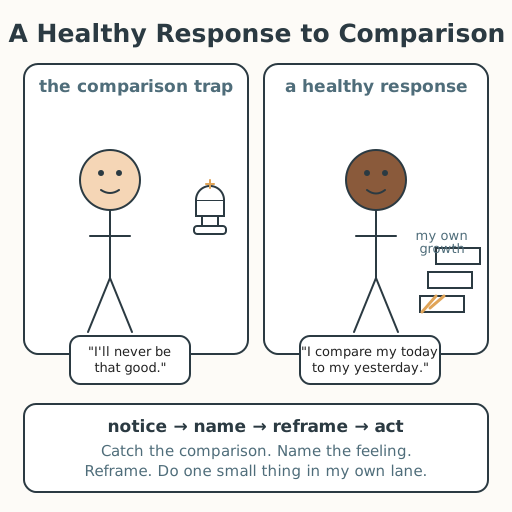
- Comparison poster · 1 A two-panel poster — the comparison trap (looking at someone else's highlight and feeling "less") and a healthy response (comparing to my own growth)
- Notice–name–reframe–act page · 1 per learner A four-step page for the learner to work through a real (small, safe) comparison
- Pencils · per learner
Low-tech / no-cost
- A four-step path drawn on the ground Draw four stepping stones — notice, name, reframe, act — and step through them aloud for one comparison; no page needed
- Voice and body Say a comparison aloud, then say the reframe aloud in a kinder tone to hear the shift; no poster needed
Enriched / lab & device
- Laminated notice–name–reframe–act strips · 1 per pair Reusable strips with dry-erase markers to rehearse healthy responses to many comparison scenarios
- A class 'my own lane' growth wall · 1 A wall where learners post one small thing they can do today that grows *their own* skill, not someone else's
Works in different contexts
- large-group Work one worked example together, then have small groups rehearse the four steps for a scenario and share out one reframe each
- multi-age Younger learners name the feeling a comparison stirs while older learners write the reframe and the small act
- self-directed A learner works through the four steps for a real (small, safe) comparison of their own and reads the reframe back to check it is kind
- level-grouped Learners ready to extend distinguish "comparing to others" from "learning from others," and write why one helps and one hurts
- outdoor-only Step along four stones — notice, name, reframe, act — speaking each aloud for a small comparison; no paper needed
Lesson 8 — A Healthy Response to Negative Comparison
Summary
Learners practice a healthy response to negative comparison. Comparing is normal; the problem is comparing our whole, messy, real life to someone else’s edited highlight. The healthy response is a four-step move — notice, name, reframe, act — that returns them to self-compassion and their own growth, without suppressing the feeling and without putting the other person down.
Objectives
- Examine how peers and media can influence self-image, and describe a healthy response to negative comparison. (D01.S2.06.02)
Connection
You see a friend’s perfect drawing — or their perfect game, or their perfect photo — and your own hand stops. A small voice says, “I’ll never be that good.” That is a negative comparison, and almost everyone has it. The healthy response is not “I’m better than them” (that’s just another comparison) and not “I’ll never be good” (that’s giving up). It is turning back to your own lane: compare your today to your yesterday, name what is real, and do one small thing that grows you. A runner does not win by staring at the runner beside her; she runs her own race — on a track, a trail, or a village road.
Materials
- Comparison poster
- Notice–name–reframe–act page
- Pencils
Preparation
- Print or draw the comparison poster (the trap vs the healthy turn).
- Copy a notice–name–reframe–act page for each learner.
- Arrange a circle and space for paired work.
Facilitator note
This lesson is written to the learner (“you”). The idea to land is that comparison is
normal and the healthy move is self-compassion and growth — never winning, and never
shame. Do not frame comparison as a “bad habit” learners should be ashamed of; frame it
as a natural pull they can learn to notice and redirect. Never rank learners or imply
anyone is “better” or “worse.” The reframe must never become “at least I’m better than X”
— that would trade self-criticism for unkindness toward others, which violates the
egalitarian lens. The goal is returning to one’s own lane: compare today to one’s own
yesterday, and treat both oneself and the other person with kindness. See
docs/facilitation.md and docs/philosophy.md §8.
Procedure
- Gather (5 min). Last time you noticed the two mirrors — peers and media. Today you learn what to do when a mirror makes you feel less.
- Meet the trap and the turn (10 min). Look at the poster. The comparison trap: looking at someone else’s highlight and thinking “I’ll never be that good.” The healthy turn: comparing my today to my yesterday. Here is a worked example with four steps. Notice: “I just compared my rough draft to their finished piece.” Name: “I feel discouraged.” Reframe: “They show their best; I don’t see their rough drafts. My own drawing is better than my last one.” Act: “I’ll practice one small thing today.” Notice: the reframe is kind to me and to them — it never puts them down.
- Work the four steps (15 min). Think of one small, safe comparison from your week — a skill, a photo, a grade, a look. On your page, walk the four steps: notice, name, reframe, act. Check with a partner: is your reframe kind to both of you?
- Learn from, don’t compare to (10 min). Discuss: what is the difference between comparing to someone (which can make you feel small) and learning from someone (which can help you grow)? Write one thing you could learn from the person you compared yourself to — not to copy them, but to grow your own way.
- Close (5 min). Comparison is a pull, not a verdict. You can notice it, name it, reframe it, and act — and run your own race with your head up.
Differentiation
- Support: Provide a worked four-step example to copy the shape of, and sentence starters (“I notice ___, I feel ___, a kinder way to see it is ___, one small step is ___”).
- Extension: Write why a reframe that says “at least I’m better than ___” is not healthy, and craft a reframe that is kind to both people instead.
Assessment
- Formative (performance): Can the learner work through notice–name–reframe–act for a comparison, producing a reframe that is kind to themselves and the other person?
- Self-check: The learner rereads their reframe and asks, “Is this kind to me and to them — no one put down?” and revises if not.
Home connection
Next time a comparison sneaks up on you at home or online, try the four steps silently — notice, name, reframe, act — and notice how the day changes.
Resources
- Social comparison theory (Leon Festinger) describes our tendency to evaluate ourselves against others; research on social media shows curated content can intensify upward comparison. The healthy-response framing of self-compassion connects to the work of Kristin Neff. For classroom SEL framing, see CASEL’s self-awareness competency: https://casel.org/fundamentals-of-sel/