Lesson 09 — Set, Track, and Reflect on a Short-Term Goal
Learners set a short-term goal they can actually reach, build a simple tracker, and plan to reflect on what worked. They learn that a good short-term goal is small and specific (something doable in days, not a wish), and that the cycle set → track → reflect turns effort into learning. They begin the goal today and track it over the following days, returning in Lesson 10 to reflect.
Objectives
Objectives
- D01.S3.06.01 Set a short-term goal, track their progress, and reflect on what worked.
Essential question
How do I set a goal I can actually reach — and learn from trying?
Key vocabulary
Materials
Standard materials
- Goal-cycle poster · 1 A poster of the set → track → reflect cycle with a worked example goal
- My goal page · 1 per learner A page with a specific-goal box, a five-day tracker, and a reflection box
- Pencils · per learner
Low-tech / no-cost
- A goal ladder drawn on the ground Draw a ladder of steps and a daily tracker in the dirt; mark a step each day with a stone or a scratch
- Voice and body Say your goal, your tracker, and your reflection question aloud; no page needed
Enriched / lab & device
- A personal goal tracker notebook · 1 per learner A small notebook to track a goal across the week and beyond, building a habit of reflection
- A class 'goal garden' board · 1 A shared board where each learner's goal is a seed that grows a mark each day, celebrating progress together
Works in different contexts
- large-group Model one worked goal together, then have learners write their own goal and tracker in small groups, checking each other's goals are specific
- multi-age Younger learners choose a two-step goal with pictures while older learners write a five-day specific goal and a reflection question
- self-directed A learner writes a specific goal, builds a tracker, and sets a reflection time; they return to it each day on their own
- level-grouped Learners ready to extend write two goals — a five-day one and a two-week one — and compare what "specific" means at each scale
- outdoor-only Draw a ladder on the ground and mark each day's step; say the goal and the reflection question aloud; no paper needed
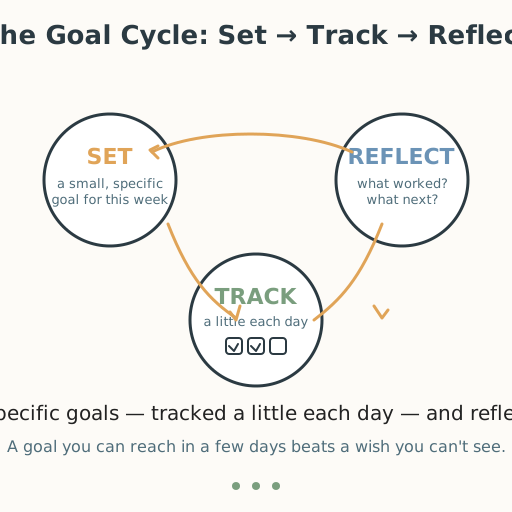
Lesson 9 — Set, Track, and Reflect on a Short-Term Goal
Summary
Learners set a short-term goal they can actually reach, build a simple tracker, and plan to reflect on what worked. They learn that a good short-term goal is small and specific — something doable in days, not a wish — and that the cycle set → track → reflect turns effort into learning. They begin the goal today and track it over the following days, returning in Lesson 10 to reflect.
Objectives
- Set a short-term goal, track their progress, and reflect on what worked. (D01.S3.06.01)
Connection
Think of anything you have learned to do — riding a bicycle, cooking a dish, hitting a note, clearing a level in a game. Almost nobody learned it in one leap. They set a small goal (“ride to the end of the street,” “make the rice without burning it”), practiced a little each day, and noticed what worked. A wish is “someday I’ll get better.” A goal is specific, small, and checkable: what, how much, by when. The people who reach things do not wish harder — they set a goal and track it. That works in a city, on a farm, or anywhere there is something you want to grow.
Materials
- Goal-cycle poster
- My goal page
- Pencils
Preparation
- Print or draw the goal-cycle poster (set → track → reflect, with a worked example).
- Copy a “my goal” page for each learner.
- Arrange a circle and a quiet space for individual work.
Facilitator note
This lesson is written to the learner (“you”). The idea to land is that a reachable
goal is small, specific, and tracked — not that a learner “failed” if they don’t meet
it. Frame missing a goal as information (“what made it hard? what would I change?”), the
spirit of mastery learning: revisit and adjust, never a verdict. Let learners choose goals
in any domain — a school skill, a sport, a craft, a habit, a kindness — so no one’s goal
is ranked against another’s. The tracker is personal and private; progress is compared only
to the learner’s own start. Plan for the goal to run over the days between this lesson
and Lesson 10, and prompt learners to touch their tracker daily. See docs/facilitation.md
and docs/contexts.md (mastery learning, TaRL).
Procedure
- Gather (5 min). You have studied your feelings, your triggers, and your many selves. Now the turn toward agency: setting a goal you can actually reach and learning from the try.
- Meet the cycle (10 min). Look at the poster: set → track → reflect. Worked example: a wish is “get better at reading.” A goal is specific: “read for 15 minutes every evening for five days.” Set: name what, how much, by when. Track: mark a little each day — a check, a note, a number. Reflect: what worked? what was hard? what next? A specific goal can be checked; a wish cannot.
- Set your goal (10 min). On your page, write one small, specific goal you can do in the next few days. Test it with a partner: can you answer what, how much, by when? If not, make it smaller or clearer. It can be about a skill, a habit, or a kindness — your choice.
- Build your tracker (10 min). Design your tracker — five boxes, a line of marks, or a small chart. Decide when each day you will check in (right after school, before bed). Write one reflection question you will ask yourself in a few days: “What worked? What got in the way? What would I change?”
- Close (5 min). Start today. A small goal, tracked a little each day, and reflected on honestly — that is how a growing person grows. Bring your tracker back next lesson.
Differentiation
- Support: Provide a menu of small, specific example goals to choose from, and a pre-drawn five-box tracker; scribe as needed.
- Extension: Write two goals — a five-day one and a two-week one — and note how “specific” changes when the time is longer.
Assessment
- Formative (observation): Can the learner state a goal that is small, specific, and time-bound (what, how much, by when), plus a tracker and a reflection question?
- Portfolio: The goal page, kept and revisited in Lesson 10.
Home connection
Share your goal with someone at home and invite them to ask you, each evening, “How did today’s step go?” — a gentle check that helps you keep tracking.
Resources
- Decades of research on goal-setting (Locke & Latham) show that specific, challenging goals with feedback improve performance; mastery orientation (Dweck) frames a missed goal as information, not failure. For classroom framing, see CASEL’s self-management competency: https://casel.org/fundamentals-of-sel/