Lesson 10 — Staying True to My Values Under Pressure
In this capstone lesson, learners name three pressures — stress, distraction, and peer pressure — and practice a pause–name–choose strategy that keeps them true to their values (built in Lessons 5–6) while handling the pressure (built in Lessons 1–2). They rehearse a response, reflect on the goal they set in Lesson 9, and close the unit with agency and hope.
Objectives
Objectives
- D01.S3.06.02 Use strategies to handle stress, distraction, or peer pressure while staying true to their own values.
- D01.S2.06.01 Describe their identity as made of many parts that can shift by context, such as family, culture, language, interests, and beliefs.
- D01.S1.06.01 Identify patterns in their own emotional responses and name what tends to trigger them.
- D01.S3.06.01 Set a short-term goal, track their progress, and reflect on what worked.
Essential question
When stress, distraction, or peer pressure push on me, how do I stay true to my values?
Key vocabulary
Materials
Standard materials
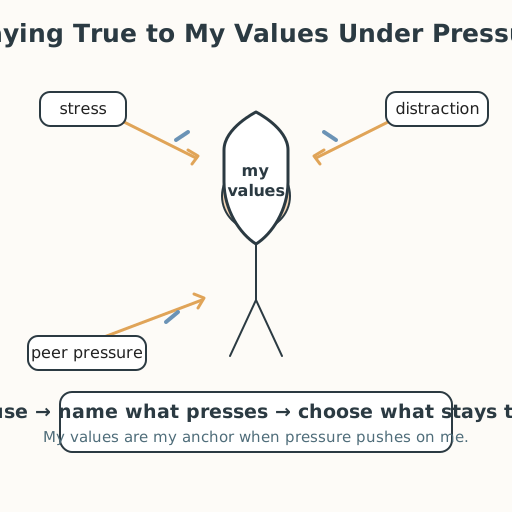
- Values-under-pressure poster · 1 A poster showing a figure holding a shield labeled "my values" with three arrows — stress, distraction, peer pressure — pressing in, and a pause step
- Pause–name–choose page · 1 per learner A page with three boxes — pause, name, choose — for the learner to work through one pressure
- Pencils · per learner
Low-tech / no-cost
- A shield drawn or mimed Draw a shield on the ground labeled with your values, or mime holding one while three "pressures" push and you pause; no page needed
- Role-play In pairs, act out a pressure and practice the pause–name–choose response aloud; no poster needed
Enriched / lab & device
- Laminated pause–name–choose strips · 1 per pair Reusable strips with dry-erase markers to rehearse responses to many pressure scenarios
- A class 'values wall' · 1 A wall where each learner posts their top values and one chosen response, building a shared picture of the group's anchors
Works in different contexts
- large-group Model one worked pressure together, then have small groups rehearse a pressure in role-play and share out one chosen response each
- multi-age Younger learners name the pressure and a value while older learners write the full pause–name–choose response and reflect on the goal
- self-directed A learner works through pause–name–choose for a real (small, safe) pressure and reflects on their goal from Lesson 9 alone
- level-grouped Learners ready to extend weigh two pressures at once and write why pausing protects their values under both
- outdoor-only Stand in a shield pose and name three pressures pushing in, then step through pause–name–choose aloud; no paper needed
Lesson 10 — Staying True to My Values Under Pressure
Summary
In this capstone lesson, learners name three pressures — stress, distraction, and peer pressure — and practice a pause → name → choose strategy that keeps them true to their values (built in Lessons 5–6) while handling the pressure itself (built in Lessons 1–2). They rehearse a response, reflect on the goal they set in Lesson 9, and close the unit with agency and hope.
Objectives
- Use strategies to handle stress, distraction, or peer pressure while staying true to their own values. (D01.S3.06.02)
- Describe their identity as made of many parts that can shift by context, such as family, culture, language, interests, and beliefs. (D01.S2.06.01)
- Identify patterns in their own emotional responses and name what tends to trigger them. (D01.S1.06.01)
- Set a short-term goal, track their progress, and reflect on what worked. (D01.S3.06.01)
Connection
Every life has the moment: a test tightens your chest (stress), a feed pulls your eyes from what you meant to do (distraction), a friend presses you to do what the group does even though something in you says no (peer pressure). The question is not “Am I weak for feeling it?” — everyone feels it. The question is “What will I do?” Your values — honesty, kindness, fairness, the beliefs and people you hold dear — are your anchor. When pressure pushes, the anchor is not willpower alone; it is pausing long enough to remember what you stand for, then choosing the act you can stand behind.
Materials
- Values-under-pressure poster
- Pause–name–choose page
- Pencils
Preparation
- Print or draw the values-under-pressure poster (a shield of values with three pressures pressing in).
- Copy a pause–name–choose page for each learner.
- Arrange a circle and space for paired role-play.
Facilitator note
This lesson is written to the learner (“you”). The idea to land is agency, not
willpower shaming: everyone feels pressure, and the skill is pausing to choose, not
never feeling tempted. Never frame a learner as “weak” for feeling peer pressure —
that is a normal, human pull, and this lesson makes it nameable and manageable, not
shameful. Connect the three pressures to earlier lessons: a pressure often triggers a
pattern (Lesson 2), and the feeling behind it can differ from what is shown (Lessons
3–4). Reflect on the Lesson 9 goal with a mastery frame — progress, not verdict. The
egalitarian lens asks: whose values win under group pressure, and is that fair? Keep the
discussion open and non-dogmatic; a learner’s values are their own. See docs/facilitation.md
and docs/philosophy.md §11–12.
Procedure
- Gather (5 min). This is your capstone. All unit you have traced your patterns, named your triggers, read what people show and feel, mapped your many parts, noticed the mirrors, and set a goal. Today it all comes together: staying true to your values under pressure.
- Meet the three pressures (10 min). Look at the poster. Three arrows press on a person holding a shield labeled “my values.” Stress — the worried, tight feeling when something is on the line. Distraction — attention pulled away from what you meant to do. Peer pressure — the push to do what the group does. None of these makes you weak; everyone feels them. The shield is your values — honesty, kindness, fairness, and the beliefs from your identity map (Lesson 5).
- Learn pause–name–choose (10 min). Worked example. Pause: take one breath before acting. Name: “A friend is pushing me to copy homework — that’s peer pressure, and honesty matters to me.” Choose: “I’ll say, ‘I’ll do my own work — but I’ll help you study if you want.’” Notice: the choice is honest and kind — it stays true to my value without putting my friend down.
- Rehearse a response (15 min). With a partner, pick one pressure (stress, distraction, or peer pressure) and act out pause–name–choose for a small, safe scene. Take turns. Then on your page, write the full response for a pressure that is real in your life. Check with your partner: does your choice stay true to your value — and is it also fair to the other person?
- Reflect on your goal (10 min). Open your Lesson 9 goal page. Ask your reflection question honestly: what worked? what got in the way? what would you change next time? Write two sentences. If you met your goal, notice what helped; if not, that is information, not a verdict — adjust and try again.
- Close (5 min). You are many parts, one whole self — and under pressure, you have an anchor. Pause, name what presses, and choose what stays true. That is how a growing person grows, and keeps growing.
Differentiation
- Support: Provide three picture cards (a test, a buzzing phone, a friend urging) and sentence starters (“I pause, I notice ___, my value is ___, so I choose ___”); scribe as needed.
- Extension: Weigh two pressures at once (stress and a friend urging) and write a response that holds your value under both.
Assessment
- Formative (performance): In role-play, can the learner name a pressure, a value, and a chosen response that is true to their value and fair to the other person?
- Self-check: The learner rereads their pause–name–choose page and their goal reflection, and checks that the choice really reflects their value, and that the goal reflection is honest (not self-punishing).
- Portfolio: The pause–name–choose page and the completed goal reflection, kept as unit artifacts.
Home connection
When a pressure shows up at home this week — a test, a screen, a friend — try pause, name, choose, and notice how the day goes. Share what you chose with someone you trust.
Resources
- Strategies for managing stress, distraction, and peer pressure while acting on one’s values connect to CASEL’s self-management and responsible-decision-making competencies; the “pause” step echoes impulse-control research (Mischel’s delay of gratification and its replications). See: https://casel.org/fundamentals-of-sel/